Crypto Commerce
OOSSXX 4K PoE outdoor camera listing vs Turing TP-MED4M28 Outdoor Camera Listings
Compare OOSSXX 4K PoE outdoor camera listing by coverage, night claims, alerts, storage, and unverified OOSSXX kit contents.
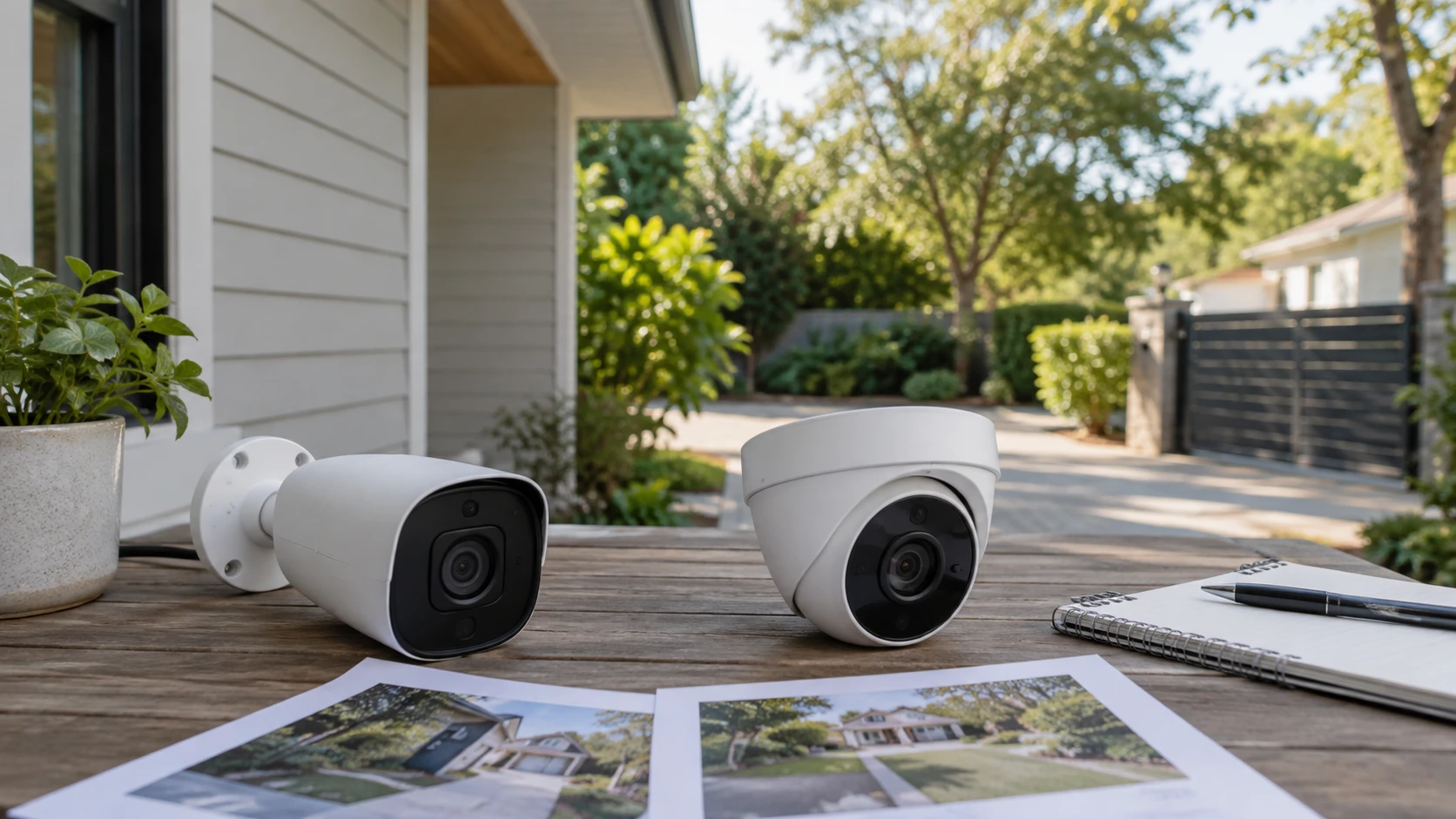
Outdoor camera listings can describe a wide view without settling what will be in the box. The OOSSXX product title calls the offer a 4K 8MP PoE camera "system," while its saved description talks about an IP camera and sometimes uses the plural "cameras." It does not state a camera count or identify an included recorder. The Turing Video TP-MED4M28 row describes one 4 MP turret camera. This comparison therefore concerns their stated camera capabilities; a buyer should confirm the OOSSXX package quantity before comparing total installation cost.
The two products are candidates for different parts of a surveillance plan. OOSSXX states a 130-degree view, two-way audio, and PIR plus AI detection. Turing gives a choice of fixed lens, a specified 4 MP video mode, local microSD support, and people-and-vehicle search when used with certain Turing services. The saved rows are vendor descriptions, not a side-by-side field test in the same light and weather.
What one mounting point can see — Turing TP-MED4M28 PoE turret camera
The OOSSXX 4K PoE outdoor camera listing claims a 130-degree wide-angle lens. That could cover a broad driveway, yard, or approach from one position. The tradeoff is that a person at the far edge may occupy only a small part of the image. Before relying on the angle to reduce blind spots, draw the property and mark the subject distance from the likely mount. Ask for a sample frame at a similar distance, then inspect the recorded image rather than just a small live preview.
The OOSSXX description calls its video 4K and 8 MP, but does not list a pixel grid, frame rate, or compression format. Those details affect both motion clarity and recorder storage. A high pixel count can give more information in a wide scene, yet lens quality, light, and compression still determine what can be read on a moving subject. Check Republeq's product page for the exact stream modes and a sample exported clip from the current model.
Turing’s TP-MED4M28 is listed at 4 MP, specifically 2688 by 1520 pixels at 30 or 25 frames per second. It has a fixed lens offered in 2.8 mm or 4 mm versions. The saved row does not give the viewing angle of either version. Do not assume the two lens choices produce the same coverage. Obtain each field-of-view specification or place a test unit at the planned mounting height. The longer focal length may show a narrower area with a larger subject, but the exact difference depends on the sensor and lens design.
The Turing row describes one compact turret body measuring 3.7 by 7.2 inches. Verify which dimension is depth, width, or height in the current drawing before laying out a tight mounting spot. Check whether the eave, wall, or junction box can support the camera and leave room to route the cable. The OOSSXX row gives no comparable dimensions or confirmed item count, so a package-level footprint cannot be inferred from the title alone.
Decide what the recording must show. A broad context shot can help reconstruct movement across a property; a narrower entrance view may be better for seeing a face at the door. A single wide view may not replace a second camera around a corner. Walk the site and identify obstructions such as posts, parked vehicles, trees, and night lighting before committing to a count of mounts.
Night claims and exposure — outdoor camera coverage planning
OOSSXX says its cameras use 845 nm infrared lights and provide night vision up to 100 feet. Turing describes Smart IR with a reach up to 30 meters, or roughly 98 feet, and names TwilightVision for low-light clarity. These two distances are vendor maxima under unspecified conditions. They are too close numerically to justify calling one a better night camera from the catalog alone. The useful test is whether a person at the required distance is visible and recognizable on the saved recording.
Turing also lists WDR, which is meant to help with bright and dark parts of the same scene. The OOSSXX saved row does not name a WDR function. This absence does not prove that its current hardware lacks exposure controls, but it leaves the buyer without a comparable claim. Test at dawn, dusk, and when vehicle lights face the camera. A camera that gives a clear static porch image may blur a moving person or wash out a reflective plate.
Infrared can reflect from nearby walls, soffits, spider webs, and dirty covers. Mount either candidate so the lens has a clear path and check the night image after the final enclosure is installed. If the site has a strong floodlight, make a second test with that light turning on during recording. Neither saved row supplies a controlled exposure series or a measured identification range, so the property’s light pattern matters more than the advertised distance.
The published outdoor camera coverage planning guide discusses a different, solar-powered camera. Its view-planning questions apply here, but its battery and mounting details do not establish specifications for either PoE candidate. Use it to check blind spots and viewing distance while keeping the OOSSXX and Turing claims tied to their own listings.
Power, recording, and package contents — Turing TP-MED4M28 PoE turret camera
Both saved rows list Power over Ethernet. A PoE connection can carry data and power through one suitable cable, but the system still needs a compatible switch or injector and an adequate power budget. Verify the supported PoE standard and maximum draw for the exact camera, especially if night infrared or audio functions change consumption. Neither catalog row provides a wattage figure. Test the fully populated switch, not only one camera on a bench.
The OOSSXX title uses the word "system," yet its saved record does not list how many cameras, whether an NVR is included, drive capacity, or cable lengths. Its description reads like a camera feature summary. Check Republeq's product page for a current in-box list with item counts and model numbers. Do not price it as a multi-camera kit or promise recorder storage until that list is clear. A product page with a singular variant could still be marketed under a broad system title, so the title alone cannot settle the purchase unit.
Turing’s row describes onboard storage that accepts a 256 G microSD card. Confirm the supported card format, whether the card is included, and how long recordings remain available at the selected video settings. A card slot does not replace a retention plan for a site that needs weeks of footage, redundancy, or central review. The Turing description also says People and Vehicle Search is available with a SMART series NVR or Turing Vision Cloud Max. Without that specified service, the saved row does not promise the same search workflow.
For OOSSXX, the row mentions remote speaking and listening but says nothing about a recorder, cloud subscription, app requirements, or local storage. Check how live and recorded video is accessed, who can receive alerts, and how long clips are kept. The saved title cannot fill those omissions. Draw the whole path from camera to PoE switch, recorder or service, viewing device, and backup before comparing it with Turing’s stated microSD and conditional search options.
If the property already has a video management system, confirm compatibility with that exact version. Ask for supported stream and control protocols, and test recorded playback. A camera that shows a live image in its own app may not provide the format or event information required by an existing NVR. Preserve the model, firmware, stream settings, and switch port in the installation record so a later service call has a starting point.
Alerts and two-way communication — Turing TP-MED4M28 PoE turret camera
OOSSXX says it combines PIR and AI motion detection to reduce false alerts. The saved description does not specify the AI classes, sensitivity controls, or whether a subscription is needed. Test common sources of motion at the site: passing cars, animals, moving branches, and people at the intended distance. Count both missed events and nuisance alerts. A description promising fewer false alerts does not prove that the defaults will suit every yard.
OOSSXX also lists two-way audio for speaking and listening remotely. Confirm the microphone, speaker, app, and network path in the exact package. Test whether speech remains understandable with wind and road noise. Local rules and the site’s privacy policy may affect whether sound is recorded or only used for live talk. The Turing saved row does not describe audio support, so do not assume it offers the same interaction or that it lacks every possible accessory; ask for current details if audio is required.
Turing’s People and Vehicle Search is a different claim from OOSSXX’s PIR plus AI detection. Search suggests finding recorded events after the fact, and the row explicitly conditions it on a SMART series NVR or Turing Vision Cloud Max. Confirm which event types the chosen service indexes and how a user retrieves clips. Do not treat search availability as proof that the camera sends the same real-time alert as a PIR trigger. Map the actual workflow: who gets notified, who verifies an event, and how the saved clip is exported.
Weather and mounting checks — Turing TP-MED4M28 PoE turret camera
The OOSSXX listing says its housings have an IP66 rating. Turing lists IP67 protection and describes the turret for indoor or outdoor use. These ingress ratings concern tested dust and water exposure, not every mounting condition or cable connection. Follow the current installation instructions for weather sealing and approved orientation. A poorly sealed junction can fail even when the camera body carries a rating.
Plan the cable route before drilling. Identify the switch location, cable length, conduit or wall penetration, and how the connector will be protected. Turing’s turret size is documented in the saved row, while OOSSXX’s physical kit contents are not. Check brackets, fasteners, and junction boxes in the current package. A planned one-hour replacement can turn into a longer job if a bracket or power injector must be sourced separately.
Both saved snapshots mark the products available, but stock, price, and package details can change. Compare the current Republeq's catalog, warranty, return conditions, and the cost of any required recorder, card, switch, or service. The OOSSXX entry’s unclear item count should be resolved in writing before calculating a per-camera cost. Turing’s conditional search feature should be priced with the SMART NVR or Cloud Max plan it requires.
Choose against the site plan — Turing TP-MED4M28 PoE turret camera
OOSSXX is worth testing when a broad 130-degree view, 4K/8MP claim, two-way audio, and PIR plus AI alerts match the site’s needs. Confirm the purchase unit, exact stream modes, and storage path before calling it a complete system. The Turing TP-MED4M28 PoE turret camera is the clearer single-camera listing, with a specified 4 MP video mode, lens options, WDR, microSD support, and conditional People and Vehicle Search. Confirm the lens version and the recorder or cloud service needed for the planned workflow.
Install one representative camera at the hardest location before ordering the rest. Save daytime, night, and motion clips from the actual recorder, then check blind spots and alert behavior. Keep the results beside the in-box list and network plan so the final camera count is based on observed coverage and a known purchase unit.