Home Decor & Table Settings
A one-off Christmas dinner without an annual promise
After a completed first Christmas dinner, Elva leaves her own imagined annual hosting role unannounced; no guest has asked for it.
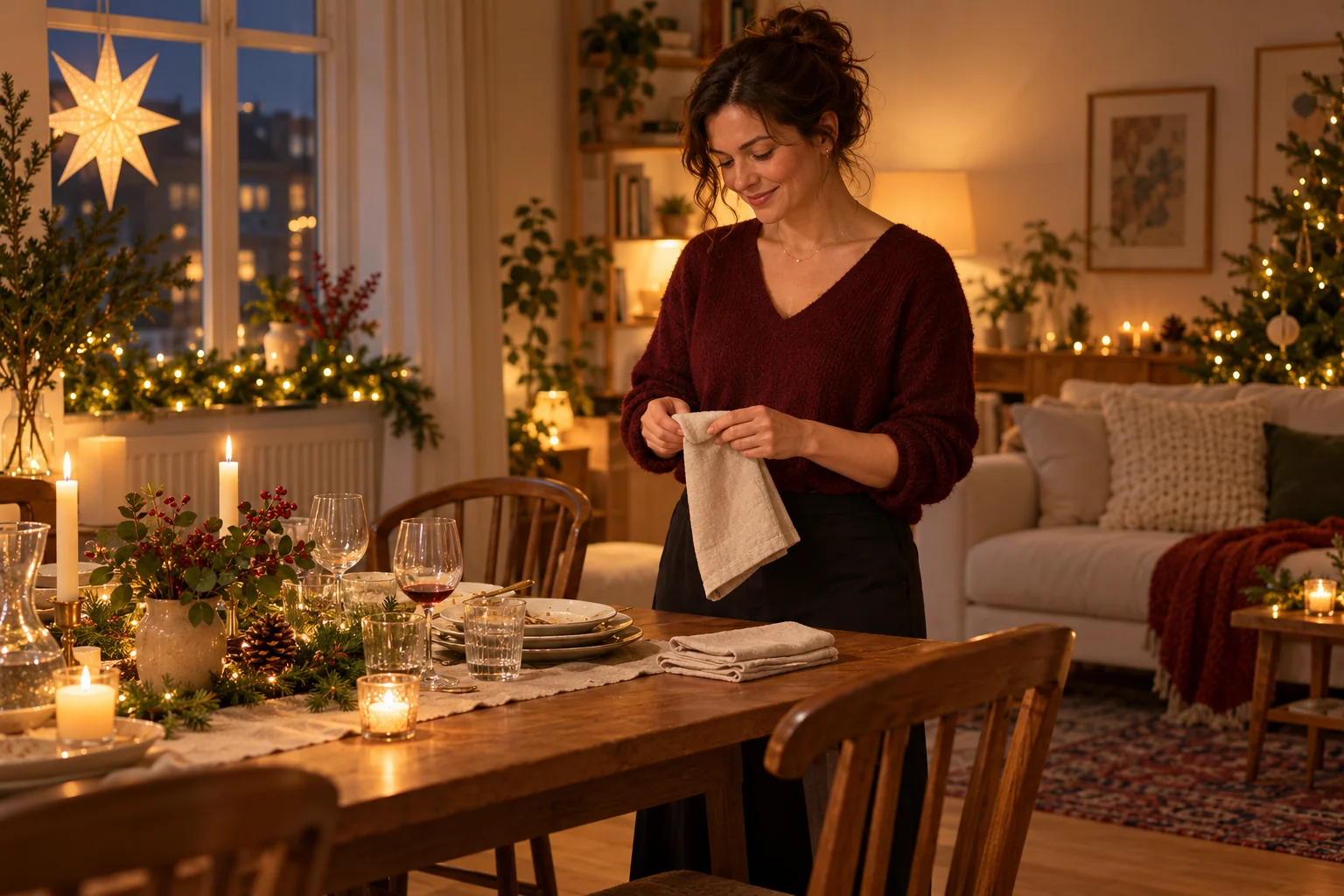
This one-off Christmas dinner story is original fiction. Elva, Kit, Dena and Arun, the flat, the meal and every conversation are invented. Elva has invited friends to her home for Christmas dinner for the first time. She enjoys the evening. Nobody asks her to repeat it next year. The continuing hosting role she begins to imagine is something she supplies herself, before deciding whether she wants to announce it.
Elva keeps one Christmas evening complete without announcing next year’s gathering.
The room after the main course
Kit had brought her chair close to the table while telling a story about a lift that stopped at every floor except the one she wanted. Now she pushed it back and laughed at the part Elva had missed because she was carrying plates. Elva asked her to begin at the wrong button. Dena said that was very nearly the beginning. Arun held out his empty plate without interrupting Kit, and Elva took it to the kitchen.
From the doorway she could still see the end of the table and Dena’s hand resting beside a glass. The room looked less arranged than it had that afternoon. Someone had moved the small lamp so it would not stand between two faces. A cushion lay on the floor near Kit’s chair. Elva had spent a long time deciding where to put it before anybody arrived. Nobody had mentioned its journey from the sofa.
She set the plates beside the sink and returned without bringing anything else. For a moment she stood behind her own chair, looking at the table as though she had come into somebody else’s flat. Kit had reached the lift’s final stop. Arun asked whether she ever found the person she had gone to see. “Eventually,” Kit said. “But by then I had a much better account of the building.” Elva sat down to hear the rest.
A compliment about tonight
Later, while Dena was looking for the name of a book on her phone, Kit turned to Elva. “I’m glad you asked us,” she said. “This has been lovely.” Elva felt the pleasure of being told that in her own room. She had worried about the narrow space beside the table, about everybody arriving while she was still moving things and about the conversation stopping whenever she went into the kitchen. None of those worries was the conversation they were having now.
“I’m glad you came,” she said. Kit smiled and reached for the glass she had put farther along the table. She had said something about this evening. She had not asked for another invitation, mentioned next Christmas or proposed that Elva become responsible for a recurring gathering. The distinction was plain in the actual words. Elva was the one who began supplying the next part before Kit had even returned to Dena’s search for the book.
She could almost hear herself saying that they ought to do it here every year. The sentence arrived with an image of the same chairs being pulled out again, the lamp moved from the middle and a familiar knock at the door. She liked the image. Then it acquired preparations she had not chosen: another invitation, another day to keep clear, another expectation that the room would become this room again when December returned.
The sentence Elva nearly offered
Elva opened her mouth while Dena was still looking at her phone. She was going to make the annual suggestion sound casual, as though it had been there in the invitation all along. She had not put it there. The message she sent concerned this Christmas dinner. She remembered choosing the words after looking at the table and deciding that she wanted these friends around it. There had been no private second message in which she volunteered for all the later occasions she could now picture.
She let Dena finish reading out the title. Arun knew the book, though he remembered a different cover. Kit said she would recognize the cover if somebody showed it to her. The conversation had somewhere to go without Elva putting a future gathering into it. She listened while Dena described a scene she wanted them to find. The book in that conversation was invented too; no actual author or passage was being quoted.
When there was a pause, Elva said she had liked hearing Kit’s lift story from the beginning. Kit told her that she had left out the least believable part. Elva asked for it. She did not add the sentence about every year. Keeping it unspoken did not require her to announce that this was the last Christmas dinner she would ever host. She had reached neither decision. For the moment, she wanted to hear what else had happened in the lift.
A little work that belongs to this evening
Dena stood when Elva began collecting the remaining plates. “Where would you like these?” she asked. Elva showed her the clear space beside the sink. Arun brought the glasses that had been left at his end, then returned to the table for his own napkin. Kit stayed seated to finish the account, raising her voice slightly when the others moved into the kitchen. Elva could still follow it from where she was standing.
For a few minutes the flat contained a conversation crossing a doorway and friends finding places for the objects they had used. Elva did not need to turn that small help into a plan for future dinners. Dena had asked where to put tonight’s plates. Arun had carried tonight’s glasses. Those actions made the end of this meal easier to manage. They were not an agreement about who would clear a table next year or whose home would contain it.
Elva returned with a cloth and found Kit holding the corner of a paper star that had slipped behind the lamp. The star was an ordinary fictional decoration. Kit asked where it belonged. Elva said she could leave it on the side table. She had meant to hang it near the window, but she liked finding it beside the lamp now. Kit set it down and finished the story there, with one hand still resting on the table’s edge.
The invitation she actually sent
While the others talked, Elva remembered the afternoon when she wrote the invitation. The table had been covered with papers from an unrelated piece of work. She had cleared just enough space for a cup, then looked around the room and decided that she would like to make a Christmas dinner there. The wish had been small and definite. She wanted one evening with people she liked, in the flat where she was living.
She had not needed an account of herself as somebody who always hosted. That figure had appeared later, after the evening began going well. Elva could see why she had been tempted to offer the role: it seemed to give the pleasure somewhere permanent to live. But she had enjoyed the actual conversation before she imagined any of the later rooms. Kit’s thanks had reached her while the dinner still belonged to the invitation she had written.
She could keep the message without turning it into the first notice of an institution. If she wanted to invite them again, another invitation could be something she chose later. Nothing in this story settles what she will want then. At the table, the present question was whether anybody had found the book cover Dena meant. Arun had found a picture of another edition, and Kit was explaining why it could not possibly be the one she remembered.
Friends at the door
They did not all leave at once. Dena went first, putting her phone away only after checking that she had sent Kit the title. Elva stood beside the open door while she found her gloves. Dena thanked her for dinner and said she would send the photograph they had discussed earlier. It was a photograph of a place Dena had visited, not an agreed record of this gathering. Elva said she would like to see it.
Arun and Kit stayed until the conversation about the lift had finally reached the person waiting on the other side of its doors. Arun carried the last glass into the kitchen before putting on his coat. Kit retrieved her bag from beneath the chair and found a scarf she had forgotten putting there. Elva held the door while they arranged themselves for the stairs. They thanked her again, and she told them she had been glad to have them there.
Neither friend asked what they would do next Christmas. Elva did not pretend they had. She did not need to answer an imagined demand or make their thanks smaller before she could accept it. After they had gone, she stood in the hall long enough to hear the outer door close. The flat was quiet. In the kitchen the plates were gathered where she and Dena had put them, Nobody had claimed that the rest of the work was finished.
One finished evening in an ordinary room
Elva went back to the table and picked up her own napkin. She folded it once, then opened it because she had trapped a small piece of paper inside. It was the corner left from making the star that afternoon. She put the scrap aside and folded the cloth again. The chair beside her still stood at the angle Kit had left it. Elva moved it only far enough to walk past.
Her calendar lay beneath a book on the side table. Earlier she had thought about opening it, as though she ought to give the annual idea a place before she forgot how the room had felt. Now she left it beneath the book. There was no announced event waiting to be entered and no promise she needed to record. She could remember this evening without using its warmth to make a decision about another one.
She carried the folded napkin into the kitchen and returned for the paper star. Its bent corner had caught a little of the lamplight. Elva left it where Kit had placed it. The table was smaller without the plates and glasses, and the flat had become her ordinary flat again. She was glad that the dinner had happened. She had not offered an annual gathering to make that gladness count.
Different Christmas decisions in neighboring stories
The Christmas dinner invitation story answers an actual extra request for an overnight stay, then leaves the guest to choose whether to accept the meal. Elva receives no extra request. Her continuing role is something she nearly proposes herself after enjoying the actual dinner. There is no declined accommodation question to resolve.
The second-person folder story keeps a shared drawing unfinished while siblings agree to return to it without a settled visit day. Elva’s occasion is complete, with no joint project waiting for another meeting. She leaves an annual role unannounced rather than choosing a continuing activity and asking when it can resume.
Actual pillow accounts outside the fiction
The Sterling pillow account names Elizabeth Austin as its brand and Howard Elliott in its description. Its two original images show complete pale-blue and orange pillow forms separately. Those color alternatives do not establish a delivered pair or authenticate size, internal filling, material or comfort. Both names remain in the account without a manufacturer identity being resolved here.
The Simply Daisy Central Comb account describes a decorative pillow with a polyester exterior and faux-down filling. Its sole original image shows one complete cream-and-lavender patterned pillow. That closed view is not an interior inspection or a care, material or comfort test. Neither offer identifies the generic cushion or any other belonging in Elva’s invented flat.
If you plan to purchase an item on republeq.com, check the particular offer and current checkout before ordering. This guide does not establish that any cryptocurrency payment option is available. If USDT is offered for the intended order, verify the requested asset, network, amount, receiving destination and order reference with the responsible service before authorizing a transfer. Review the actual product identity, selected variant, quantity, delivery details, total charge and applicable terms. Use the confirmed order details when checking the payment instructions. Confirm any fee, conversion term or exchange rate from the current transaction information. Determine the applicable cancellation, return and refund process, including how a refund would be handled for the selected payment method. Keep the relevant instructions and transaction records, with dates and confirmed references. If essential instructions change, ask the responsible service to confirm the change against the exact order. An acknowledgement should identify the order and the agreed details; it does not replace checking whether the selected product is the one you intended to buy. If payment or order status remains uncertain, reconcile that status before considering another transfer. Do not treat an unresolved transaction as evidence that nothing happened. This article supplies no wallet address, transfer guarantee, recovery procedure or assessment of a counterparty. A product enquiry does not authorize a payment or resolve an uncertain order. If support provides an answer, retain the exact question and response so a later reviewer can understand what was confirmed. Decide whether to proceed only when the conditions of the particular transaction are clear, and retain the confirmed transaction information with the exact order.