Cost & Savings Articles
NYC sales tax estimate: separate coffee from paper filters
Build a conditional NYC sales tax estimate for packaged coffee and paper filters, with captured prices, official rules and a clearly stated taxable share.
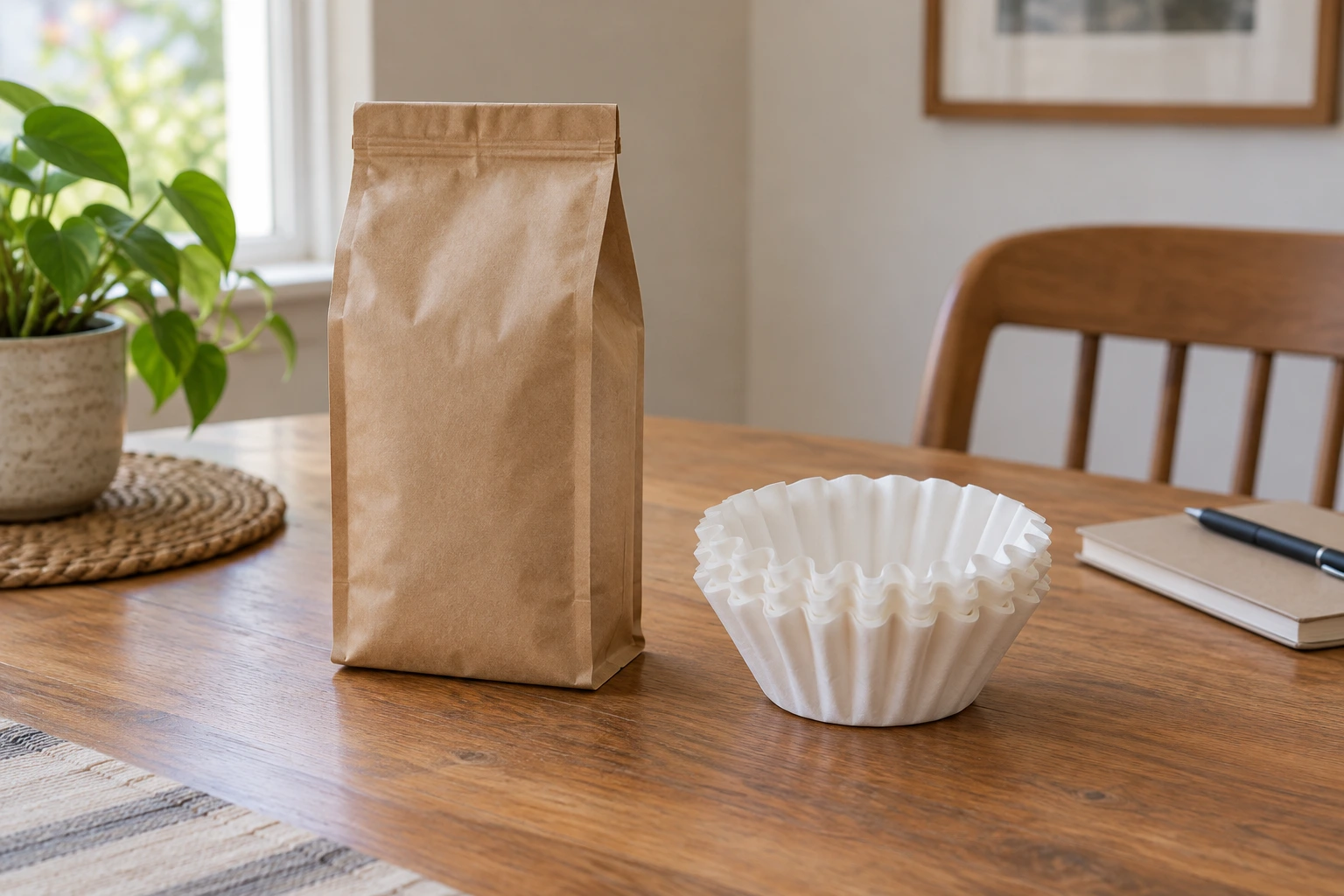
A NYC sales tax estimate needs the taxable part of a purchase, not simply the largest subtotal on the page. In a mixed coffee-supply example, packaged ground coffee and empty paper filters have different roles in the calculation. Applying a rate to both lines can produce the wrong model even when the arithmetic itself is correct.
This article uses actual captured republeq item prices with a conditional ordinary retail-sale example in New York City. Official New York guidance and the city's rate page were checked on October 16, 2026. It does not report an actual checkout, determine republeq's collection obligation or promise the tax assessed on any particular order.
Define the particular sale before doing the calculation
Assume an ordinary retail purchase for private household use, sourced to New York City, with no resale purpose or applicable purchaser exemption. The coffee is packaged, unheated ground coffee for consumption off the seller's premises. The separate filters are empty paper coffee filters, treated in this example as ordinary taxable tangible personal property.
The calculation contains the two item lines and their illustrative sales tax only. It has no shipping, handling, discount or other charge line. That defines the model's scope; it does not claim those charges would be absent from an actual order. A real transaction with other facts would need its own applicable treatment.
The shared purchase purpose is coffee supplies. The example does not establish that the selected filter fits a particular brewer, how much coffee anyone needs or which equipment someone already owns. Those product-use questions remain separate from the tax-base calculation.
The coffee line has a documented packaged-food identity
The Lion Coffee Vanilla Macadamia ground-coffee offer was captured at 74.49 US dollars. Its description identifies a two-pack of twenty-four-ounce bags, light roast and one hundred percent Arabica beans, with vanilla macadamia flavour. SKU sku-444387264 and UPC 079975000483 identify the actual offer.
This is a packaged ground-coffee account, rather than a described cup of prepared coffee served by a restaurant. The stated flavour does not turn the product into the separate paper-filter line. The price used here is the captured whole-offer amount; no price per cup, bag or ounce is needed for this calculation.
New York's bulletin on beverages sold by food stores and similar establishments covers beverages sold for human consumption off premises. Its exempt list includes unheated coffee products, naming beans, grounds, instant, flavoured and specialty coffees. Its taxable list separately includes hot and cold coffee sold and served in a cup or other container.
Retain those conditions with the exemption. The example uses the stated packaged, unheated grounds and off-premises consumption assumption. It does not extend that treatment to a prepared drink, every food-related sale or every place where a buyer might encounter the Lion Coffee name.
The filter line is a different kind of coffee supply
The BUNN thirty-two-cup commercial coffee-filter offer was captured at 121.00 US dollars. The native record identifies flat-bottom filters, with fifty filters per cluster, ten clusters per pack and two packs in the bundle. SKU sku-384972166 and UPC 745296147403 identify the item.
The description calls the paper heavyweight, with taller, stronger sides intended to help prevent grounds overflowing. It also states an elemental chlorine-free bleaching method. Those are attributed product claims, without a brewing, overflow or materials test performed here. The tax illustration uses the whole captured offer price.
The filters are paper equipment consumables, not the packaged grounds held in the other line. New York's current quick-reference guide states that sales of tangible personal property are subject to sales tax unless specifically exempt. The model applies that general rule to the ordinary retail paper-filter purchase, assuming no applicable exemption.
The word commercial in the filter title does not establish the buyer's tax status. This article gives no exemption, resale, filing or tax-avoidance instructions. A different purchaser or transaction condition would fall outside the ordinary retail example defined above.
The taxable share of a mixed order is the amount that receives the rate
For the taxable share of a mixed order in this example, keep the two price lines visible. Coffee contributes 74.49 dollars to the item subtotal. Paper filters contribute 121.00 dollars. Together, the captured item amounts total 195.49 dollars.
Under the example's classification and transaction assumptions, the coffee line contributes zero to the taxable base, while the filter line contributes 121.00 dollars. The taxable base is therefore 121.00 dollars. The difference between that base and the item subtotal is the 74.49-dollar coffee line.
Classify the two lines before multiplying. A calculator given 195.49 can multiply it accurately, but it cannot decide whether that number represents the correct taxable base. Keep the reason each line enters or stays outside the base beside the amount.
An exempt line remains part of the purchase cost
The coffee's 74.49 dollars remains in the item subtotal even though the model excludes it from the taxable base. Exempt describes its treatment in this sales-tax calculation. It does not describe a free item, a discount or an amount removed from what the buyer is purchasing.
Adding the filters' 121.00 dollars and illustrative tax of 10.74 dollars gives 131.74 dollars. That figure covers only the taxable item line plus its tax. The coffee line still contributes 74.49 dollars, bringing the model to 206.23 dollars. The classification has changed the tax base while preserving both item prices.
Give each amount a label when checking the arithmetic. Item subtotal, taxable base, tax and item subtotal plus tax identify four different amounts here. Replacing one with another can conceal an omitted item as easily as it can create an overstated tax estimate.
A rate and its tax base need to stay together
New York City's Department of Finance states a combined ordinary sales-tax rate of 8.875 percent: 4.5 percent city, 4 percent state and a 0.375 percent Metropolitan Commuter Transportation District surcharge. That is the stated ordinary rate used for this particular NYC example, not a rate for every New York address or every category of sale.
Keep a rate and its tax base together when applying that figure. Convert 8.875 percent to 0.08875 for the multiplication. The example's 121.00-dollar taxable base multiplied by 0.08875 gives 10.73875 dollars before rounding.
Rounded to cents for this illustrative calculation, the tax is 10.74 dollars. Adding that figure to the two item amounts gives 206.23 dollars for item subtotal plus illustrative sales tax. That is the defined three-line model, rather than a delivered-price quote or an observed payment request.
Taxing the full subtotal creates a different answer
If the same rate is mistakenly applied to the whole 195.49-dollar item subtotal, the result is 17.3497375 dollars before rounding, or 17.35 dollars to cents. That is not the result of the mixed-order classification used here. It treats the packaged-coffee line as part of the taxable base.
The two rounded calculations differ by 6.61 dollars. This is a difference between two mathematical models, not a saving obtained from a merchant, a refund due or money actually paid. No transaction has been performed to establish any of those outcomes.
The comparison identifies the source of the disagreement. Both calculations use 8.875 percent. They differ because one uses a 121.00-dollar base and the other uses a 195.49-dollar base. Changing the rate would answer a different question from correcting the amount to which it was applied.
A percentage of the whole order can conceal the actual base
Suppose a reader sees the model's 10.74-dollar tax beside its 195.49-dollar item subtotal. The tax is a smaller fraction of that whole subtotal than 8.875 percent. That alone does not show that a lower statutory rate was used. The example has an exempt item line alongside a taxable one.
To understand this particular calculation, return to the 121.00-dollar taxable share and the stated rate. Dividing a tax amount by an unrelated whole-order figure mixes the two roles. A mixed subtotal can include money that was never part of the base used in the example.
The rounded tax is also different from the unrounded multiplication result. Retain which figure you are comparing. The illustration has shown its multiplication and cents rounding explicitly, so the reader can reproduce the stated amount without treating the rounded figure as a different rate.
Use each captured offer price once
The Lion Coffee quote covers its stated two-pack, and the BUNN quote covers the described filter bundle. The model enters each selected offer's displayed amount once. It does not multiply the coffee price by two because two bags are described, or multiply the filter price by its individual-filter count.
A request for two whole offered bundles would be a different order quantity. The item quantity on such an order would need to be identified separately from the contents of one bundle. This example uses one captured offer of each product, which is why its two item lines remain 74.49 and 121.00 dollars.
The filter's thirty-two-cup label also supplies no quantity multiplier in this model. It describes the stated brewer-size category. It is neither the number of bundles purchased nor a count of cups prepared in a tax calculation.
Keep actual price terms separate from the illustration
Republeq's public terms state that prices exclude taxes, shipping and handling unless explicitly stated otherwise. They also say product descriptions, prices, availability and specifications are subject to change without notice. The two captured item prices are therefore dated inputs to this illustration, not promises about a later order.
That seller statement supplies no determination of the tax on this hypothetical purchase. The article's New York classification and rate assumptions are stated separately. A reader should not convert the public price-exclusion clause into a claim about a particular checkout calculation or the seller's legal collection obligation.
When the selected item or quoted price changes, identify that changed input before reusing the arithmetic. A different coffee preparation, an added charge or an applicable exemption would be another change to the model's facts. The earlier calculation remains a record of the example it actually used.
Use related cost guides for their own charge questions
The greeting-card mailing budget guide separates stationery acquisition from the complete prepared mailing and postage. That is a different charge question from the taxable share examined here. Its mailing and product details supply no New York tax classification for coffee or paper filters.
The picture-frame return-budget guide concerns the merchant's actual refund and exchange conditions after a wrong variant is purchased. It does not determine a tax amount for this illustration. An estimated charge, an amount actually paid and an approved refund should retain their different identities.
Retain the classification with the final amount
The example's conclusion is specific: 195.49 dollars in captured item prices, a 121.00-dollar assumed taxable share and an 8.875 percent NYC rate produce 10.74 dollars in illustrative tax after cents rounding. The item subtotal plus that tax is 206.23 dollars under the defined assumptions.
The NYC sales tax estimate keeps its item categories, transaction conditions, jurisdiction, dated price inputs and arithmetic together. Here, separating packaged ground coffee from empty paper filters is the step that gives the rate its intended base. The resulting model explains the taxable share without pretending to be an actual order receipt.