Crypto Commerce
NutriChef PKCWCDS278 dual-zone wine cooler and DISHUP for wine bottles or mixed drinks
Compare NutriChef PKCWCDS278 dual-zone wine cooler by wine-bottle claims, beverage-can space, temperature controls, installation, racks, and unanswered…
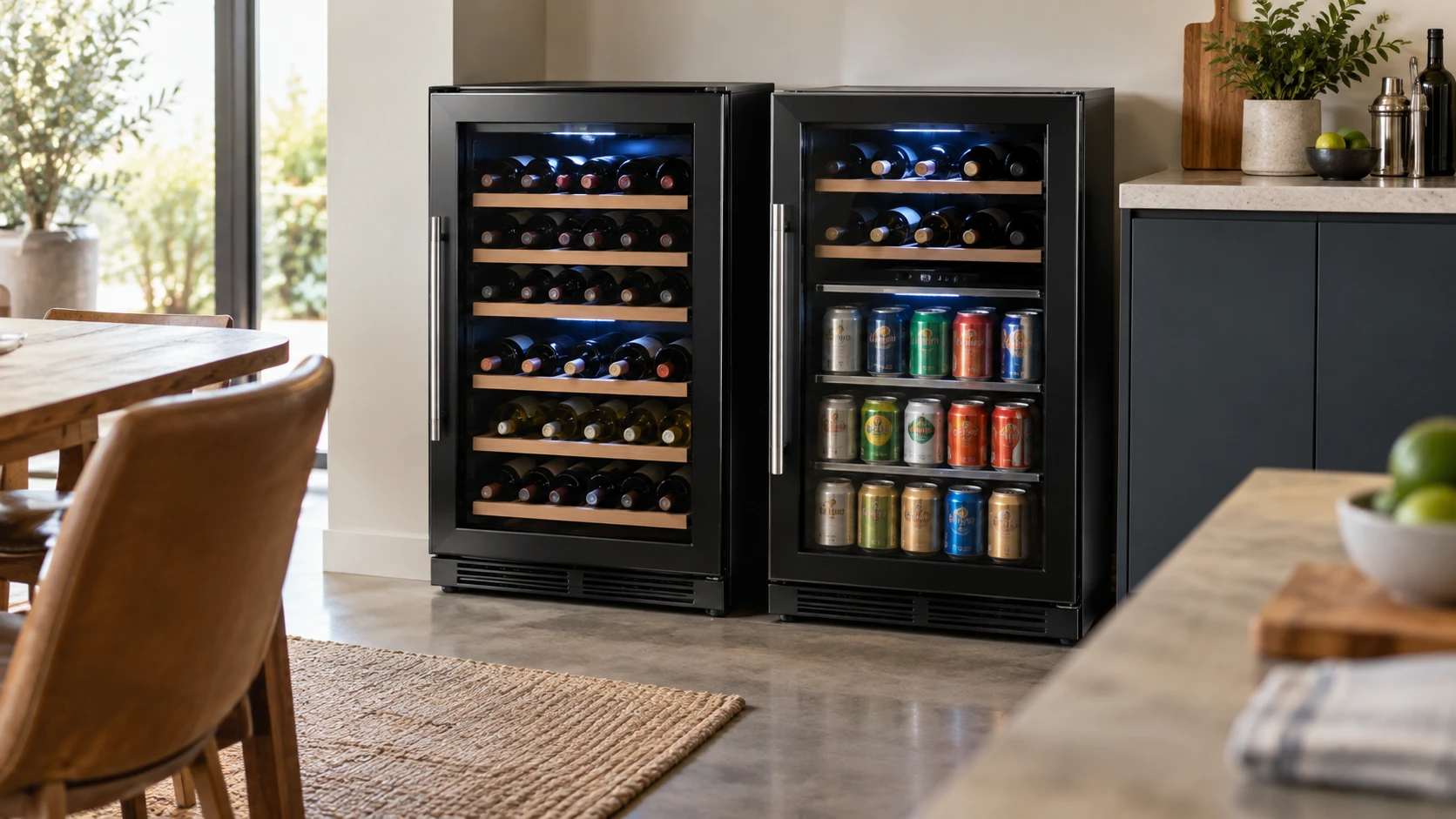
Two coolers can both say "dual zone" while organizing entirely different collections. NutriChef's PKCWCDS278 is presented as a freestanding wine cooler with chrome racks and a stated adjustable range of 41 to 64°F. DISHUP's 24-inch listing is for a wine and beverage fridge, with one space described for 21 wine bottles and another for 88 cans. Choose first between a wine-focused cabinet and one that reserves space for other drinks. Then check whether the bottles and cans you actually buy match the capacity claims.
The NutriChef PKCWCDS278 dual-zone wine cooler has an immediate catalog discrepancy: its saved title says 27 bottles, while its description says it accommodates 24. The listing also gives a 75.4-liter figure but no rack-by-rack measurement. DISHUP lists 21 bottles plus 88 cans and says its two zones have independent temperature control. Neither short description provides a shared loading test, so the published capacities are questions to verify with your bottle shapes and shelf settings.
Count the containers you will really store — wine cooler bottle capacity checks
Wine-bottle counts commonly depend on a particular bottle shape and how racks are arranged. NutriChef's title and body disagree by three bottles before you even account for wider sparkling bottles or unusual labels. Check Republeq's product page for the exact model's rack diagram, usable dimensions, and the bottle shape used in its capacity test. Do not resolve the conflict by choosing the larger number. If you plan to store only a dozen bottles, shelf flexibility and access may matter more than whether the nominal capacity is 24 or 27.
The related published guide on wine cooler bottle capacity checks compares different models with matching headline counts. It offers useful context for this pair: a number on a listing does not establish that your own collection will fit. Lay out the tallest and widest bottles you normally buy, then compare them with each cooler's interior diagram. Check whether a shelf must be removed for a larger bottle and how many ordinary bottles that change displaces.
DISHUP has a different counting problem. Its saved description says 21 wine bottles and 88 beverage cans, but does not identify the can size, arrangement, or whether both totals are reached simultaneously. If you host people who drink cans and wine, the divided cabinet could be practical. Confirm the actual shelf and can-rack layout before assuming you can reach either advertised total with your preferred drinks. Tall cans, craft-beer bottles, and wine bottles with broad shoulders all change a packing plan.
NutriChef's description names contoured chrome wine racks. DISHUP's short excerpt does not itemize its shelves. A rack that presents every wine label clearly can help you find a bottle without pulling several out. A flexible shelf may matter more if the cabinet will hold mixers or bottles that are not standard wine size. Get images of the supplied racks and ask whether they can be rearranged or replaced. The saved capacity numbers alone cannot settle daily convenience.
Temperature controls need zone-specific detail — DISHUP 24-inch dual-zone wine and beverage fridge
NutriChef's saved listing calls it a dual-zone chiller and gives a 41 to 64°F adjustable range, but does not specify the range for each zone or how independently they can be set. DISHUP states that its two zones have independent temperature control, yet its excerpt gives no numeric setpoint ranges. Ask for both zones' allowed settings, any minimum difference between them, and where their temperature sensors sit. A dual-zone name is useful only when the two compartments support the temperatures you intend to use.
The DISHUP description claims sensors maintain an error within 0.5 degrees. It does not say whether that figure refers to display accuracy, sensor precision, or actual drink temperature in a full cabinet. NutriChef's source says it keeps conditions stable despite external heat, also without a measured test. Treat both as manufacturer claims until you have model-specific performance evidence. An independent thermometer can help you check the actual space after installation, but it should be placed and read according to the appliance instructions.
For wine, write down whether you mainly store bottles for later or want drinks ready to serve at different temperatures. For cans, think about the temperature you prefer and how often you open that side. Neither listing guarantees that every corner of the cabinet will match a digital display. Loading, door openings, and the surrounding room can all affect the result. Seek model-specific temperature instructions or measured results before deciding which cooler runs colder.
A weekend gathering is a useful test case. Estimate how many chilled cans people will take in an hour and whether you also need to serve wine from the cabinet. Frequent opening can change the conditions inside either zone, so ask how long the model takes to recover after loading room-temperature drinks. The saved descriptions provide no recovery-time test. If the can side will be refilled repeatedly, leave space to do that without moving wine bottles or blocking the door from closing.
The NutriChef listing mentions a digital touch panel for temperature and light control. DISHUP's saved description says it has soft blue LED lighting but does not describe its controls in comparable detail. Inspect the current control layout, including whether temperatures remain visible with the door shut. If the cooler sits in a dim home bar, lights can help you see labels; check whether they can be switched off when you do not want a lit display.
Freestanding or built into a cabinet? — DISHUP 24-inch dual-zone wine and beverage fridge
NutriChef is described as freestanding and narrow. Its title includes 43 by 11 by 23 inches without identifying which measurement is height, width, or depth in that short title. Get the labeled dimensions and required ventilation clearances from the model manual. Do not slide a freestanding cooler into enclosed cabinetry merely because an 11-inch side appears to fit. It still needs whatever air path its maker specifies.
DISHUP's saved listing says its 24-inch cabinet can be built in or used freestanding, with adjustable feet. That makes it a candidate for a planned kitchen or bar opening, but the excerpt does not give the cutout dimensions, vent position, door swing, or electrical-clearance details. Ask for the installation drawing and confirm whether its door can open fully next to adjacent cabinets. Built-in approval for one model does not transfer to the NutriChef unit.
Floor and counter placement also change access. NutriChef's description suggests floor, table, or countertop use, but the saved entry gives no appliance weight or loaded-weight guidance. A full collection of glass bottles is heavy. Confirm the supporting surface and lifting instructions before placing it on a table. DISHUP's larger mixed-drink arrangement may belong on the floor or in a designed cabinet, depending on its actual dimensions. Measure reach height for the bottles you use often.
Both listings mention glass doors. NutriChef describes a glass door with a plastic frame; DISHUP describes double tempered glass doors and a stainless-steel exterior. Those are construction claims, not measured insulation or UV-protection results. If the placement receives direct sunlight, check each manual for allowed location and door treatment. A cooler can struggle in a hot or sunny spot regardless of how attractive the glass looks. Keep the required clearance and ambient-temperature range in the plan.
Sound, maintenance, and ownership cost — DISHUP 24-inch dual-zone wine and beverage fridge
NutriChef's source calls operation ultra-quiet, but gives no measured decibel value or common test conditions. DISHUP says an intelligent compressor adjusts power based on temperature differences and saves electricity, without a usable energy figure in the short excerpt. Compare current energy labels or model-specific measurements if the cabinet will run in a living area. A compressor cycle may be more noticeable in a quiet room than in a kitchen, and the sound will also depend on placement and floor contact.
Cleaning includes more than wiping the front door. Check how each rack comes out, whether spills can be reached at the back, how condensation is handled, and what the maker says to do before a long absence. Neither saved listing gives a complete maintenance schedule. A wine cooler that is difficult to clean beneath its racks can be inconvenient even if the stated bottle capacity meets your target. Keep the glass and door seals in good condition according to the instructions.
NutriChef's saved description mentions a one-year warranty and support claim. DISHUP's excerpt does not give comparable warranty details. Verify coverage, parts availability, and the responsible Republeq's catalog on the current product pages. A model-specific repair route matters for a cabinet intended to hold an ongoing collection. Do not assume a support promise in a brief listing guarantees a particular response time or service outcome.
At the September 30 catalog capture, NutriChef was marked available at $746 and DISHUP at $624.99. Those are dated prices. Add the cost of any shelving changes or qualified built-in installation when comparing current offers. A narrow freestanding wine cabinet and a 24-inch built-in-capable beverage cabinet solve different space problems, so a simple price-per-bottle calculation would hide their main tradeoffs.
NutriChef deserves a closer look if you want a narrow, freestanding, wine-focused cabinet and its actual rack plan fits your bottles. Resolve the 24-versus-27 bottle conflict and obtain zone-specific temperature instructions first. DISHUP deserves a closer look if you want separate room for wine and cans and have a safe place for its wider cabinet. Verify both capacity claims together and the required installation opening. The DISHUP 24-inch dual-zone wine and beverage fridge has the clearer saved mixed-drink use case; the right choice depends on your actual containers and placement.