Crypto Commerce
Newbealer NB318A garment steamer or Singer ESP260T for the garment pile
Compare Newbealer NB318A garment steamer by garment shape, setup, water capacity, steam controls, safety, and storage.
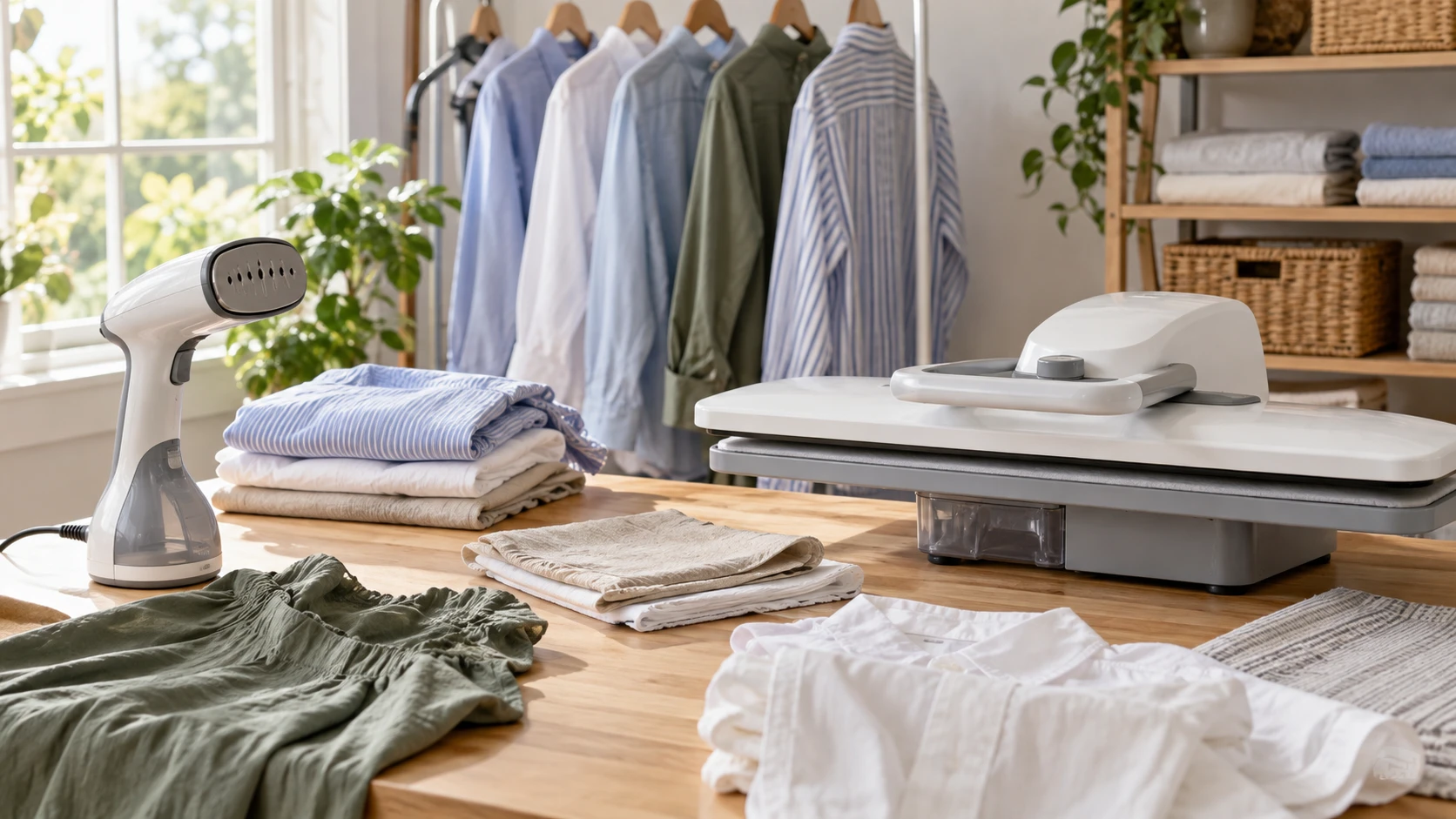
The Newbealer NB318A garment steamer combines a handheld steamer with a ceramic soleplate for dry ironing. Its head swivels, and the listing says it can work vertically or horizontally. The other option is a tabletop press with a 26-inch heated surface. It asks the user to place fabric flat, close the press, and move to the next section. The useful comparison starts with the clothes waiting to be cared for because the two steam figures describe different motions.
A hanger of lightly wrinkled shirts, a stack of flat cotton pieces, and a garment with small seams will not take the same path through a laundry session. The published guide to garment care washing and pressing helps put wrinkle removal after washing and drying in a sensible order. For these two products, count how often clothes can stay hanging and how often they need a firm, broad press on a flat surface. Fabric-care labels and the product manuals should govern heat and steam choices for each item.
The Singer ESP260T steam press has a nonstick 26-inch pressing surface, continuous steam and an on-demand burst, according to its saved listing. It may make sense for repeated flat sections such as shirt fronts, pillowcases, or napkins. That does not show how quickly it finishes a shaped jacket or a tiny cuff. The saved row gives no dimensions for the closed machine, so measure the storage and working surface before assuming it will fit on the laundry shelf.
Sort the work by shape — Singer ESP260T steam press
NB318A is a portable unit with a listed body weight of 1.7 pounds. A hanging garment can be turned to expose different panels without repeatedly laying it out. Its 90-degree swivel head and collapsible hook may help a user work around a garment or put it away between sessions. The saved row also describes a wall-mount kit, but does not specify the installed load limit or exact clearance. Check those details before fixing a hook to a wall or using the steamer near anything that heat or moisture could damage.
The handheld design does not eliminate the need to support fabric. An ironed collar, a crease, or an edge needing pressure may require a board or a protected flat surface. Newbealer describes its NB318A as a two-in-one steamer and dry iron with a diamond-coated ceramic soleplate. Try the intended motion on a permitted test area of the garment and follow its care label. A hot soleplate and steam on the wrong fabric can leave a mark regardless of how easy the device is to hold.
Singer's press makes the surface part of the appliance. The 26-inch nonstick plate can contact a broad area at once, and the listing includes a pressing cushion for shapes that need support. The user still has to arrange each section so seams, buttons, and layers are positioned safely. A long item may need several placements; the plate length is not the same as the full length of a dress or sheet. If the work is mostly small irregular pieces, lifting and repositioning them could erase the apparent advantage of the broad plate.
Set aside a safe, stable table for the press before buying one. Plan where the machine will cool, where the cord will go, and how a person will lift it into storage. The saved Singer row does not state the unit's weight or closed footprint. Ask for the current dimensions and weight from the model sheet. A press that stays set up can be ready for a weekly batch, while one that must be carried from a closet may be less appealing for one wrinkled shirt before work.
Read the heat controls without equating the numbers — Singer ESP260T steam press
Newbealer lists a 1550-watt dual-core heater, a claimed 30-second warm-up, three adjustable steam levels, and a maximum steam output of 40 grams per minute. Its LED controls adjust temperature from 212 to 338 degrees Fahrenheit. The figures describe the appliance's listed operating range; they do not establish safe settings for any particular fabric. Steam rate is a maximum, and a lower setting may be more suitable for some items. Confirm whether the temperature setting applies to the soleplate, steam path, or both in the current manual.
Singer lists 1500 watts and a 70-gram-per-minute steam rate for ESP260T. Its source row says the press reaches its nylon setting in 1.6 minutes and offers continuous steam plus an on-demand burst. It does not provide the full temperature range or a fabric-by-fabric table in the saved excerpt. A 70-versus-40 comparison alone would be misleading: one product emits steam while it is moved over or near fabric, and the other presses a broad area in a different way. The test that matters is how each handles the household's actual garments without scorching, spotting, or repeated passes.
Do not put a delicate item into either device on the strength of a preset name. Read the sewn care label, consult each appliance's current instructions, and test a less visible area when the fabric permits it. For a garment with coatings, embellishments, or an unfamiliar blend, the permitted treatment may exclude direct heat or steam entirely. A towel between the cloth and a hot plate is not a universal fix; use an approved pressing cloth and method only when the garment instructions allow one.
Claims in Republeq's catalog for speed also need context. Newbealer describes up to 40 minutes of continuous use and enough water for 12 suits or 20 shirts. Those garment counts are promotional estimates, not a measured result for the reader's fabrics and wrinkle levels. Singer gives a heat-up time to one setting, not a complete cycle time for a pile of clothes. Work in batches that match the real setup: hanging pieces together, then flat pressing if both treatments are used.
Plan refills, pauses, and cleanup — garment care washing and pressing
NB318A has a detachable 1.2-liter tank. That is larger than the Singer's listed 800-milliliter removable tank, but the different steam rates make a simple tank-size comparison incomplete. A higher setting can empty a reservoir faster. The NB318A listing says the tank can support up to 40 minutes; the Singer excerpt does not give a comparable continuous-use duration. Use a normal session as the test: count pauses to refill and the time the appliance needs to return to temperature.
Water handling is part of the routine. Newbealer includes a silicone funnel and lists a self-cleaning function and anti-drip technology. Its claim of 90 percent fewer water stains is not accompanied by a matched test or a named comparison in the saved row. Treat it as a claim in Republeq's catalog, and check the manual's water type and cleaning instructions. Singer includes a refill bottle and spray bottle along with the pressing cushion. Ask how its removable tank is emptied for storage and whether the press must cool before a refill.
Both machines should have an accessible place to rest safely during a pause. NB318A lists a manual pause, safety lock, anti-misoperation switch, and ten-minute automatic standby. Those features are helpful to examine, but standby is not a substitute for unplugging and cooling the tool according to its manual. Singer lists an auto shut-off, with no delay specified in the saved row. Check its exact trigger and reset procedure before relying on it. Keep children, pets, and loose cords away from the working area while the surfaces are hot.
At the end of a session, allow the appliance to cool and handle any remaining water as its manual directs. The handheld unit's small body and hook may simplify storage, although the separate tank and accessories still need a dry place. Singer's larger pressing surface needs a planned footprint and protection from being knocked over while it cools. A care routine that takes too much setup or cleanup tends to be skipped, so include those minutes when deciding which machine suits the household.
Decide where the pressure is useful — Singer ESP260T steam press
A steamer can refresh the appearance of a hanging garment without repeatedly rearranging it on a board. Newbealer's dry-iron soleplate adds a contact option for spots that need it. The available source does not provide measured crease quality or fabric-specific before-and-after results. If crisp trouser creases and long flat seams are the priority, try a press or conventional iron on the actual fabric before assuming the handheld combination will deliver the finish wanted.
A press spreads contact over a broad area, which can be welcome for repeated flat pieces. Singer's 26-inch plate and supplied pressing cushion suggest that kind of work, but its saved row does not state how much force it applies or how large the safe treatment area is after seams and edges are considered. Practice positioning a shirt around buttons and pockets before planning a production pace. The press may be faster on one flat panel yet slower on a fitted sleeve or ruffle.
If both functions seem necessary, separate them by task instead of comparing only wattage. Hang and steam items that can be treated vertically; reserve the press for garments whose label permits contact heat and whose shape lies well under its plate. Decide whether there is enough laundry volume to justify keeping two hot appliances. The published garment-care guide provides context for the sequence, while the exact model manuals determine safe operation.
Which tool should be set up first? — Singer ESP260T steam press
Choose NB318A for a household that mostly handles hanging clothes, wants a portable steamer with a dry-ironing soleplate, and can work within its listed 1.2-liter tank and three steam levels. Verify the manual's heat-control meaning and the wall kit's placement requirements. The 30-second warm-up and garment-count claims are useful questions for a demonstration, not guaranteed time savings in every home.
Choose ESP260T when the routine includes enough flat pressing to justify a dedicated tabletop machine, and when a 26-inch plate can be stored and used safely. Confirm its closed dimensions, weight, complete fabric settings, and actual shut-off behavior. The 800-milliliter tank, 70-gram-per-minute listed steam rate, and supplied accessories describe the package; a trial on the family's common fabrics will show whether its working motion suits the pile.