Seasonal & Holiday Content
New Year letter: leave one question for next January
Write a private letter around the New Year with one unfinished question for next January. An invented reader illustrates how an answer can change without rewriting the earlier letter.
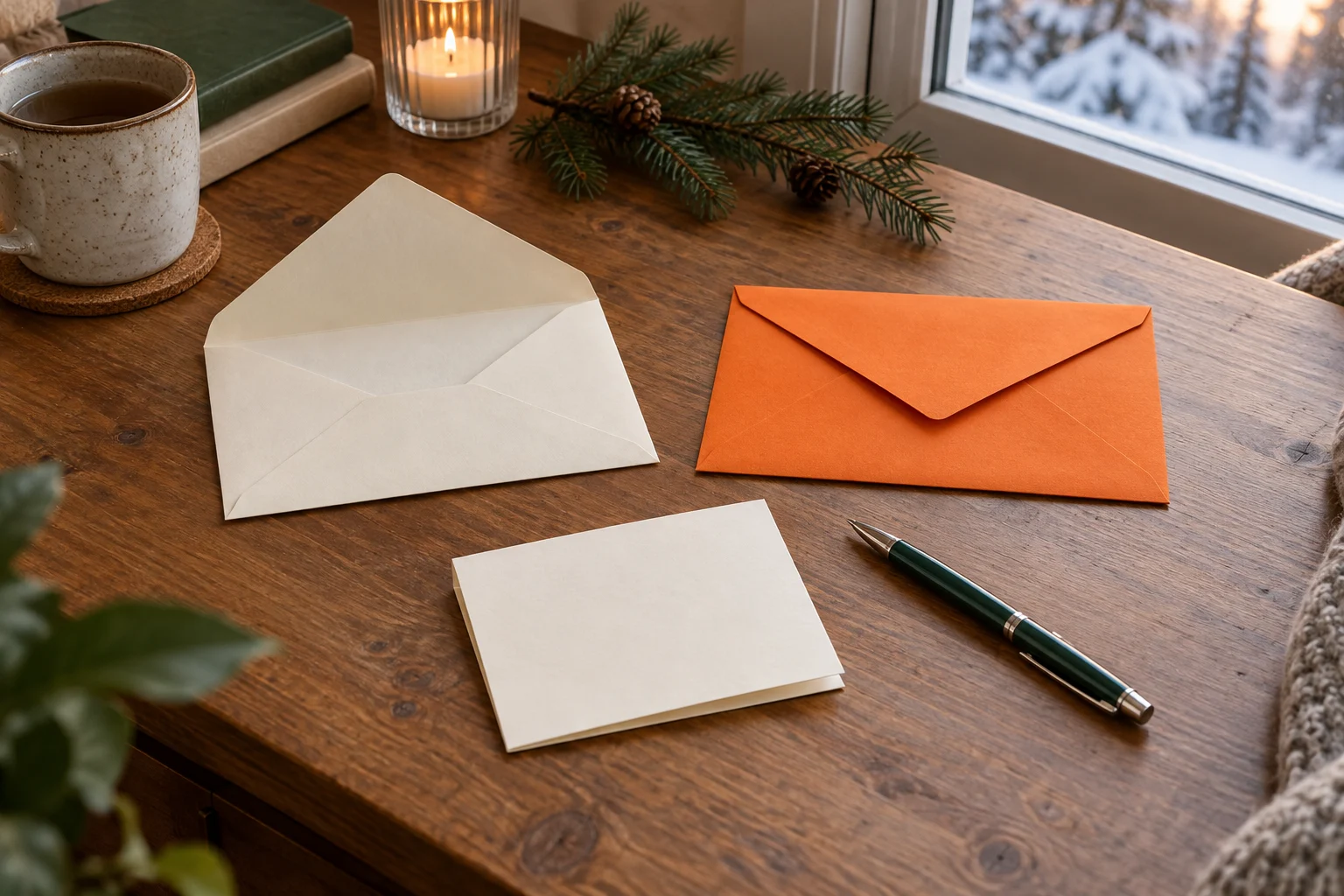
A New Year letter can hold a question you would like to meet again next January. You can leave annual summaries and resolutions out of it. This proposed private activity begins with something unfinished: an interest, a small choice or an ordinary part of life whose future you cannot yet know.
Write to the person who will eventually open the envelope. That person will have lived through months you have not reached. Give them enough of today's context to recognise the question, then leave room for an answer you cannot supply now. The letter can remain short, personal and entirely unshared.
Choose a moment around the turn of the year
Find a moment when writing would feel welcome. It might be a quiet part of New Year's Day or an evening after the seasonal gathering has ended. The calendar gives this activity an occasion; it does not require you to write while guests are waiting or stay awake until a particular hour.
Use suitable paper and something you like writing with. Drafting on an existing scrap sheet can make the first attempt feel less precious. Leave the envelope aside until the words are ready. A presentation choice can wait while you decide which unfinished subject you actually want to send forward.
You can write alone even if other people are nearby. If someone wants to join, explain that each person keeps their own letter. Sharing a table need not include reading the drafts aloud, comparing ambitions or collecting everyone's envelopes. Agree on that arrangement before anyone begins a private message.
Begin with the part you have not finished
Look for a question that interests you today. Perhaps you have started a book you want to return to, found a place you would like to visit again or begun making time for an activity you enjoy. Choose a subject you can describe from your own position, without needing somebody else's private story.
Keep the question small enough to recognise later. “Will everything be different?” leaves the future reader a large and indistinct job. A question about whether you still want a particular reading evening gives that reader something concrete to consider. It also allows several answers, including an answer you have not imagined.
The letter does not need a problem to solve. You might simply be curious about whether an interest will last. If a subject feels too personal to leave on paper, choose another or stop. This activity asks for a letter you want to keep, with no obligation to make the contents more revealing.
Try future-self letter prompts with an actual starting point
For future-self letter prompts, begin with what you know about the subject now. Describe the thing you have begun, what attracts you to it and the question you would like the later reader to consider. These are suggested directions for an original letter, rather than a questionnaire with required fields or a promised result.
Consider Mara, an invented writer making a letter at the turn of the year. She has begun a novel and likes reading a little of it on Wednesday evenings. She does not know whether that evening will remain available or whether the book will continue to interest her. That uncertainty gives the fictional letter its subject.
Mara could begin, “I am still near the beginning of the novel. Last Wednesday I put the book beside the chair before supper because I wanted to return to it afterwards.” The detail describes her fictional present. It gives the later Mara a scene to recognise without pretending to describe what the following months will contain.
Her question might be, “When you open this, do you still want an evening for reading?” It asks about an interest she has now. It does not tell the future reader that a reading routine must have survived. Mara can also leave out a question about finishing the particular book if the evening itself is what she cares about.
Give the future reader your present view
Write the reason you chose the question. Mara might say she enjoys having an evening with one activity already waiting. Another writer might enjoy choosing a book on impulse and have no wish for a regular evening. The letter belongs to its writer, so there is no need to borrow Mara's preference.
Separate a present observation from a hope about later. “I have been enjoying Wednesdays” describes Mara's account of the present. “I hope you still have time for it” gives the future reader a hope. “You will have done this every week” would make a claim the writer cannot establish at the time of writing.
You can include an expectation if it matters to the letter, while calling it an expectation. That gives a later change some context. The reader can see what you imagined rather than being asked to treat that imagined future as a fact. Your uncertainty can stay in your own ordinary words.
Keep the letter in your current voice. A half-finished sentence in a draft may reveal the part you have not yet decided. You can complete it honestly, leave the question open or remove it. There is no requirement to give each paragraph a lesson or end the letter with a confident announcement.
Imagine two different answers without writing either as history
One invented future Mara still enjoys a reading evening. She might open the letter and recognise the chair, while having moved on to a different novel. Her later answer could concern the pleasure of that evening more than the title she happened to be reading when she wrote.
Another invented future Mara prefers reading in the morning. The original evening no longer fits the way she wants to spend her week. She can still recognise the interest in the letter and answer its question. A changed preference need not be presented as a broken promise that the original wording never asked her to make.
These are two imagined continuations, not observed outcomes or predictions. Their purpose is to show how the same question can remain understandable after circumstances change. Your own letter might reach a very different answer. Leave that answer for the person who actually opens it, rather than supplying a compulsory conclusion today.
If you notice that the draft already judges one future answer harshly, decide whether you want that demand in this letter. You can keep it if it expresses what you mean, revise it or choose another subject. The activity offers no rule that your future interests must match your present ones.
Choose an opening date for your letter
An opening date for your letter gives the envelope a particular occasion to return. For this proposed version, choose a date around the following New Year and write the actual date you mean. “Next year” alone can become unclear once the envelope has been moved or the writing date is forgotten.
Put the writing date on the letter as well. If you draft during December and finish during January, use the date that identifies the version you decide to keep. You can mention that you began it earlier if that matters to the message. The dates should help you recognise the letter, without requiring a diary of every revision.
Decide whether you want the envelope to say anything beyond the opening date and that it is yours. Its outside can stay plain. An opening instruction identifies your intention; it does not establish that you will find the envelope on that day or feel like reading it when the occasion arrives.
Consider the envelope after the words
The Neenah Astroparche Natural A7 envelope offer names a thousand-envelope carton. Its short description gives “5-1/4-x-7-1/4,” 30% recycled wording and “089 GSM (24/60lb Text).” It supplies no long-term paper-preservation or privacy guarantee.
The Astrobrights Cosmic Orange A7 offer describes envelopes measuring 5¼ by 7¼ inches, a smooth 60 lb text finish and a thousand per carton. Those are package and material details, with no particular letter or storage arrangement tested here.
One suitable envelope already available may be enough. Neither thousand-count carton determines how many letters you should write. Check your actual folded sheet against the envelope you intend to use. A selected paper size, fold and closure remain choices for the item in front of you, rather than something established by a catalogue label.
Think about where you will keep this particular letter. Choose a place you expect to be able to find again and that suits the privacy you want. If a storage place is shared, make clear that the envelope is personal. An ordinary paper envelope is not a demonstrated secure storage system for sensitive information.
Let next January bring its own reading
When the chosen occasion arrives, you can decide whether to open the letter. You may want a quiet moment, another day or no reading at all. The earlier date records an intention. It does not remove your later choice about what to do with a personal message you wrote for yourself.
If you read it, begin with the question as it was written. Notice which details still make sense and which need the context of that earlier moment. You can answer on a separate sheet if you want, keeping the original wording visible. There is no need to rewrite the old letter so it sounds as though it knew the answer.
Mara's later reply might say that the Wednesday evening changed while her interest in reading remained. Another writer may have lost interest in the original subject altogether. A reply can be a few words or remain unwritten. This activity provides no score, completion target or obligation to make another annual letter.
If you choose to write again, give the new letter its own writing and opening dates. You can carry the question forward or choose a subject that matters now. Keep a later reply identifiable as a reply, rather than putting new words into the earlier letter. That separation lets you see the question that was actually waiting in the envelope and the answer you chose after opening it. A second envelope can hold a different question without replacing the first one.
The postcard-writing afternoon guide concerns a message for another person. The greeting-card budget guide includes delivery choices for finished messages. A private letter kept for yourself has no outward delivery arranged by either discussion.
A New Year letter can leave one unfinished question in your own words. Give it the present detail it needs, the date you intend and a place to wait. The later reader can then meet the question with whatever has happened in the months between.