Programming & Compilers
Mutual adapter reachability: group both directions
An original finite directed-relation exercise builds reversible reachability groups and proves why their collapsed graph has no directed cycle.
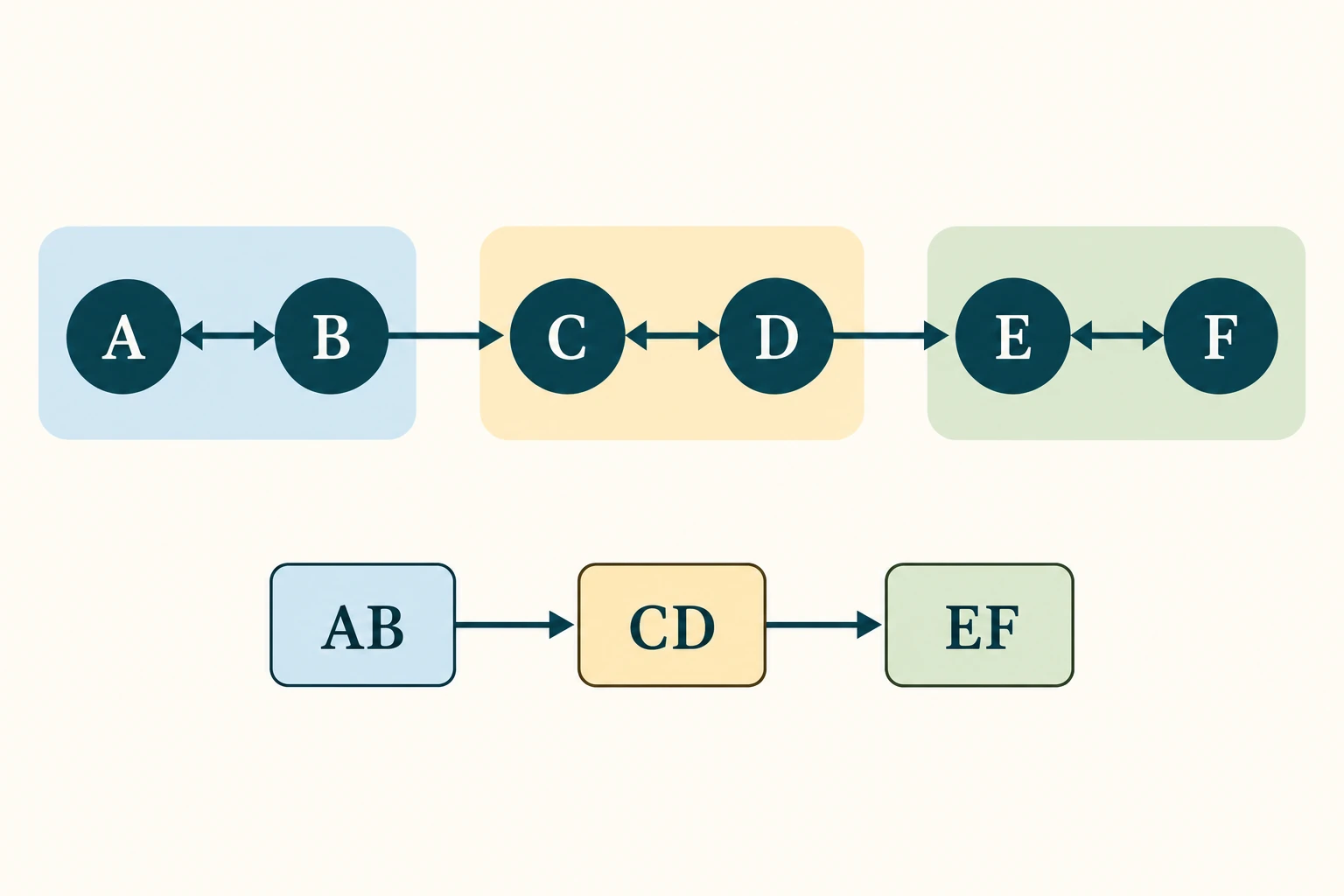
Mutual adapter reachability requires a route in each direction between two labels. A route from A to F alone does not put A and F in the same reversible group. In this original six-label exercise, A and B form one group, C and D form another, and E and F form a third. Routes connect those groups from left to right, with no return route between different groups. The result follows from the complete declared link list, rather than from the appearance of a connector.
The word adapter names a fictional directed link here. Each label is an abstract interface type with no electrical, mechanical or software specification. An arrow says only that the model permits that direction of transition. There are no real devices to test, and no claim that an actual accessory can connect two products. This lets us examine the difference between a one-way path and a group whose members can all reach one another.
Write all eight permitted links
Use exactly six labels: A, B, C, D, E and F. The directed links are A to B, B to A, B to C, C to D, D to C, D to E, E to F and F to E. No other direct link exists. The first and second links permit travel both ways within the A/B pair. The same is true within C/D and E/F. The links from B to C and D to E point only toward the next pair.
A route follows zero or more of these links in their stated direction. Its ending label must match the starting label of the next link whenever another link is used. For example, A to B to C is a route from A to C because both required arrows exist. A to C is not a direct link, even though the two-step route reaches C. Keep direct links and complete routes distinct when reading the diagram.
Allow a zero-length route that stays at its starting label. Thus A reaches A without requiring an original self-loop. The same convention applies to every label. Reachability records whether some route exists; it does not count how many routes exist or select the shortest one. Repeating a permitted link is allowed. No payment, time, capacity or loss is attached to following an arrow in this model.
Call x reachable to y when a route starts at x and ends at y. This relation is reflexive because of the zero-length route. It is transitive because a route from x to y can be followed by a route from y to z. The combined sequence is a route from x to z. Those two properties alone do not say that every route has a return direction.
Fill the six reachability rows
Starting at A, reach B directly. Continue through B to C, then D, then E and F. Together with the zero-length route, A can therefore reach all six labels. Starting at B, first use its direct link to A when A is wanted; use B to C to continue toward the later labels. B also reaches all six. These two rows contain the same destinations, although their first steps can differ.
Starting at C, reach D directly, then continue through D to E and F. C also reaches itself. There is no outgoing arrow from the C/D pair back to A or B. Its complete destination row is C, D, E and F. Starting at D gives the same row: D reaches C directly and reaches E directly, then F through E, while retaining itself by the zero-length convention.
Starting at E, reach F, and starting at F, reach E. Neither label has an outgoing link to an earlier pair. Their two complete rows therefore contain E and F only. These rows account for every permitted departure: E has only its link to F, and F has only its link to E. Repeating those arrows cannot introduce C, D, A or B.
The completed table has six destinations in each of the A and B rows, four in each of the C and D rows, and two in each of the E and F rows. That gives twenty-four reachable ordered pairs out of the thirty-six possible ordered pairs. An ordered pair includes its direction. The entry saying A reaches F and the entry asking whether F reaches A occupy different positions in the table.
Require both directions for group membership
Define x and y as mutually reachable when x reaches y and y reaches x. A and B satisfy both demands by their direct opposing arrows. C and D do too, as do E and F. Every label is mutually reachable with itself under the zero-length convention. These observations put A with B, C with D and E with F.
No label from an earlier pair belongs in the same mutual group as a label from a later pair. For example, A reaches C by A to B to C, but C's complete row excludes A. Similarly, D reaches F through E, while F's row excludes D. In each case one of the two required directions is missing. The existence of the forward route does not fill the missing reverse entry.
The three groups are therefore exactly {A, B}, {C, D} and {E, F}. Each two-member group contributes four mutual ordered pairs, including its two diagonal entries. The complete mutual relation has twelve ordered pairs. This count is separate from the twenty-four entries in the broader reachability relation. A cross-group forward route belongs to the latter and fails the former's two-direction test.
Prove that the groups form a partition
Mutual reachability is reflexive because every label reaches itself. It is symmetric by its definition: if x reaches y and y reaches x, the same two statements show that y is mutually reachable with x. This symmetry belongs to the relation that requires both directions. It does not make the original eight-link graph symmetric, since its two cross-pair arrows still lack direct reverses.
For transitivity, suppose x is mutually reachable with y, and y is mutually reachable with z. Follow x to y and then y to z to obtain a route from x to z. For the return direction, follow z to y and then y to x. Hence x and z satisfy both requirements. Four available route directions supply the two new directions needed by the conclusion.
These properties mean the relation divides the labels into equivalence classes. To see why two classes cannot partly overlap, take a shared label y. Every member x of one class is mutually reachable with y, and every member z of the other class is mutually reachable with y. The transitivity argument then makes x and z mutually reachable. The proposed separate classes describe the same full group.
A label also cannot be left outside every class, because it is mutually reachable with itself. In this finite example the three displayed groups are disjoint and cover all six labels. The argument explains why taking both directions produces genuine groups, rather than a collection of overlapping forward destination lists. A's six-destination row by itself is not a mutual class.
Collapse each group without reversing its links
Replace the A/B group by a single box labeled AB, the C/D group by CD, and the E/F group by EF. Retain a direct arrow between different boxes whenever an original direct link crosses those groups. B to C gives AB to CD. D to E gives CD to EF. The arrows within each group stay inside its box and do not become links between different boxes.
The resulting direct group graph has two arrows, forming AB to CD to EF. Its route relation also includes AB reaching EF through CD. That longer route does not create a third original cross-group arrow. Keeping the two-arrow graph beside its three forward cross-group reachability entries preserves the same distinction between direct links and routes used for the six individual labels.
This collapse also explains why a direct link between particular members supports access between their groups. Any member of AB can first reach B inside AB. After B to C, the route can continue to any member of CD inside CD. The freedom to make those internal journeys follows from mutual class membership. The cross-group arrow remains one way because the link list supplies no route returning to AB.
A cycle between different groups would merge them
Suppose a collapsed graph contained a directed cycle through several different mutual classes. Choose a class on that cycle and follow its outgoing cross-class link. Inside the next class, use mutual reachability to get from the arrival member to the member providing the next outgoing link. Continue around the cycle. This builds a route through the classes and back to the first one.
Take any two classes on that cycle. Traveling forward along part of the cycle reaches the second from the first. Continuing around the rest returns to the first. Internal routes connect the necessary entry and exit members at each stage. Members in the two classes would then reach each other in both directions. By the definition already established, they would belong to one class.
That contradicts treating them as different classes. Consequently the graph between distinct mutual classes has no directed cycle. The conclusion permits cycles inside a class: A to B to A is present in the original graph. Collapsing a class packages its internal return routes together. It does not delete a required original arrow or declare the original graph free of cycles.
The argument uses only finite routes and the definition of mutual reachability. In the displayed example, the complete reachability rows also provide a direct check: neither CD nor EF can return to AB, and EF cannot return to CD. The general grouping argument explains the structural reason, while the six-row table verifies the particular labels and eight links supplied here.
Inspect the long route and its absent reverse
A to B to C to D to E to F is a valid five-link route. Every arrow appears in the original inventory. Starting at F instead gives only F to E, followed by E to F if another step is chosen. All later steps stay in that pair. There is no first permitted step that leaves E/F for C/D, so there is no route from F back to A.
An exhaustive finite check closes the original relation under composition and tests all thirty-six ordered label pairs. It reproduces the six destination rows, twenty-four reachable pairs and twelve mutual pairs. A separate control explicitly checks all 216 ordered triples for the transitivity implication. It also checks that the two-edge class graph has no directed cycle. These are exact checks of the declared finite model, with no random route procedure or measured performance claim.
Two decorative accounts outside the relation
The native Roman rotating gnome snow globe account accompanies photographs of a round globe on an integral snowy landscape base. Sculpted gnomes and trees belong to the pictured decoration. The catalogue maker name identifies the source; the images do not authenticate it or verify movement, music, material, dimensions or performance. This physical scene supplies none of the graph's links.
The native NOBRAND ballerina snow globe account shows a tall pink framed lantern enclosing a ballerina scene, with an attached ring above its roof. Reflections, effect graphics, detail crops and background decorations do not add supplied items. Music, spinning, light, timer, power and material claims remain unverified here. Neither account establishes actual adapter compatibility.
Nearby questions use different relations
The topological ordering tutorial seeks a complete strict-precedence order or a directed cycle that prevents one. This exercise deliberately retains internal cycles and asks which labels belong together under mutual reachability. No zero-indegree elimination algorithm or repaired task schedule supplies the groups.
The one-sided inverse guide checks whether particular compositions restore every input in their declared domains. Here arrows assert permitted abstract transitions, without a coordinate map or information-restoration promise. A return route establishes relation membership under the present definition, rather than an inverse function for a physical device.
Keep an optional purchase outside the diagram
If a decorative item interests you on republeq.com, assess the actual offer independently of this fictional graph. Read the selected item, variant and quantity together with the current delivery and order terms. An illustration containing several figures does not establish several separately supplied products. Resolve any uncertainty about what the offer includes before considering payment. This article does not establish that a particular cryptocurrency method is available for your order. If the current checkout offers USDT and you choose to investigate that option, verify the stated asset and network against the instructions for that exact transaction. A familiar token name alone does not specify the receiving network or identify the correct destination. Check the requested amount, destination, order reference and any validity period with the responsible service. Review any displayed fees or conversion conditions using current information, and ask about missing details rather than substituting assumptions. Establish the cancellation, return and refund terms that would apply, including how a refund would be handled for the selected method. Keep the relevant instructions and any eventual acknowledgement attached to the actual order. If the order or payment status remains uncertain, reconcile it before considering another transfer; an unresolved result does not establish that nothing happened. The graph provides no wallet address, payment amount, merchant assurance, transfer guarantee or recovery procedure. Its arrows are stipulated mathematical transitions. A route in each direction between two labels does not promise that a real payment can be reversed. You can verify all six rows without buying either decoration, creating an account or holding a token. Keep that completed mathematical record separate from any transaction you later decide to make.
Retain the groups and their directions
Save the complete eight-link inventory, the six reachability rows and the groups {A, B}, {C, D}, {E, F} together. Preserve the direct group arrows AB to CD and CD to EF, with AB to EF recorded as a derived route. This record establishes exactly which labels have routes both ways and which cross-group journeys remain one way under the declared rules.