Crypto Commerce
MOVA S20 Ultra robot vacuum-mop vs Roborock Qrevo S5V: map the home first
Compare MOVA S20 Ultra robot vacuum-mop by carpet lift, room mapping, obstacle detection, dock washing and water handling, with care around uneven suction and…
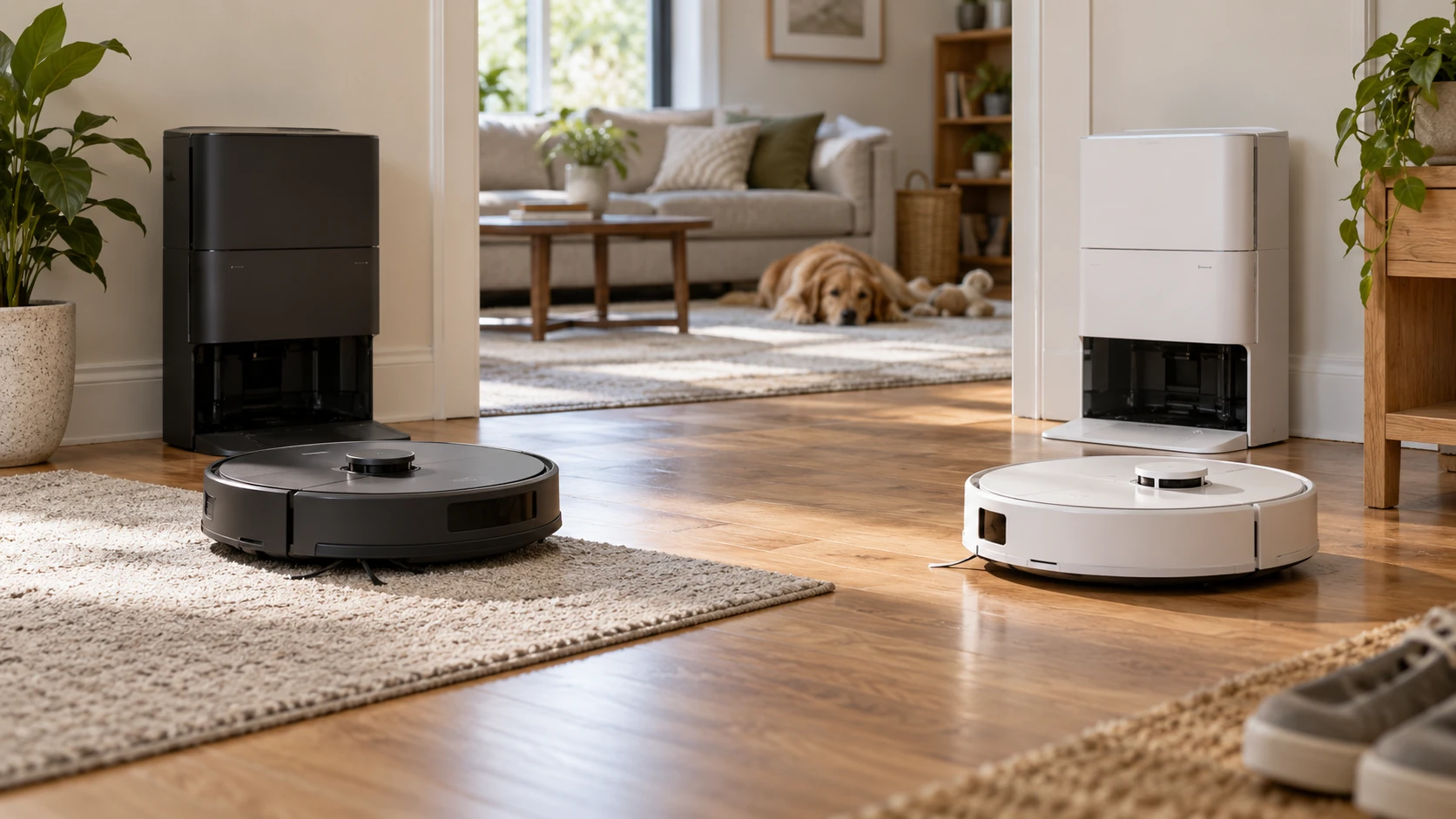
The MOVA S20 Ultra robot vacuum-mop lists camera-assisted object recognition, several mop-lift behaviors and a dock that washes mops with hot water. Roborock's Qrevo S5V listing emphasizes LiDAR floor maps, room controls, a reach-extending mop and a dock that empties, washes, dries and refills. Both aim to automate mixed-floor cleaning. The best fit depends on floor transitions, obstacles, dock space and the amount of setup a household will tolerate.
These are Republeq's product descriptions, not a matched pickup or navigation test. MOVA quotes 8,300 Pa of suction and Roborock quotes 12,000 Pa, but the rows do not state common measurement conditions or a shared debris test. Coverage and maintenance intervals are similarly uneven. Treat the numbers as questions for a trial in the actual rooms rather than as a ranking.
Map rooms before enabling every feature — robot-vacuum mapping before choosing room controls
MOVA's row says it uses a camera, 3D structured light and an LED to recognize and avoid more than 70 object types, including in low light. It mentions four-level 3D maps, virtual walls, excluded zones, schedules and customized cleaning modes. These features can be useful in a home with pet bowls, toys or frequently moved chairs. The listing does not document how well the robot handles a particular cable or a dark rug. Tidy obvious hazards before the first run and check the map afterward for rooms that were divided or missed.
Roborock describes PreciSense LiDAR with 360-degree scanning, structured-light obstacle detection and up to four stored floor plans. Its app can select rooms, schedule cleaning, create No-Clean Zones and use SmartPlan to adjust suction and mopping by room. The source says sensors can suggest No-Go Zones; a suggestion should be reviewed before a robot is allowed near stairs, pet food or a delicate carpet. Ask how floor switching is recognized in the specific home, particularly if the dock stays on one level and the robot is carried upstairs.
The published guide on robot-vacuum mapping before choosing room controls offers a general setup framework. It does not certify either MOVA or Roborock's mapping accuracy. Walk through the home and note door thresholds, rugs, low furniture and areas that should never be mopped. Then map those areas and perform a supervised first cleaning. A polished app map is useful only when the physical robot respects it.
Roborock's saved row says it supports only 2.4 GHz Wi-Fi. Confirm that a compatible network is available where the dock will sit before counting on app controls. The MOVA row does not state its supported Wi-Fi bands. Ask for that requirement as well rather than assuming the two models join the same network without adjustment. An otherwise suitable robot can be frustrating if it cannot stay connected in a far room.
Handle carpet edges and mixed surfaces — Roborock Qrevo S5V robot vacuum-mop
MOVA lists ultrasonic carpet recognition and says its mops lift eight millimeters to protect carpet. Elsewhere in the same row, it says the mop lifts 10.5 millimeters in Vacuuming Mode and the brush lifts seven millimeters in Mopping Mode. Those figures describe different parts or modes and should not be collapsed into one clearance number. Measure the pile height and observe whether the selected program keeps a rug dry. A mat with a curled edge may be a bigger problem than its pile height.
Roborock says its spinning mop pads lift 10 millimeters over low-pile carpet and offers 30 water-flow levels in the app. That may help set a lighter pass for one room and a wetter pass for another, but the source does not give a floor-material approval list or a drying-time result. A thick rug or loose fringe can still need a No-Mop Zone. Check the manual's carpet guidance and supervise transitions during the first few runs.
MOVA's twin rubber brushes are described as reducing hair tangles and helping avoid rolled-up carpet corners or mats. Roborock uses a rubberized floating main brush and an arc-shaped side brush with an SGS-certified zero-percent hair-tangling rate under a specified test. Neither description proves the brushes will never need manual cleaning in a home with long pet hair. Inspect the brushes after a normal cleaning week. Note whether the hair collects at the ends, where it can be harder to see.
Suction claims and repeat passes — Roborock Qrevo S5V robot vacuum-mop
MOVA offers four selectable suction levels and lists 8,300 Pa. Its description says it is intended for hard-floor and carpet dust, pet hair, cat litter and crumbs. Roborock lists 12,000 Pa and says it works across carpets, rugs and hard floors. A higher quoted Pa value does not tell us how much cereal, fine dust or embedded hair each complete machine picks up. Brush design, route, carpet pile and number of passes all matter. Try the debris that actually causes extra work at home.
MOVA's row also describes an RGB camera with five-channel color sensing that can detect dirt and trigger another mop pass. That could help with a visible spill, provided the system identifies it correctly and the floor tolerates extra moisture. Roborock's app can use SmartPlan to adjust settings by room. Neither row provides a controlled result for dried-on stains. If kitchen mopping is the priority, watch a normal run and see whether the robot revisits the messy area without making the surrounding floor too wet.
The robots differ in edge claims. MOVA lists dual-edge cleaning. Roborock says its FlexiArm mop extends around furniture legs and into corners. Those descriptions concern reach, not a measured amount of dirt removed from a baseboard. Put a few ordinary crumbs near an edge and observe what remains after the cycle. A separate hand tool may still be needed for tight grooves or a spill under a cabinet lip.
The dock sets the maintenance routine — Roborock Qrevo S5V robot vacuum-mop
MOVA's dock is described as washing mop pads with 140-degree-Fahrenheit water, then drying them with hot air. It has a 3.2-liter dust bag, a 4.5-liter clean-water tank and a four-liter used-water tank. The row claims up to 75 days between some maintenance and coverage up to 4,300 square feet. That interval is conditional on how much dirt and water the home produces; it does not mean the used-water tank can be left unattended for months. Ask which tasks still need weekly attention and how the hot-water cycle is controlled.
The Roborock Qrevo S5V robot vacuum-mop dock empties dust into a bin rated for seven weeks of storage, washes the mops, dries them with warm air and refills the robot's water tank. Its row mentions mopping coverage across 3,552 square feet. It does not give the dock's individual tank volumes or a water-wash temperature. A smaller coverage number in one saved Republeq catalog record cannot establish that Roborock needs refilling sooner in an actual apartment; the claims may use different conditions.
Measure where the dock can sit with room to lift out tanks or a dust bag, and keep it near the permitted outlet and network connection. Both machines need a clear approach path so they can return after cleaning. A dock hidden behind a chair or squeezed under a low shelf may be harder to refill than the robot is to operate. Check the replacement bag and mop-pad prices as part of ownership, since neither saved row supplies those costs.
Runtime, noise and household comfort — Roborock Qrevo S5V robot vacuum-mop
MOVA's specifications list a 5,200 mAh battery and 210 minutes of running time, with a 200-minute charging time for vacuuming and mopping. The row does not clearly explain modes or test conditions for the runtime. Roborock's saved row gives no comparable minutes or battery capacity. Ask how long the chosen room plan takes at the settings you expect to use, and whether the robot resumes after charging. A large quoted maximum can be irrelevant if the dock must interrupt cleaning to wash mops or empty water.
Neither listing gives a matched noise measurement for vacuuming, mop washing or dock drying. A robot that is quiet on open tile can sound very different on carpet or during automatic emptying. If a baby sleeps or someone works from home, schedule a trial at the intended hour and listen to the complete cycle, including dock activity. App scheduling is valuable when it moves the loud steps to a time that suits the household.
MOVA's row names interactive voice calling through the app and an RGB camera. Some households may find a camera useful for object recognition, while others will want to examine its account settings, permissions and storage policy before placing it in private rooms. The saved product row does not describe those practices. Roborock's row names structured-light sensing and LiDAR but no camera in this snapshot. Check the exact model's current privacy documentation rather than inferring a full privacy comparison from feature labels.
MOVA is worth investigating if hot-water mop washing, dirt-triggered repeat passes and its stated object recognition address the home's problems. Roborock is worth investigating if LiDAR floor plans, 30 water-flow choices and the extendable mop suit its mixed rooms. Verify Wi-Fi, rug clearance, dock access and cleaning supplies for the exact selected unit. Then supervise one ordinary run; a correct map and a manageable dirty-water routine will matter more than the larger suction number.