Crypto Commerce
MOVA K30SE wet-dry floor washer vs Tineco Floor One S2: plan for the floor and the cleanup
Compare MOVA K30SE wet-dry floor washer by low-clearance reach, mess sensing, clean and dirty water handling, runtime and post-cleaning maintenance.
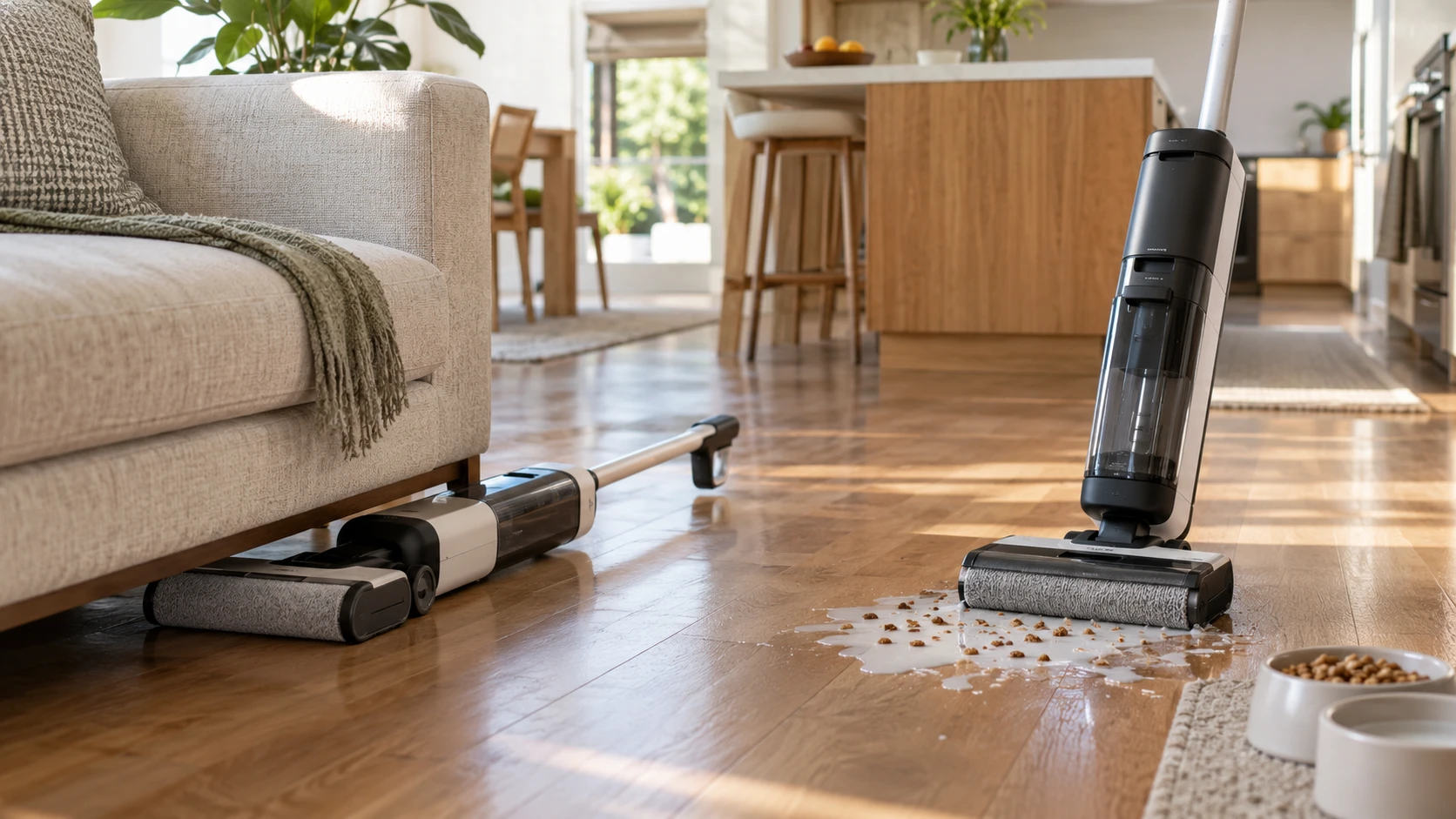
The MOVA K30SE wet-dry floor washer is described with a lie-flat design for low furniture, a self-propelled feel and a brush-cleaning cycle. The Tineco Floor One S2 listing emphasizes a mess sensor that adjusts water, brush speed and suction, with a display ring that changes color as the floor is cleaned. Both are cordless machines for wet and dry floor messes. The choice turns on the spaces you need to reach and the maintenance you are willing to do after every run.
These are catalog descriptions, not a matched floor-cleaning test. MOVA gives a suction figure and an estimated floor-area claim; Tineco gives neither in its saved row. Their runtime numbers also lack identical conditions. Neither source provides a complete floor-material approval list, cleaner-solution instructions or a standardized drying measurement. Check each manual before using a wet-dry machine on a particular surface.
Where does the floor head need to go? — handling checks for a cordless vacuum
MOVA's row describes a 180-degree lie-flat position and says the body can fit into spaces as low as 5.51 inches, with a brush head about 3.15 inches high. That could help beneath a low bed or sofa where a conventional upright handle hits the furniture first. Measure the actual clearance from floor to furniture frame, including feet and crossbars. The brush head may fit while the rest of the machine or the user's hand does not. Ask whether the stated clearance applies while the brush is actively washing or only while sliding it under furniture.
The MOVA listing also mentions dual-sided edge cleaning and an 8.8-pound weight with self-propelled motion. Edge access matters around baseboards and cabinet toes, where a wide roller may leave a narrow strip. A self-propelled drive may make forward movement easier but may feel less controllable in a cramped kitchen. Try reversing, turning and pulling it away from a wall. The saved row does not state the turning radius or how easily the machine travels up a threshold.
Tineco's row does not give a lie-flat measurement, body weight or edge-distance figure. It calls the S2 a multi-surface floor washer, but the source does not identify every approved surface. A buyer with low furniture should ask for its clearance and maneuvering dimensions rather than assuming it has the MOVA's posture. A buyer whose rooms are open may care more about how the head moves around chair legs than about a few inches of reach beneath a sofa.
The published guide on handling checks for a cordless vacuum covers general handling rather than these two wet-dry models. It is useful as a reminder to test lifting, turning and storage in the actual home. It does not certify either machine's wet-floor performance. Trace the route from charging spot to kitchen, hallway and bathroom. Include the places where the machine must be carried, parked or emptied, not just the stretch of floor it cleans.
Sensor control or deliberate passes — Tineco Floor One S2 cordless wet-dry vacuum mop
Tineco says its iLoop Smart Sensor detects mess level and adjusts water flow, brush speed and suction. An LED ring changes from red to blue as the floor becomes cleaner, according to the row. That can provide feedback while moving across a room, but a color change is not a laboratory proof that every residue or stain is gone. Watch whether the machine responds to the actual messes in the household, including fine crumbs, tracked-in grit and a sticky spill.
Tineco also lists Auto, Max and water-only modes. Auto lets the sensor guide the machine, Max is presented for stubborn messes, and water-only is for light maintenance. The saved row does not specify how much water each mode applies or how long the battery lasts in Max. Test whether a wet pass leaves the floor safe to walk on in the room's usual conditions. Claims in Republeq's catalog streak-free, fast drying, but no shared drying time is given for a particular tile or sealed wood floor.
MOVA's description highlights a 500 RPM mopping action and 18,000 Pa suction. It does not name a comparable dirt-sensing display or water-only mode. That does not establish that its controls are primitive; it means the saved row cannot tell us how much manual adjustment is available. If automatic response is important, request a demonstration of both machines on the same mess. If it is not, compare the basic control sequence: fill, start, clean, dock and empty.
Read the suction and coverage claims carefully — Tineco Floor One S2 cordless wet-dry vacuum mop
MOVA's 18,000 Pa number is a suction claim. The row does not state where it was measured, the mode used or how that value translates to pickup of wet cereal and fine dust on the same floor. Its estimate of up to 2,595 square feet without recharging also depends on how much water is used, how dirty the surface is and the route's interruptions. A large open floor is unlike a home with many corners and rugs. Treat both figures as questions for a practical trial rather than as a promise for your rooms.
Tineco's row does not offer a Pa figure or area rating, so the catalog cannot support a numerical suction ranking. It does claim the sensor adjusts suction and brush speed. A person cleaning sticky spills may want to see whether Auto increases effort where needed or whether Max must be selected manually. For either product, check the manual's limits on large debris and liquids. A wet-dry floor washer is not necessarily a substitute for every dry vacuum attachment or carpet-cleaning machine.
Battery and the complete cleaning session — Tineco Floor One S2 cordless wet-dry vacuum mop
MOVA states up to 30 minutes of runtime. Tineco states up to 35 minutes. The saved rows do not give equal test conditions, battery sizes, recharge times or how self-cleaning affects the total session. A five-minute difference in advertised maximums may disappear when one machine works in a stronger mode or needs extra passes. Estimate how long the floors actually take today, then allow time for an interrupted fill or an unusually dirty area.
If a home needs more than one charge, ask whether the battery is replaceable on the exact model and how long recharging takes. Neither row supplies that answer. It is also worth checking whether the charging base fits near an outlet with room to remove the tanks. A machine that finishes a floor but cannot be cleaned or stored conveniently still adds work to the end of the session.
The Tineco Floor One S2 cordless wet-dry vacuum mop lists a 0.6-liter dual-tank system that separates clean and dirty water. Its saved row does not specify whether that capacity belongs to one tank or a combined system, so ask for the individual tank sizes. MOVA also describes an integrated tank system with clean and dirty water kept apart, but gives no volume in the row. The smaller of the useful capacities may determine when a cleaning run stops, regardless of battery life.
Cleaning the cleaner — Tineco Floor One S2 cordless wet-dry vacuum mop
MOVA describes a one-press self-cleaning process with alternating brush rotation, followed by a high-speed spin to remove excess water. It also names a comb-tooth scraper intended to reduce hair tangling. Those mechanisms could be helpful in a home with shedding pets. The source does not say that every strand will be removed or that the brush and tanks never need hand cleaning. Ask how to access the roller and waste path when hair, grit or a sticky spill remains after the cycle.
Tineco says its self-cleaning mode runs when the machine is docked in its base. The row does not describe a high-speed drying spin or a specific anti-tangle comb. A self-cleaning cycle can rinse the brush without replacing the need to empty dirty water, wash a filter or dry removable parts as instructed. Read the maintenance steps and decide where wet components will sit afterward. A small apartment may have less room for an open drying station than for the vacuum itself.
Both listings describe fresh and dirty water as separate. That design reduces the chance of pushing collected dirty water back onto the floor, but it still requires careful tank handling. Empty the waste tank promptly after a wet spill and clean it as directed. Check whether the tank openings are wide enough for a hand or brush, and whether the base tray collects water. The saved rows do not provide those ergonomic details.
Choose by the awkward part of the job — Tineco Floor One S2 cordless wet-dry vacuum mop
MOVA is the listing to investigate if low-clearance reach, edge passes and a stated anti-tangle brush design address the trouble spots in the home. Verify the lie-flat clearance, tank size and maintenance steps in the exact manual. Tineco is the listing to investigate if mess-responsive controls, visible cleaning feedback and selectable modes would make the routine easier. Verify its tank capacities, approved floors and drying behavior on the actual surface.
Both machines promise to reduce the separate vacuum-and-mop routine, but the saved descriptions cannot measure how well either handles your floor. A short trial with a familiar dry mess and a small wet spill, followed by the full empty-and-clean cycle, will answer more than either runtime headline. Include storage and cleanup in that trial; those minutes happen every time the floor gets washed.