How-To Guides & Tutorials
How to monitor fridge and freezer temperature with appliance thermometers
Monitor fridge and freezer temperature using FDA targets and placement guidance, with the actual range and display limits of mechanical and SJJ thermometers.
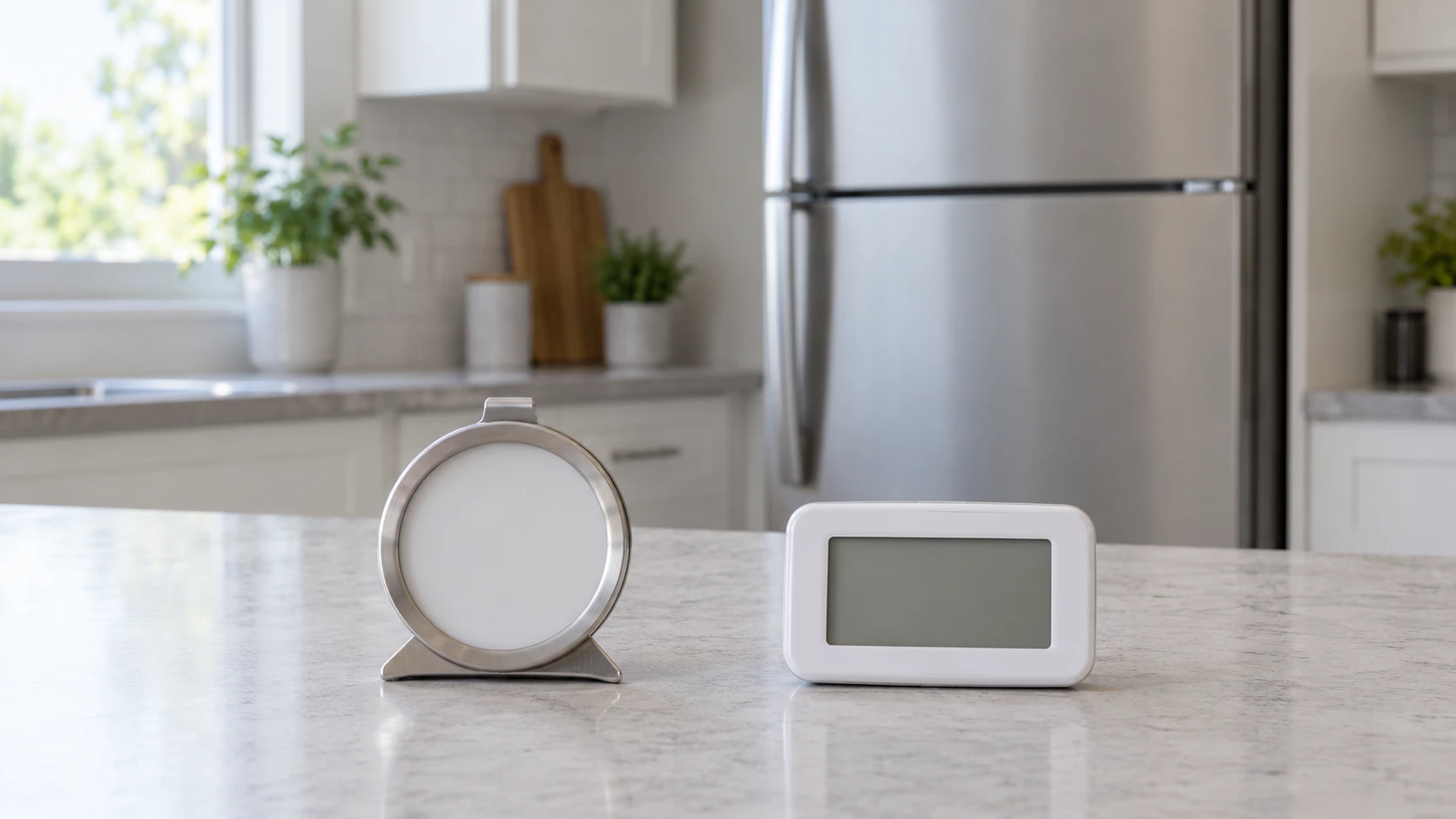
To monitor fridge and freezer temperature, use appliance thermometers intended for those conditions and compare the readings with the correct target for each compartment. The US Food and Drug Administration recommends a refrigerator at 40°F or below and a freezer at 0°F or below. A numbered cooling control may help you change the appliance setting, but its number is not necessarily a measured temperature. Read the measured temperature before deciding whether the selected setting needs attention.
This guide concerns ordinary household monitoring while the appliances are operating. It combines the FDA's refrigerator-thermometer and food-storage guidance with the actual details of two thermometer listings. It does not provide a power-outage food assessment, a calibration method or an appliance repair procedure. If you have an uncertain food-safety situation, a newly cool reading alone cannot establish what happened to the food earlier.
Start with the fridge and freezer temperature targets
The fridge and freezer temperature targets differ because the two compartments serve different storage purposes. A reading below 40°F can meet the refrigerator limit while still being far above the freezer target. Do not use a refrigerator's acceptable range as your freezer goal. The FDA's food-storage guidance gives 0°F, equivalent to approximately minus 18°C, for the freezer and 40°F, approximately 4°C, as the refrigerator's upper limit.
Check which unit the instrument displays before comparing it with those figures. A dial can show Fahrenheit and Celsius scales together; an LCD may have its own controls and presentation. Read the actual instructions for the instrument you receive. Neither a coloured zone nor the apparent position of a pointer replaces knowing the scale and the relevant target. The appliance's own manual also remains the source for its controls and adjustment procedure.
The purpose of monitoring is to find out how cold the compartment is, rather than assuming that a selected control position proves the result. FDA guidance notes that few refrigerator controls display actual temperatures. If your appliance does show a temperature, establish what that display represents in its manual before treating a separate thermometer as redundant. An instrument reading and a selected setting answer different questions.
Choose a refrigerator thermometer with a suitable stated range
The Unbranded ATZNZIK Restored Home thermometer pack contains 12 stainless steel mechanical thermometers. The description gives a two-inch dial with Fahrenheit and Celsius markings, a wide base for standing on a flat surface and an integrated hook for hanging from a rack or drawer. It identifies the product with SKU sku-18568112233 and UPC 367391230639.
Its stated scales run from minus 20 to 80°F and minus 30 to 30°C. These are the ranges supplied in the listing; they are not an independently tested accuracy specification, and the listed endpoints should not be treated as exact equivalent conversions. The description says the mechanical movement needs no batteries. It also describes corrosion resistance and wipe-clean care, without supplying a calibration procedure or permission to submerge the unit.
The SJJ four-pack fridge and freezer thermometers instead uses a large LCD and lists a range from minus 4 to 122°F. The stated accuracy is plus or minus 2°F, a retail specification rather than a result from testing these particular units. Its ABS construction has an IPX3 rating, and the description supplies a replaceable CR2032 battery. A hanging hook is named for placement inside appliances.
The SJJ description tells the buyer to peel the protective film off the screen before first use and names a minimum-recording feature. It does not provide the controls for recalling or resetting that record, a recording interval or a maximum-temperature history. Obtain the actual instructions before relying on a stored value. A minimum is the lowest recorded value under the feature's operating rules; it does not tell you the warmest temperature the compartment reached.
Both listed ranges include the FDA's ordinary refrigerator and freezer targets, but they have different lower limits. The SJJ range ends at minus 4°F, so the listing does not establish measurement below that limit. Choose for the temperatures you need to observe, including the instrument's stated boundaries. Do not extrapolate a reading, add an imaginary extension to the scale or assume that every fridge thermometer can measure any freezer condition.
Place appliance thermometers where you can read them
When deciding where to place appliance thermometers, the FDA recommends putting one thermometer in the refrigerator and one in the freezer, at the front in an easy-to-read location. Match that general placement advice to the mounting options and instructions for your actual units. The mechanical product lists a standing base and hook; the SJJ description names a hook. Those details do not establish that either hook fits every appliance rack or drawer.
Check that the proposed location works with the real interior before relying on it. A photograph of the thermometer cannot confirm your shelf arrangement, drawer clearance or the size of a particular rack. If the mounting position does not work, follow the instrument's instructions or obtain the missing compatibility information. Do not invent an attachment method from an accessory the listing never names.
Both products are intended for refrigerator and freezer use, but their descriptions differ on materials and care. The SJJ IPX3 rating does not authorize submersion, and the other listing's wipe-clean wording is no basis for soaking it either. This guide uses the FDA's easy-to-read placement advice. It does not ask you to put either of these products in a glass of water, freeze it into ice or apply a calibration treatment.
The pack quantities can help if you have several separate appliances to monitor. They do not require placing every supplied unit in one refrigerator. Decide which actual compartments need an instrument, then confirm that each instrument is appropriate for its location. A larger pack supplies more units; it does not establish a more accurate reading, automatic logging or better temperature control.
Read the thermometer and keep its different numbers separate
The FDA recommends checking refrigerator and freezer thermometers regularly, at least once a week in its food-storage guidance; its refrigerator-thermometer page also says to check them often. Make the reading part of using the appliance. An instrument at an easy-to-read location helps you see the result, but you still need to look at it and compare it with the appropriate target.
For the mechanical dial, identify the scale and read the pointer against that scale. The product description names blue and red temperature-zone markings, but those colours are not independent proof that stored food is safe. For the LCD, follow the actual instructions to identify the displayed information. Do not confuse the present temperature with a stored minimum simply because both are numbers the instrument can show.
The article on readings, ranges, totals and forecasts explains the importance of distinguishing different kinds of instrument information. That distinction applies when reading these listings: a measurement range describes the instrument's specified span, while a particular reading is information from an observation. The linked weather-station products do not verify either fridge thermometer's performance, and their update periods or features should not be transferred to these units.
If you make a note, write down the compartment and what you actually read, including the temperature unit. Label a minimum value as a minimum instead of turning it into a complete record of the week. A few written observations can help you explain a concern accurately, but they do not establish temperatures during all the periods between checks. Neither selected description supplies a continuous, complete temperature history.
Respond to a reading that misses the target
If the reading is above the target for that compartment, review the appliance's instructions for adjusting its temperature control. The FDA recommends monitoring with an appliance thermometer and adjusting the setting when necessary. The direction of a numbered dial and the appropriate adjustment process belong to the specific appliance manual. Do not assume a larger control number means a particular temperature or invent a universal waiting period after adjustment.
Keep checking the result rather than treating the movement of a control as confirmation. If you cannot obtain a suitable temperature, or you are unsure whether the instrument is operating correctly, seek guidance for the actual appliance or thermometer. A pack of replacement instruments is not a diagnosis of a cooling fault. This guide does not establish that either product will identify the cause of a warm compartment.
A separate concern is the food already inside. The FDA warns that food can cause illness even when it looks, smells or tastes normal. A current temperature is useful information, but it cannot reconstruct an unknown history. Do not taste a questionable item to decide whether the refrigerator reading matters. Food-safety decisions can require knowing the food, its handling and how long it was outside suitable conditions.
Other food-handling practices still matter when the readings are satisfactory. FDA advice includes refrigerating perishables promptly and checking storage directions on labels. Foods needing refrigeration should not remain at room temperature for more than two hours, or one hour when the air temperature is above 90°F. Those are limits on time out of refrigeration; a thermometer purchase does not extend them.
Keep cold air circulation and food handling in the routine
The FDA advises against overpacking refrigerated food because cold air needs to circulate. When putting shopping away, leave the compartment able to do its job instead of fitting in every possible container. If the interior is already too crowded, the thermometer's presence does not remove that problem. Use the appliance's own instructions for its layout and avoid assuming that any particular arrangement is correct solely because it looks tidy.
Wipe spills promptly and clean the refrigerator regularly, as the FDA recommends. It specifically notes the importance of preventing drips from thawing meat from spreading bacteria to other food. Keep refrigerated food in covered containers or sealed storage bags. A satisfactory temperature reading supports one part of storage practice; it does not clean a spill or separate raw food from ready-to-eat items.
The guide on rinsing produce before serving deals with a different part of this routine: handling produce with the applicable washing and drying guidance. Its produce-washing tools do not monitor a refrigerator or establish a safe storage time. Keep the tasks distinct so a thermometer reading is not mistaken for a substitute for the food's preparation and storage instructions.
Purchase the pack that matches the monitoring task
Before ordering refrigerator thermometers from republeq, compare the number of actual compartments you want to monitor with the supplied pack. The mechanical listing describes twelve units; the SJJ listing describes four. Keep the chosen pack and the instrument's stated range in view when proceeding to payment. Anyone planning to use crypto, including USDT, needs to inspect the payment options and instructions presented for that particular checkout. Cryptocurrency appears as an accepted category in these product records, but that category does not confirm support for every token or network. A preferred wallet cannot resolve whether the thermometer's hook fits your appliance or whether its lowest specified temperature covers the conditions you intend to measure. Settle those product questions while you can still choose another instrument. For the LCD option, retain any clarification you obtain about the minimum-recording controls with the product information, so the instructions you receive correspond to the model you ordered. Read the requested payment details directly at checkout before authorizing a transfer. This article provides neither a wallet address nor a network recommendation, and a reference to USDT should not be used to fill a missing checkout instruction. If a payment detail is ambiguous, obtain clarification before proceeding. Keep the resulting order confirmation alongside the available transaction confirmation so a later enquiry can refer to the same purchase. Finally, review the delivery details offered for your order. New equipment is useful once it is available and understood; waiting for a package does not establish that existing stored food has been kept safely. Continue using applicable food-storage guidance and an existing suitable instrument where available, while resolving any current temperature concern through the actual appliance or instrument instructions.
Once your instruments are in place, keep reading them as part of the ordinary storage routine. Compare each compartment with its own target, preserve the difference between present and stored values, and follow up on a reading that needs attention. Keep the actual instructions available so questions about the display or the cooling control can be answered for the equipment in front of you. A missing instruction is a reason to obtain that information before relying on a feature.
Monitor fridge and freezer temperature shown conceptually with two whole generic inactive appliance thermometers; blank faces show no readings, operating method or exact retail model.