Skills & Planning
Minimum connection cost: keep every point connected
A five-point paper graph separates cheap edge selection from a connected minimum. Two forced links and a three-point choice establish a matching lower bound.
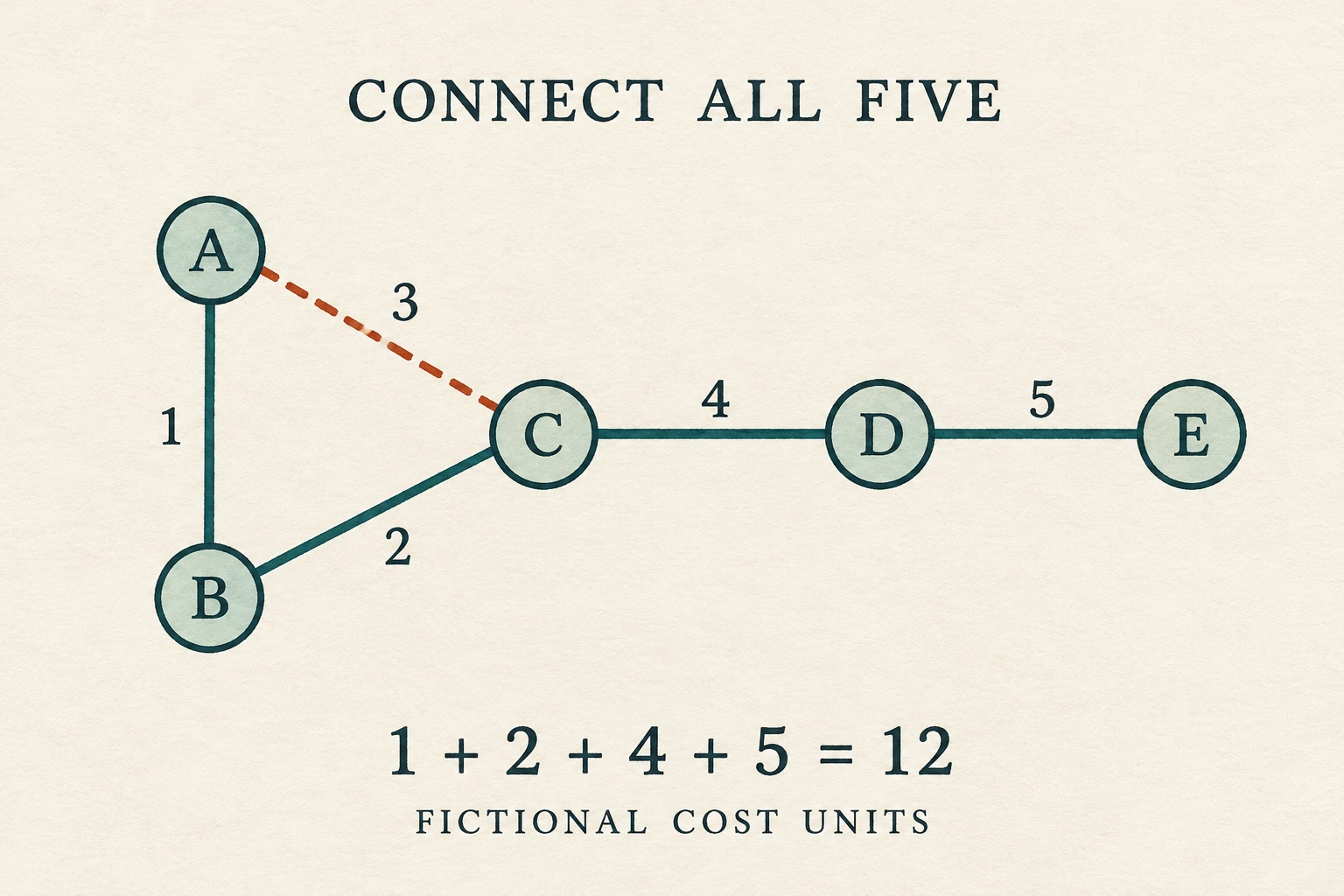
Give each allowed link a declared cost
Minimum connection cost is a small paper problem with two separate checks: every point must be reachable, and the chosen links must have the lowest total among choices that meet that requirement. Draw five points named A, B, C, D and E. The only allowed links are AB, BC, AC, CD and DE. Write fictional costs of 1, 2, 3, 4 and 5 beside those links respectively. These numbers are invented units for this exercise. They are not lengths, prices, installation estimates or measurements of anything in the room.
A link can be followed in either direction. AB and BA therefore name the same available connection, charged once if selected. You may select or omit each of the five links, but you may not invent a sixth one. A selected link can be used whenever you check reachability; there is no rule about tracing it only once. Record the full list before doing arithmetic. This prevents a neat-looking sketch from quietly introducing a shortcut between points that were never declared connected.
Test the cheapest four links
Five isolated points begin as five separate components. Here a component is a group within which every point can be reached from every other through selected links. Adding one link can reduce the number of components by at most one. It might join two groups, or it might stay entirely inside one group and change no component count. Getting from five components to one consequently needs at least four selected links. That lower bound concerns the number of links; it says nothing yet about their total cost.
Take the four cheapest available links: AB, BC, AC and CD. Their total is 1 + 2 + 3 + 4 = 10. A reaches B and C, and C reaches D, so A, B, C and D form one connected group. E has no selected link touching it. The answer fails even though it uses four links and costs less than the result we will eventually accept. The missing connection is specific: nobody in the larger group can reach E through the selected set.
Another four-link choice is AB, BC, AC and DE, costing 1 + 2 + 3 + 5 = 11. Every point now touches a selected link, which can make the drawing look more convincing. It still has two components: A, B and C together, and D and E together. Having no isolated point is weaker than having one connected group. In this example, the absent CD is the only possible connection between those two groups, and extra movement around triangle ABC cannot replace it.
Identify the links that every valid answer needs
Begin with E. Its only allowed incident link is DE. Any connected answer must include that link, because omitting it leaves E alone regardless of what happens elsewhere. This forces a cost of 5. Follow the same reasoning across the division between A, B, C on one side and D, E on the other. Of the five declared links, only CD crosses that division. Every connected selection must therefore include CD as well, forcing another 4 units.
The two forced links already join C, D and E. They do not yet connect A and B to that group. All remaining available links lie inside the three-point set A, B, C: AB, BC and AC. To connect those three points requires at least two of their internal links. The cheapest possible pair is AB and BC, with total 1 + 2 = 3. The other two pairs cost 4 and 5. No one-link choice reaches all three points under the declared inventory.
Every valid selection must pay at least 5 for DE, at least 4 for CD, and at least 3 to connect the ABC portion. Adding those unavoidable amounts gives a lower bound of 12 fictional units. This is stronger than observing that several cheap attempts failed. It rules out every connected selection with a total below 12, including any arrangement we have not individually drawn. The argument works because we can name which obligations force each part of that bound.
Build an answer that reaches the bound
Select AB, BC, CD and DE. Starting at A, the successive steps A-B-C-D-E reach every point. Starting at another point also allows travel along those same links in either direction. The total is 1 + 2 + 4 + 5 = 12. This supplies a connected construction at the lower bound. Together, the bound and the construction establish the minimum for the stated five-link model. Neither half alone would be enough: a low estimate needs an attainable answer, and an attainable answer still needs a reason that cheaper valid choices cannot exist.
You can check the result without relying on where the points sit on paper. Put a finger on A and mark every point reachable through selected links. AB adds B, BC adds C, CD adds D and DE adds E. All five are marked. Then read the selected edge inventory again and add each cost once. The reachability check and the arithmetic check answer different questions. A correct sum attached to the wrong inventory remains a wrong answer, just as a connected drawing with a copied total can misstate its cost.
Account for every connected choice
There are only three ways to choose two links from the ABC triangle. With the forced CD and DE retained, AB plus BC gives 12 overall, AB plus AC gives 13, and BC plus AC gives 14. Selecting all three triangle links gives 15. These are the four connected subsets of the allowed five links. Any selection missing CD or DE is disconnected; any selection with fewer than two triangle links leaves A or B outside the connected group. This short classification covers all possibilities without listing 32 separate yes-or-no selections.
The all-five selection costs 15 and includes a redundant connection inside triangle ABC. Remove AC and the path A-B-C still connects that portion. The remaining network costs 12, a reduction of 3 fictional units. That is the precise savings claim this exercise supports. Removing CD or DE would break the connection requirement, and removing a different triangle link would retain connectivity at a higher total. Savings here depend on which link can be omitted while keeping the original requirement satisfied.
The minimum selection is unique for these costs. Any connected four-link answer must contain CD and DE, leaving a choice of two triangle links. Only AB and BC achieve the internal total of 3. The alternatives are strictly more expensive. A fifth selected link also adds a positive cost. This uniqueness statement is narrower than the claim that every connection problem has one best answer. If two allowed alternatives had equal costs, more than one connected selection might attain the same minimum. Our specific cost list contains no such tie among its three internal pairs, which is why this example settles on a single selected set.
Keep a changed input visible
Suppose a second exercise changes only the cost of CD from 4 to 9. Keep the same points and allowed links. DE and CD are still forced, while the cheapest internal pair remains AB and BC at 3. The new lower bound is 5 + 9 + 3 = 17, and AB, BC, CD, DE attains it. The old total of 12 no longer answers this revised exercise. Write the changed edge list beside the answer so that the new result cannot be mistaken for a contradiction in the first calculation.
Adding another allowed link would require a fresh connectivity analysis too. For example, declaring a new connection between B and E could remove the reason that CD was forced. Its cost and its effect would need to be specified before deciding anything about a new optimum. A line drawn accidentally across the page is not enough to change the model. Keep the input record separate from the selected answer, and amend that record openly whenever the problem changes.
Leave the paper calculation independent of the display
The FM97SI frame account supplies optional presentation context. Its sole photograph shows one rectangular frame, a white mat and a Craig Frames insert. The exact model and dimensions are not verified by that photograph.
The 10953 frame account shows one narrow, silver-looking rectangular frame with a Craig Frames insert. The printed insert does not authenticate the model. No size, material, fit or hanging-performance claim is adopted here.
Neither frame supplies the paper graph, its edge costs or the proof. Both are optional display context; complete the exercise without purchasing either offer.
Compare neighboring paper questions
The graph coloring on paper guide assigns labels to points while honoring every declared edge. Its five-cycle needs three labels. Here the question is which optional weighted links to retain, and the answer concerns connected total cost.
The task order conflict guide examines strict directed requirements that form a cycle. Its obstacle is a missing linear order. Our links have no direction or precedence meaning, so a connected selection answers a different question.
Separate any transaction from the exercise
If you separately consider a frame order on republeq.com, keep the current transaction evidence beside the order. Before using USDT or another cryptocurrency, inspect the actual checkout and determine what that particular transaction presents. Check the requested amount and denomination, the payment destination displayed, any network instruction, and the order status before sending funds. These are questions to resolve, rather than statements that an option exists for either offer. An arithmetic answer cannot authenticate a transfer destination or establish that an order has been accepted. Confirm that the item and quantity still match the purchase you intend. Resolve package and product questions separately from payment instructions. A photograph does not verify transaction terms. Keep a record of the current instructions and the result of any action you actually take, including a clear distinction between a pending step and a completed payment. If something changes while you are checking, review the new transaction instead of carrying an earlier conclusion across automatically. Determine what information the current merchant supplies about delivery, cancellation and any refund process before relying on it. Do not assume that a transfer can be reversed or that a particular network will be supported. This conditional checklist makes no claim about token acceptance, transfer success or available remedies. You can finish the paper exercise without ordering a frame. The fictional cost units remain separate from any money a checkout requests. A lower edge total does not predict a lower purchase price, and a completed purchase would supply no missing step in the mathematical proof.
Keep the answer with its assumptions
File the original five-link inventory with the selected set AB, BC, CD, DE and its total of 12. Beside it, retain the two failed selections costing 10 and 11 and identify their disconnected components. The complete record shows why choosing cheap individual links can fail and why this particular answer succeeds. Someone checking it later can follow the forced-link argument, verify the cheapest internal pair and trace reachability through the finished selection. The conclusion applies to these declared points, allowed links and fictional costs; a revised input deserves its own bound and construction.