Crypto Commerce
Midea MDF18A1ABB built-in dishwasher vs ChicHomey0723: choose an installation path
Compare Midea MDF18A1ABB built-in dishwasher by installation, dish capacity, cycles, noise claims, and daily kitchen use.
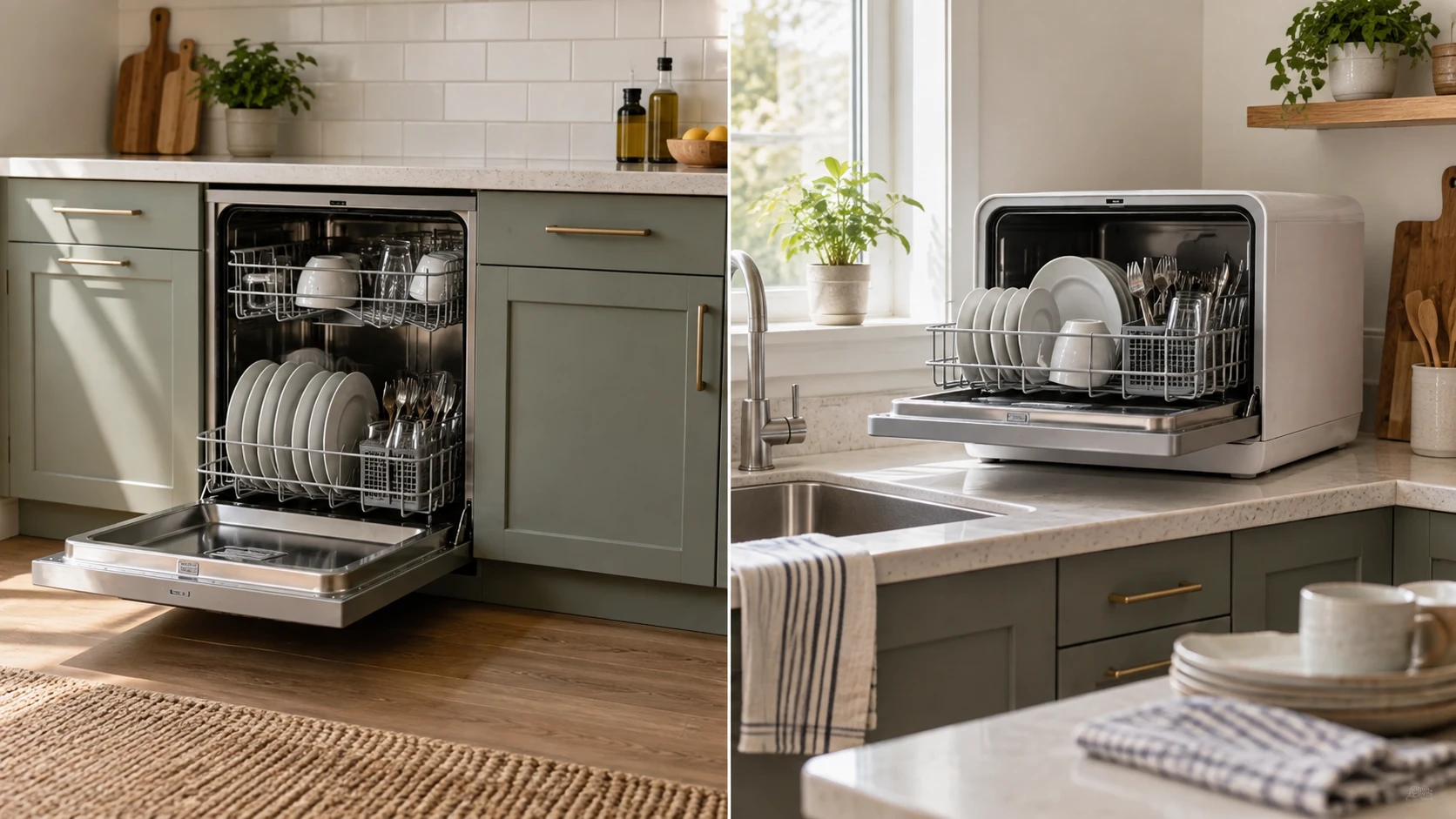
The Midea MDF18A1ABB built-in dishwasher and the ChicHomey countertop model suit different small-kitchen layouts. Midea's saved row describes an 18-inch unit designed to fit below a counter. ChicHomey's row describes a compact machine that sits on the counter and fills with water after installation. Before comparing the program lists, decide whether the kitchen can spare a base-cabinet opening or a permanent patch of worktop beside the sink.
The choice changes the project around the appliance. A built-in unit needs a measured cabinet opening, utility connections, and access for service. A countertop unit needs an operating spot with a safe water supply, drain route, and electrical outlet. Neither saved row is a complete installation manual. Put the current model drawings beside measurements from the actual kitchen before ordering either one.
The built-in opening — built-in and countertop dishwashers
Midea's row calls the MDF18A1ABB 18 inches wide and ADA compliant, designed for space beneath a counter under 34 inches tall. Those phrases do not supply a full cutout drawing. Measure width at the front and back of the opening, finished floor-to-counter height, depth behind the cabinet face, and the route for water, drain, and power. Check the current manufacturer's clearance and accessibility instructions for this exact model. A nominal 18-inch width cannot settle whether an existing cabinet bay is ready for installation.
The Midea listing says it has adjustable feet. Those can help level the machine within the range the maker permits, but they cannot make an undersized opening usable. Ask how the door swings in front of nearby drawers, whether the toe kick can be removed for service, and how the unit is secured. If cabinetry must be altered, include that work in the purchase estimate. A machine that costs less at checkout may require more labor before it is washing dishes.
ChicHomey's row gives external dimensions of 15.74 by 15.74 by 17.71 inches. The description does not label the axes, so request a dimensioned drawing before placing it beneath an overhead cabinet. Allow room for the open door and any clearance the manual requires around the unit. Its row says the machine fills with water automatically after installation, but it does not specify the inlet fitting, hose length, or required water pressure. “Countertop” describes placement; it does not explain the connection.
The published guide comparing built-in and countertop dishwashers covers a different pair of products. Its category comparison is useful for thinking through cabinet loss versus counter loss. Use the Midea and ChicHomey manuals for the final dimensions and utilities. If the countertop model needs a faucet adapter, find out whether it fits the actual faucet and whether the sink remains usable during a cycle. The saved ChicHomey row does not establish those details.
The drain deserves the same attention as the inlet. A built-in drain may require a suitable connection under the sink; a countertop drain hose may occupy the basin. Ask for the permissible hose height, routing, and securing method for the exact delivered unit. Keep both types of connection accessible enough to inspect for leaks. A countertop machine that is moved between loads also needs a place to empty or store its damp hoses without dripping into a cupboard.
Space for a normal load — ChicHomey0723 countertop dishwasher
Midea lists eight place settings, an adjustable-height rack, folding tines, and a utensil basket. These features are worth testing with the household's plates and cookware. The place-setting figure describes a standard arrangement, while a large frying pan can consume much of a narrow dishwasher's lower rack. Check the tallest glasses with the rack in its chosen position and make sure the spray paths remain clear. A built-in machine can be convenient because it stays ready for a day's dishes, provided its rack fits the awkward pieces you actually wash.
The ChicHomey0723 countertop dishwasher row claims its rack holds approximately six sets of dishes. It does not define the set or give interior basket measurements. Compare a real dinner plate, bowl, mug, and pan against a rack diagram before using six sets as a shopping guarantee. A smaller machine may work well for frequent light loads yet leave a stockpot for the sink. Count the dishes produced in a typical day and decide how many cycles would be acceptable.
Door and loading position affect capacity in practice. Midea's door opens at base-cabinet height, so check the standing room in front and the travel of any neighboring drawer. ChicHomey's door opens above the counter; make sure it does not take over the only space where dirty dishes can be stacked. A rack can have room for another cup while the kitchen has no convenient spot to scrape a plate. Try the planned movements on the measured layout before the appliance arrives.
Midea's black model has a stainless-steel tub, according to its row. ChicHomey's row describes painted PP and ABS construction. Materials alone do not establish cleaning quality or life span. Ask how filters and spray arms are reached and what cleaning the manuals require. The ChicHomey description mentions 12 spouts and a rotating 360-degree spray; Midea's row does not give a directly comparable spray count. A higher number in one listing does not substitute for a matched wash test.
Cycles and drying — ChicHomey0723 countertop dishwasher
Midea lists six wash programs and a one-hour cycle. Its row also describes a hygiene cycle that reaches a maximum water temperature of 136°F, with examples including heavily soiled dishes and children's dinner sets. Check the current manual for the program conditions and acceptable dish materials. A stated maximum temperature is not a sanitation certification for every load. The row also lists delay start up to 24 hours, useful if the water and electrical installation can safely remain ready for a later cycle.
ChicHomey's row names Quick Wash, Strong Wash, Fruit and Vegetable Wash, self-cleaning, and disinfecting modes. It gives a 35-to-55-minute range for cleaning cycles without pairing each time to a named mode. Ask for a program table. A fruit mode and self-cleaning operation serve different purposes from washing dinner dishes, and the word “disinfecting” needs the maker's instructions before it is used for hygiene-sensitive items. Do not assume every program fits every material in the basket.
Midea describes heated dry and a stainless-steel tub that retains heat. Those features may help with moisture, but the saved row does not give a drying score against ChicHomey. The countertop row does not provide a comparable drying specification. If plastic containers are a routine load, ask whether the current manuals recommend particular placement or a drying period. Inspect a normal load after installation. A Republeq's product description cannot predict every cup rim or recessed lid.
Midea is listed as ENERGY STAR certified and rated at 52 dB. ChicHomey's row lists 55 dB and a 1200-watt rating. These figures are useful for asking follow-up questions, but the saved rows do not provide matched test conditions or a common energy-use figure. A countertop machine near a seating area may be more noticeable than one enclosed by cabinetry even if their labels look close. Ask for current specifications and listen during an ordinary installed load before treating a small numerical gap as a promised acoustic result.
The 1200-watt ChicHomey figure also matters for the counter outlet. Check the model label, plug requirements, and other appliances on that circuit. Midea's built-in installation requires its own electrical plan from the current instructions. Avoid relying on a generic “small kitchen” label to decide whether a circuit is adequate. A qualified installer can check the connection before the appliance becomes part of a daily routine.
Cost and upkeep — ChicHomey0723 countertop dishwasher
The pinned catalog snapshot lists the Midea at $573.75 and ChicHomey at $204.94 as minimum prices in US dollars. Those are saved product prices, not complete installation bids. For Midea, ask about cabinet changes, plumbing, electrical work, delivery, and haul-away if replacing an old unit. If the kitchen is rented, confirm which permanent changes are allowed before estimating the built-in option. For ChicHomey, ask what hoses and adapters are included, how the drain is secured, and whether a different faucet fitting is needed. Confirm current Republeq's catalog pricing and return terms for the exact SKU.
Midea's row mentions a wash-cycle indicator light and fingerprint resistance only for a metallic finish; this listed model is black. Do not assume the finish claim applies to the black unit. ChicHomey's row mentions a magnetic induction door seal intended to help prevent leaks and a circulating soft-water system. Ask how the seal is cleaned and whether the soft-water system needs a consumable or setting. Neither row gives a full maintenance schedule, so keep the current manual accessible after installation.
If an 18-inch base-cabinet opening is available, Midea's eight-place-setting capacity could reduce the number of daily loads. ChicHomey may fit better where counter space is easier to spare, provided its inlet, drain, and rack suit the kitchen. Verify the drawings, connection details, and usable dish space before purchase. Then watch the first cycle, inspect both water connections, and test how the open door fits the room during an ordinary meal cleanup.