Crypto Commerce
Midea MDC22P1AWW countertop dishwasher vs MDC17P0ABB: measure dishes and water access
Compare Midea MDC22P1AWW countertop dishwasher by dish capacity, plate fit, manual tank or faucet connection, cycles, countertop clearance and source-listing…
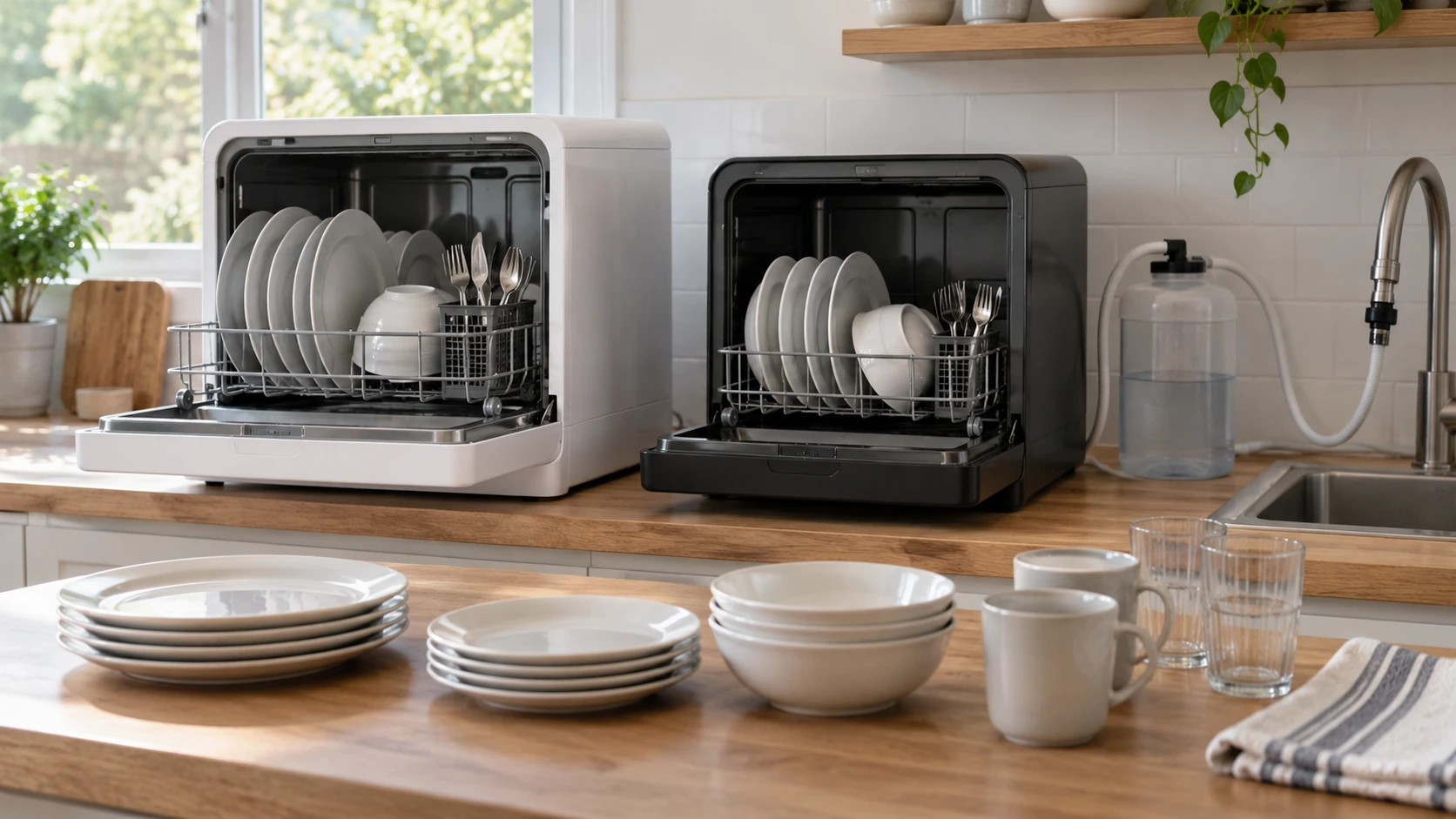
The Midea MDC22P1AWW countertop dishwasher is described as a six-place-setting model that fits tableware up to 10 inches across. The smaller MDC17P0ABB listing focuses on a five-liter tank that can be filled by hand or supplied from a faucet, with space for over 30 items and plates up to 9.5 inches. Both are portable countertop dishwashers. Begin with the plates you own, the counter space available and the way water will reach the machine.
These are catalog rows, not an installation manual or a matched wash test. MDC22's row gives external dimensions but does not identify its water-supply method. MDC17's row gives two water options but no external measurements. A useful decision requires both sets of missing details from the exact model documentation. The MDC17 row also conflicts on color: its description says black while its title says white with a see-through window. Confirm the finish in the cart before ordering.
Check the largest dishes first — Midea MDC17P0ABB mini dishwasher
MDC22 is listed for six place settings or up to 70 pieces of tableware, with items up to 10 inches across. That gives a household with dinner plates near 10 inches a promising starting point. The maximum width alone cannot guarantee a plate will fit in every rack position or that a deep bowl will leave clearance for the spray arm. Measure the diameter and height of the largest dishes used most often. Ask for the rack layout and manual's loading diagram if a pan lid or tall glass is a frequent problem.
MDC17's source says it washes over 30 items per load and takes plates up to 9.5 inches in diameter. If the home's everyday plates are larger, the stated limit may rule it out even if the unit fits neatly on the counter. “Over 30 items” is a broad count that can depend on small cutlery and cups; it is not directly comparable to six place settings or 70 pieces in the other row. Lay out a normal meal's dishes, then consider whether one load can hold them without stacking items so tightly that water cannot reach them.
The difference can show up in a small apartment with two people. A compact unit that handles breakfast plates and mugs may still need a separate hand-wash for a skillet or a wide dinner plate. A larger unit can take more items yet occupy the one counter where food is prepared. Decide which compromise appears every day, rather than choosing from a headline capacity number alone.
The counter needs room for the whole cycle — Midea MDC17P0ABB mini dishwasher
MDC22's stated outside dimensions are 17.2 inches high, 20.6 inches wide and 21.6 inches deep. Measure the counter from the wall to the front edge, then include room behind the dishwasher for hoses, a power cord and any clearance required by its manual. Check the height below cabinets while allowing the door to open and the top to be accessed. A machine can fit in a photograph of a kitchenette but block a cabinet or overhang the counter in the actual room.
MDC17 is described as a mini dishwasher suitable for apartments, RVs, dorms, boats and campers, but the saved row gives no width, depth or height. Request those dimensions before assuming “mini” will fit a particular shelf. Also ask how much the door extends when open and whether its five-liter tank is filled from the top or another side. The fill location matters if it will live beneath a low upper cabinet. If it must be moved for each use, ask for its weight and safe carrying instructions.
The published guide on countertop dishwasher water hookups compares different products. Its useful lesson is to trace water into and out of a countertop machine before buying. It does not document either Midea model's installation. Sketch the sink, faucet, drain, outlet and proposed dishwasher position. Include the path a person will walk while the door is open, especially in a narrow kitchen.
Water supply is the biggest documented difference — countertop dishwasher water hookups
The Midea MDC17P0ABB mini dishwasher has a built-in five-liter tank, according to its row. It can be filled manually, or connected to a kitchen faucet with the included hose and adapter. Manual filling may suit a counter where the faucet cannot stay occupied through a cycle, provided there is a safe way to move water to the tank. A faucet connection may reduce repeated fills, but it still depends on the tap's thread and the exact adapter. Verify those dimensions and the manual's permitted setup.
The MDC17 row does not explain where wastewater drains or how long the included hose is. A refillable tank does not remove the need for a secure drain path. Ask whether the outlet hose can reach the sink without crossing a walkway, how it is held in place and what happens if the sink is needed while a load runs. Keep electrical connections away from the water path. The saved text alone cannot establish that a particular dorm or RV installation is safe.
MDC22's saved row does not state whether it has a refillable tank, a faucet adapter, a permanent inlet or another water arrangement. Do not infer that it uses MDC17's dual-supply setup just because both carry the Midea name. Obtain the MDC22 installation sheet and ask which hose and connector are included. If a landlord or building prohibits changes to plumbing, confirm that the intended connection is allowed before selecting a dishwasher on capacity alone.
Compare cycles without trusting the count blindly — Midea MDC17P0ABB mini dishwasher
MDC22's source claims eight washing cycles. It names Heavy, Normal, Baby-Care, ECO, Glass and Speed, and separately mentions extra drying, Mini-party and Rinse. The row's wording does not map those labels cleanly to eight distinct buttons. Request a control-panel image and manual to learn which are full wash programs, which are options, and how long the cycles run. A household that primarily washes lightly soiled breakfast items may care more about a reliable short cycle than about the total number of named modes.
MDC17's source claims six wash programs but explicitly names Normal, Rapid, Steam, Fruit and Glass. It also describes a 162-degree-Fahrenheit high-temperature wash function and Air-Refresh for drying and odor prevention. The listing does not identify the sixth program or give a wash-temperature profile for each named setting. Confirm the exact programs before assuming that “Steam” reaches a particular sanitizing standard. A temperature claim in a product description is not a certification for baby bottles or medical equipment.
Both rows mention spray coverage. MDC22 describes 12 nozzles and a 360-degree spiral spray, with water heated as high as 68 degrees Celsius for heavily soiled dishes. MDC17 describes 360-degree Dual Spray. Those different phrases are not a measured comparison of food removal. Check whether your tallest items block a spray arm, and scrape or load dishes as the manual directs. If a family needs to clean bottles or delicate glassware, confirm the manufacturer-approved rack position and cycle for those items.
Drying and cleanup after a load — Midea MDC17P0ABB mini dishwasher
MDC22's row mentions an extra-drying function, but does not describe the method, cycle duration or how dry plastic containers become. MDC17 names Air-Refresh for drying and odor prevention. That wording does not guarantee a bone-dry interior or an odor-free machine after every load. Ask whether either cycle needs the door left open afterward and how the filter and drain area are cleaned. A countertop dishwasher can save dishwashing time while still requiring routine maintenance.
MDC22's listing says that water remaining inside at delivery can come from factory testing. That can explain some moisture in a new unit, but it does not settle condition if packaging is damaged or parts are missing. Inspect the exact delivery and document any leak or unusual residue before installation. For MDC17, the saved row does not provide a similar delivery note. Verify the condition and included accessories for both selected offers.
Water use, energy use, noise level and cycle times are absent or incomplete in these saved rows. Those may matter in a studio apartment where the dishwasher runs near a work desk or during evening hours. Request the current specification sheet for each exact model. If the appliance will be used in an RV or boat, confirm power and water demands against the available supply instead of relying on a general “portable” label.
Detergent and maintenance supplies belong on the same checklist. Ask which dishwasher detergent forms the manual permits, where the filter sits, and whether a rinse aid is recommended for the local water hardness. The saved rows do not describe those consumables. A small appliance placed beside a sink will be handled frequently, so confirm that the door gasket, filter and drain hose can be inspected without moving the unit every time. The easiest model to load may be less convenient if routine cleaning requires clearing the entire counter.
MDC22 is the model to investigate when larger plates and a six-place-setting layout are priorities, provided its dimensions and water connection fit the kitchen. MDC17 is the model to investigate when hand-filling a five-liter tank or using an included faucet adapter would solve an installation problem, provided 9.5-inch plates are large enough. Resolve the MDC17 color conflict, the cycle-count gaps and the drain arrangement before ordering either one. A paper sketch of the sink and a measurement of the largest plate will narrow the choice quickly.