Cooking & Food Prep
microwave turntable not turning: check seating and controls
Separate tray seating, ring position and visible interference from an applicable turntable control before describing a continuing motion problem to support.
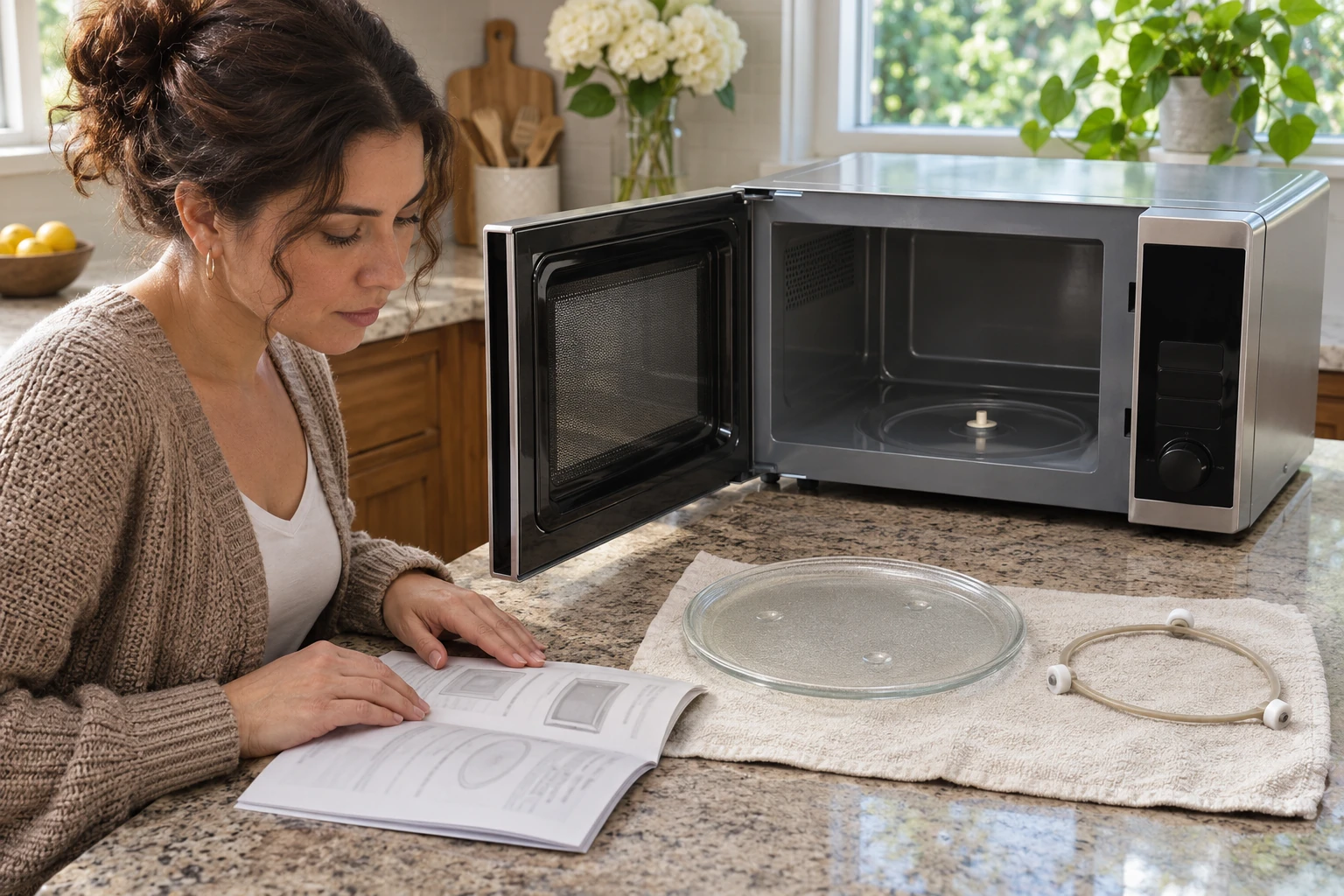
For a microwave turntable not turning, consult the actual tray arrangement and model instructions. GE Appliances separates seating, debris, the selected function and an optional control. A stationary plate identifies no failed component by itself. No rotation or heating test was performed here.
Describe what the tray did before choosing a branch
Consider an original fictional example. Nora notices that the plate in her microwave appears to move unevenly after the removable pieces have been washed. She asks Ishaan to help identify the next appropriate check. They begin with her observation and the appliance instructions, without deciding that the turntable motor has failed.
Nora describes whether the plate was motionless, shifted out of position or seemed to drag. If she remembers a sound, she reports that separately. Ishaan does not convert a vague recollection into a measured wobble or a named broken component. The fictional enquiry needs a clear starting observation, not an invented mechanical diagnosis.
They identify the microwave from the information actually available on its label or documents. A familiar brand name is a starting point, but their next question concerns the arrangement in that particular appliance. If the exact model remains unclear, they ask for help identifying it before borrowing a seating or control procedure from another model.
Nora keeps the applicable instructions open beside the task. She finds the section that identifies the removable plate and its support arrangement. If the document describes a different mechanism from the one she can identify, she leaves that mismatch unresolved. The picture that most closely resembles her kitchen does not automatically become the correct manual.
Check roller ring placement within the documented arrangement
For roller ring placement, GE distinguishes a plate attached to a shaft from one supported on a wheeled ring. Check centered seating and the correct side up under the applicable instructions; its guidance says an upside-down plate can drag.
In Nora’s fictional case, the removable pieces were set beside one another during washing. She first identifies which piece the model instructions call the plate and which they call the support. Counting two objects on the counter does not show that either has been returned to its proper position. Each has its own place in the documented arrangement.
Suppose Nora can identify the required ring but cannot tell which way the plate belongs. She stops that branch with the exact orientation question. Ishaan does not suggest pushing harder until the parts sit together. This guide provides no acceptable force, fitting modification or substitute part with which to overcome uncertainty about the intended placement.
In a different continuation, Nora discovers that she has followed an illustration for another appliance. She retains the useful model reference and obtains the applicable instruction. Starting from the correct arrangement changes the enquiry. It does not establish that the earlier arrangement damaged anything or that a new plate must be ordered.
If a required piece cannot be found, Nora describes the missing item using the actual manual reference. She does not pick a similar-looking ring from a shopping image and assume interchangeability. A parts question can remain open while the present appliance stays out of the proposed use. No improvised operating arrangement is supplied here.
Distinguish residue from a damaged or missing component
LG’s turntable guidance distinguishes absent rotation, wavering and an additional rattling noise. It identifies foreign material around the glass tray, rotating ring or shaft as a possibility and describes cleaning and replacing the parts properly. That possibility is not a diagnosis of a failed motor. Obtain the actual model’s care instructions before selecting a cleaning method.
Nora next looks for the specific condition the applicable guidance asks her to check. If she sees residue, she can describe where it is without declaring every other part sound. If she sees nothing she can identify, she retains that result. The absence of an obvious item does not require her to invent a hidden obstruction.
Before any cleaning, Nora checks the care information for the actual removable pieces and cavity. Ishaan keeps an unfamiliar cleaner out of the proposed task until its suitability is established. The example specifies no universal solvent, abrasive, soaking period or dishwasher permission for microwave components. A method for another material does not answer the present care question.
If Nora is uncertain whether a mark is residue or damage, she describes the uncertainty to the appropriate support route. She does not reshape a ring or scrape a component to find out. This fictional branch ends with an identification question. It reports no physical inspection result by the author and no part certified fit for continued use.
Keep the container-interference question specific
Samsung’s Philippines support page describes several physical branches: residue on the roller track, an incorrectly positioned ring or centre connection, and a container that is too large and touches the cavity walls. Its cleaning account includes drying the pieces before reassembly. It expressly says not to operate without the roller ring and turntable and refers persistent problems to service. These are Samsung’s scoped instructions, not a Galanz operating manual.
In another original fictional example, Miles reports that his plate appears to drag only with the container used for one particular task. He gives that detail to Ren rather than declaring that the microwave never rotates. They check which container arrangement the actual appliance instructions permit before proposing any later use. No cooking experiment is prescribed here.
Ren asks Miles to identify the container involved, including the lid or handles that were actually present. They keep physical interference separate from the material’s microwave permission. A vessel can raise more than one question, and a positive answer about its material does not identify its available movement within a particular cavity.
Suppose Miles cannot tell whether the container contacted a wall. He leaves that observation uncertain and asks what model-specific information would resolve it. Ren does not assign an acceptable clearance from a photograph or recommend a smaller vessel as a guaranteed repair. The fictional enquiry stays with the actual permitted arrangement and the specific unanswered question.
If the difficulty remains after the documented household checks, Miles includes that continuing result in his support request. He does not replace it with the outcome he expected. The next person helping can distinguish the original drag report from any later action without being told that a motor, support or plate has already been proved defective.
Use a turntable switch only where the feature is documented
A turntable switch is conditional in GE’s account: check it only if the feature exists. The same guidance distinguishes cook from timer selection and recommends service when its suggestions do not resolve the motion issue. Another appliance’s panel establishes no feature on yours.
Nora returns to the operating section for her own model. If it has no documented turntable control, Ishaan does not continue searching for a universal toggle. If it has one, they read its actual conditions. A general support description can identify a question without supplying the exact panel sequence needed for a different appliance.
If somebody deliberately selected a documented option, Nora retains that context. She asks what arrangement the intended task requires rather than calling the selection accidental without evidence. The fictional discussion concerns the applicable instruction and the actual choice. It makes no promise that changing an option will resolve a physical seating or interference problem.
Give service the unresolved motion question
Nora and Miles can each finish with a different next action. Nora may need an orientation answer for the actual support arrangement. Miles may need help with a continuing drag report. Neither needs to give the same broad instruction to replace the microwave. A focused question names the appliance, the observed motion and the applicable checks actually completed.
If support asks for information they do not have, they say so. They can obtain a document or identify an actual component without reconstructing an event that nobody witnessed. Keep the earlier account available when the enquiry changes hands. This article supplies no internal motor access, cabinet removal, electrical measurement or procedure to defeat a door interlock.
A later observation of normal-looking motion would describe that limited event. It would not establish a food-temperature result, complete mechanical certification or successful repair by the author. Equally, an unresolved observation is not permission to operate with required parts missing. Keep any subsequent use with the actual appliance’s operating and support instructions.
Read the two Galanz references as separate offers
The Galanz white microwave reference lists 925120185M and expressly includes a turntable dish. Its two frames show an intact white-and-black microwave with Galanz markings, including a kitchen scene. Multicolor remains the catalog option; the description identifies the oven as white. The full stock identifier is not printed in view.
The Galanz blue retro microwave reference lists GLCMKA07BER-07, which is also printed on the pictured retail box. Eight frames show the appliance, integral controls, an open cavity with glass plate and staged kitchen scenes. Food, utensils and surrounding décor are illustration content. The photographs establish no performed rotation test or successful seating correction.
Those retail accounts do not identify Nora’s or Miles’s existing appliance. Neither supplies a universal replacement ring or confirms a turntable-off feature for the household being investigated. Use the exact offer information if a separate equipment purchase becomes appropriate. This guide compares no prices, measured performance or cooking outcomes for the two references.
Keep adjacent microwave decisions with their own evidence
The microwave demo-mode guide concerns an apparent heating failure and a documented demonstration setting. The container-and-lid guide concerns component identity and scoped microwave permissions. Those questions do not establish the physical seating, ring position or interference condition of the tray discussed here.
Finish the household enquiry with the particular branch still open. That may be a missing support, uncertain orientation, care question, applicable control or persistent motion concern. A clear description lets the next action address that branch. It avoids treating every stationary or wavering plate as the same fault or borrowing a result from another appliance.
Keep a later replacement order with its own terms
If an eventual equipment or component order through republeq.com meets the household’s confirmed requirements, retain the exact selection before deciding how to pay. A preference for crypto, including USDT, does not identify a replacement ring or establish that the current checkout offers a particular payment method. Read the transaction information actually supplied for the order you intend to authorize. This paragraph supplies no destination address, token network, exchange rate, fee or transfer procedure. Keep the turntable enquiry with the appliance and the specific part it concerns; a payment choice cannot establish compatibility, proper seating or successful rotation. Ask the responsible seller about an unclear model reference, selected option or supplied item before committing funds. Review the delivery, cancellation and return information applicable to the exact offer. Terms from another basket do not establish those conditions for this purchase. If another person orders on your behalf, give them the confirmed reference and the unresolved questions that could change the choice. Ask them to return a proposed substitute for consideration rather than silently accepting a different component. Recheck the current basket and transaction instructions after any selection change. Retain the actual order reference and payment response after an authorized purchase. If the outcome of a payment attempt is uncertain, reconcile that attempt before considering another payment; an interrupted page does not prove that nothing happened. Compare any delivered product and documentation with the selection authorized. A payment receipt establishes no correct installation, permitted operating arrangement or repaired microwave. Those require their own applicable instructions and actual observations. Leave the order unmade while information necessary to the equipment decision remains unavailable.
Conceptual tray-seating enquiry; no powered cooking, internal repair or successful rotation test is shown.