Crypto Commerce
MEE audio Cinema Matrix headphones Cinema Matrix vs Nothing Headphone 1 for TV dialogue and travel
Compare MEE audio Cinema Matrix headphones by speech modes, Bluetooth compatibility, wired use, battery claims, fit, and included accessories.
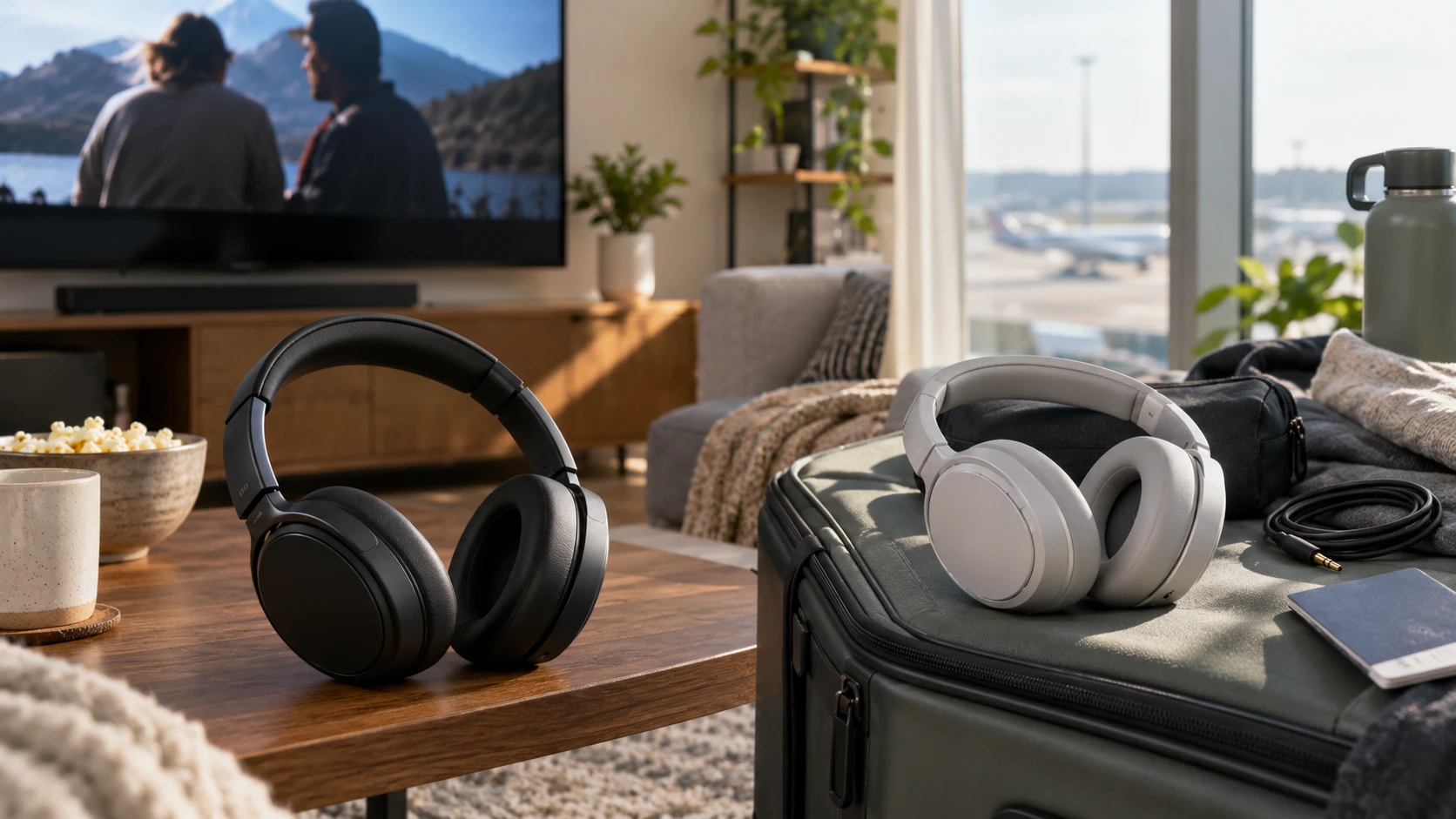
The MEE audio Cinema Matrix headphones are listed as over-ear wireless headphones with TV-oriented speech modes and aptX Low Latency support. The published headphone fit and listening guide compares other models, but its fit-first approach helps frame this choice. The Nothing Headphone 1 wireless headphones are sold in a bundle with hybrid active noise cancellation, transparency settings, wired connections, and a longer advertised battery maximum. The two listings address different moments: hearing a film's dialogue at home and listening through a noisy trip. Decide where the headphones will spend most of their hours before comparing a codec name or battery number.
Begin with the source of the sound — Nothing Headphone 1 wireless headphones
MEE's saved description emphasizes movies, television, and music. It names aptX and aptX Low Latency codecs and says the low-latency path can improve lip-syncing with compatible devices. That compatibility condition is central. A television, transmitter, or computer must support a matching mode for the claim to apply. Check the specifications of the exact source you already own and test a scene where speech and lips are easy to compare. A codec label on the headphone does not prove that every television will transmit in that codec.
The MEE package includes a stereo audio cable as well as a charging cable. A wired connection may be a practical fallback when wireless sync or pairing is troublesome, subject to the output available on the television. Check whether the headphone's controls and sound modes work the same way while wired, because the saved row does not spell out that behavior. A TV across the room may require a cable longer than the one included. Plan the chair-to-screen distance rather than assuming any analog cable makes a comfortable setup.
Nothing lists Bluetooth, dual-device connection, USB-C wired use, and a 3.5mm connection. The bundle's listing also names LDAC and high-resolution playback claims. Those features may suit a phone-and-laptop routine, but the source device and files must support the chosen path. A television that lacks the needed Bluetooth audio mode can still present lip-sync issues. Test the Nothing headset on the actual TV if television viewing is a primary use. Its saved description does not make a specific low-latency codec claim like the MEE row.
Decide whether speech modes help — Nothing Headphone 1 wireless headphones
MEE's CinemaEAR processing provides several selectable modes in the listing: Normal or Balanced, Dynamic Music, Bass Boost, and two Clear Voice settings. A dialogue-focused mode may help when effects and music drown out speech at a comfortable volume. It can also change the balance of voices and soundtrack in a way a listener may or may not like. Try the same difficult scene in the normal and Clear Voice modes, then check whether speech becomes easier to follow without turning the volume higher than necessary. The source's promised clarity is a claim in Republeq's catalog, not an independent hearing test.
Nothing's saved description emphasizes personalized ANC levels, an Adaptive setting, and Smart Transparency for hearing surroundings. It also names spatial audio with head tracking and bass enhancement. Those are different controls from a dedicated Clear Voice mode. They may help a traveler manage external noise or prefer a particular sound, but the catalog does not show how they affect quiet dialogue in a film. Adjust them on the source device that will be used daily. A setting that sounds impressive on a demo track can obscure words in a show with a different mix.
Neither listing includes a measured frequency-response chart, controlled speech-intelligibility score, or a matched listening test. Driver diameter is stated for MEE at 40mm, while Nothing names its audio collaboration and certification. Those facts do not settle which voice will sound clearer to a particular listener. If dialogue is the main problem, bring a known scene or sample file and listen at the level normally used at home. Fit and seal can change bass and apparent speech balance even before any processing is turned on.
Separate room noise from program audio — Nothing Headphone 1 wireless headphones
Nothing's listing describes adaptive hybrid ANC with High, Mid, Low, and Adaptive choices, plus a transparency mode intended to make ambient sound audible when needed. That could matter on a bus, plane, or busy office. Republeq's product description does not provide a controlled noise-reduction curve in the pinned row. Try steady mechanical noise and ordinary conversation separately; a headset may treat them differently. Also check how quickly transparency can be reached from the hardware controls when an announcement or colleague needs attention.
The MEE row does not name an active-noise-cancellation system. Its over-ear cushions can still provide some passive isolation, but the listing supplies no attenuation measurement. Do not assume the absence of an ANC claim makes it unsuitable for every journey; test the actual environment and comfort. Conversely, a person mainly watching TV in a quiet room may gain little from paying for strong cancellation. For safety, keep enough environmental awareness when walking or crossing streets, regardless of the mode selected.
Nothing names controls including a roller, paddle, and customizable button. Try changing volume and cancellation without looking at a phone, then see whether adjusting the headband triggers a control accidentally. MEE's source says its CinemaEAR modes can be toggled with a button and that the headset includes a microphone and controls. Ask how calls are answered and how source switching works on the current model. A listener who moves between work calls and TV should test those transitions rather than assuming a feature list defines the whole workflow.
Compare battery claims in the mode used — Nothing Headphone 1 wireless headphones
MEE advertises up to 30 hours of battery life. Nothing advertises up to 80 hours with ANC off and 35 hours with ANC on, plus a claim in Republeq's catalog of up to five hours from a five-minute charge. Those estimates were not produced under a shared test in the saved descriptions. Nothing's 80-hour figure is particularly easy to misuse if ANC will remain on for most of a trip. Volume, codec, calls, temperature, and the age of the battery can change endurance. Test a normal session and keep a charging plan for travel.
A home TV listener may have an outlet near the chair and a predictable place to charge. Someone using headphones through a long flight or several work shifts may value the longer claimed ANC-on figure and a quick top-up. Check what charger and cable are required for the short-charge claim, and whether the current bundle includes the right adapter. The Nothing row names a charging cable with adapter, while MEE names a charging cable. The descriptions do not report battery replacement cost or long-term capacity after years of use.
For a wired fallback, verify what happens when either battery is flat. A connector in the listing does not establish whether microphone, processing, or active functions keep working without power. Ask the current maker documentation or test a returnable unit. That matters if a trip is long enough that a charger might be unavailable. It also matters if a television viewing session starts with a forgotten overnight charge.
Check fit and the package in hand — headphone fit and listening guide
Both are listed as over-ear headphones. MEE names ultra-soft memory-foam earpads and a protective carrying case. Nothing names memory-foam PU cushions on an aluminum-reinforced frame and includes a case in this bundle. The Nothing package also lists a cleaner, desk holder, charging cable and adapter, and fiber cloth. These accessories may be useful at a desk, but a bundle list cannot tell you how the cups press against your jaw, how warm they become, or whether the case fits a travel bag. Wear each for a normal-length film or commute before making comfort claims.
The MEE listing says a one-year manufacturer's warranty is included. Nothing's pinned bundle description does not give a comparable warranty term. Confirm the Republeq's catalog and exact warranty for the unit on offer, especially where an accessory bundle has its own listing. Check whether replacement earpads and a battery service route are available. A comfortable first week is only part of ownership; pads can wear, and a headset used daily will eventually need care.
If the headset is shared, test adjustments for more than one head size and whether pairing a second person's device is straightforward. A protective case matters more when the headphones travel; a desk holder may matter more when they stay beside a computer. The saved rows do not specify a matched packed dimension or weight for both models. Measure the actual case against the shelf, drawer, or bag it must fit.
Compare the full cost with the primary job — Nothing Headphone 1 wireless headphones
The September 30 catalog snapshot marked both products available and listed MEE at a minimum of $276 and the Nothing bundle at $373.75. These are historical saved offers, not current stock or checkout totals. The roughly $98 gap may be justified by ANC, source switching, the longer Republeq's catalog battery claim, or bundle accessories if those solve a real need. It does not prove better sound or better fit. Confirm the current variant, included cables, Republeq's catalog, tax, shipping, returns, and warranty before comparing price.
Run two short trials if possible. For MEE, pair it to the TV or transmitter, play a dialogue-heavy scene, switch CinemaEAR modes, and check lip sync. For Nothing, test the same scene, then use it in the noisy environment where ANC would matter. Make a call and switch between the two devices you expect to use. Keep the playback level similar and leave time for fit to reveal pressure points. The pinned descriptions give enough detail to choose tests; they do not supply the results.
MEE is a candidate when television dialogue, compatible low-latency playback, and a straightforward home setup are the main needs. Nothing deserves inspection when travel noise, dual-device use, and its wired options will be used regularly. Make the choice with the exact sources and listening places in mind, then verify the accessories and support tied to the live offer.