Problem-Solving Articles
Measuring wheel reset record: recover the notes before the total
Two possible histories fit an unlabelled reading. A fictional route example shows how a new complete record yields a total without rewriting the old page.
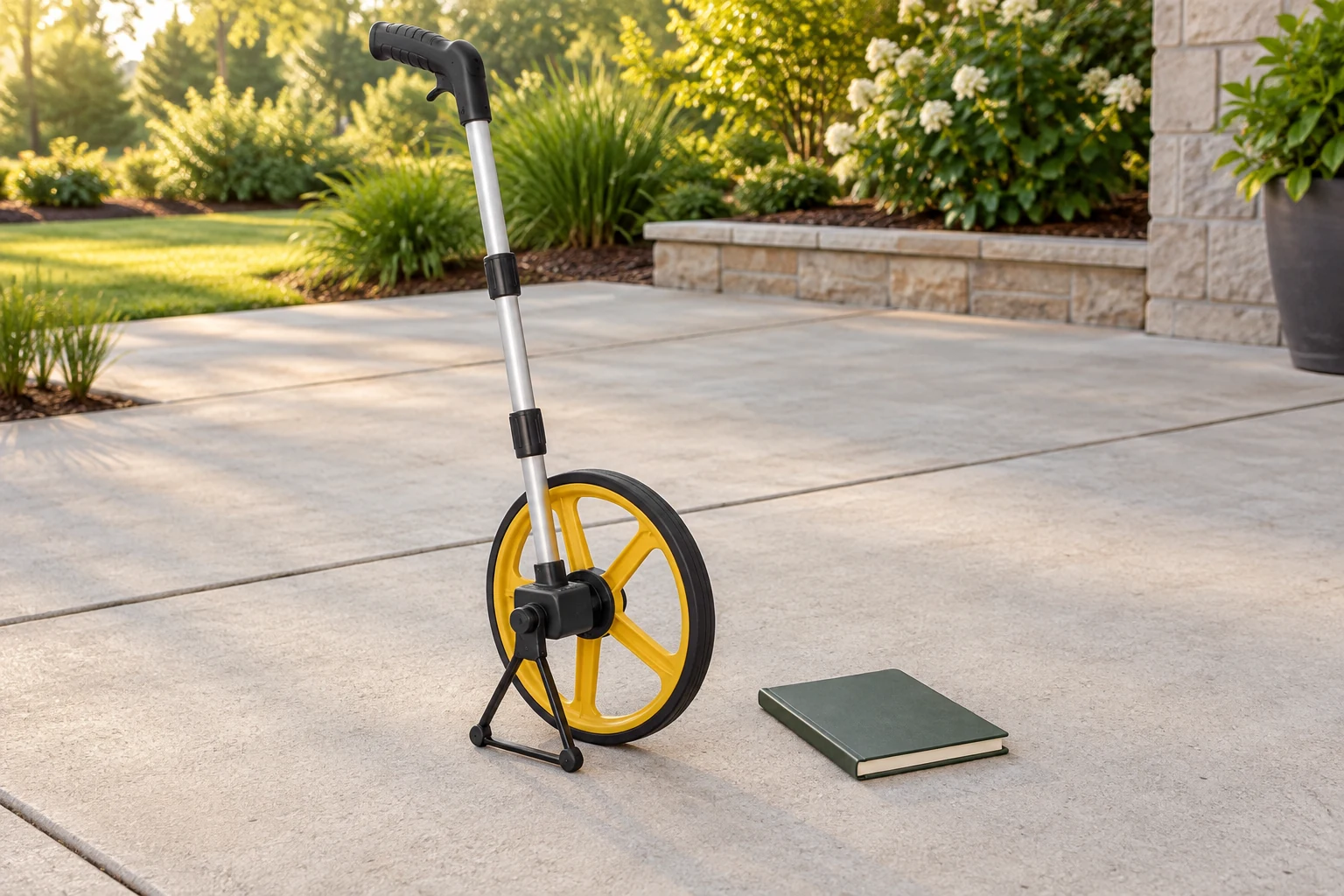
A measuring wheel reset record needs to say which reading belongs to which part of a route. When a notebook contains two labelled lengths and a third number without endpoints, adding all three can produce a tidy answer that the notes do not support. Preserve the incomplete entry, separate the known subtotal, and make the missing relationship visible before accepting a complete route total.
Consider an entirely fictional notebook for a walk from A through B and C to D. It contains “A to B: 42 feet” and “B to C: 31 feet.” Below those entries someone has written “reset” and then “18 feet.” No arrow connects that last figure to a pair of route markers. These invented notes provide the inputs for the examples below; they describe no actual site or instrument test.
The arithmetic problem is easy to spot: 42 plus 31 plus 18 equals 91. The evidence problem comes first. We do not know that 18 feet describes C to D. A correct addition cannot supply the absent endpoint information. Calling 91 the route total would accept an interpretation of the notebook that has not yet been established.
Preserve the distance measurement notes before changing the total
Preserve the distance measurement notes in a working copy without improving their wording. Keep the two complete entries, the word “reset,” and the unlabelled 18 feet in their original order. Beside the last entry, write “segment unknown.” This annotation describes the gap in the evidence. It does not turn the figure into a discarded reading or suggest that a particular control was used incorrectly.
The known subtotal is 73 feet, from 42 plus 31. Name its scope: A to B to C along the two stated route segments. Put the subtotal beside those entries, away from any proposed A-to-D total. Someone reading only “73 feet” should not have to guess whether it describes the completed walk, one part of the walk or a number copied from a product description.
Do not fill the C-to-D space with zero. Zero would state a length, whereas the notebook leaves this length unidentified. In this exercise the final route section exists by definition, but its length is absent from the complete entries. Leaving the space marked unknown preserves that distinction. The known 73-foot subtotal remains useful without pretending that the route is finished.
The earlier guide to placing saved lengths in a room measurement sketch also attaches numbers to named endpoints. For this route example, keep A, B, C and D as names in the notebook rather than drawing a scaled site plan. Nothing supplied here establishes corner angles, straight lines between distant markers or the shape of an actual place.
Distinguish the original entry from your annotation when sharing the notes. A copy that says “C to D: 18 feet, uncertain” has already supplied an endpoint pair that the original lacked. A faithful copy says “18 feet; endpoints not recorded.” That wording lets the next reader see exactly which information is missing before discussing possible histories.
Two route histories fit the missing segment reading
For the missing segment reading, consider a first hypothetical history: the recorder begins a fresh count at C and writes down 18 feet on reaching D. Under that additional assumption, the entry belongs to C to D. The complete route would then have the three lengths 42, 31 and 18 feet, and their sum would be 91 feet. Label this a possible history, not a recovered fact.
In a second hypothetical history, the recorder begins a fresh count at an intermediate marker E somewhere after C, then writes 18 feet at D. Here the figure describes E to D. The C-to-E part has been left out of the notebook. The complete route would contain 42 feet, 31 feet, an unknown C-to-E length and the final 18 feet.
To make the second possibility concrete, imagine that C to E had been three feet. That invented history would give 42 plus 31 plus 3 plus 18, or 94 feet. The three feet is a hypothetical addition for testing the interpretation; it is not evidence extracted from the old notebook. Writing it beside C to E as an observed value would conceal the very gap being investigated.
Both hypothetical histories can leave the same short entry, “reset; 18 feet.” One produces a proposed total of 91 feet. The other, with the expressly invented three-foot section, produces 94 feet. Their disagreement shows why the surviving entry does not determine a unique route total. It does not establish that either proposed history happened.
Two histories are enough to show why the old page alone cannot prove 91 feet. Keep the investigation focused on the absent segment identity instead of selecting whichever hypothetical result seems more convenient.
A remembered total of 94 feet would not, by itself, settle the history either. Different combinations can have the same sum. A total can help identify a disagreement worth examining, but it cannot recreate the endpoints attached to an individual number. Keep any later recollection separate from the original written observations, with a description of what the recollection actually supplies.
Recalculate the complete route from labelled entries
Now introduce a separate, complete set of fictional inputs. On a new page, retain A to B as 42 feet and B to C as 31 feet, then supply a newly labelled C-to-D value of 21 feet. Treat these as the stated inputs for a second calculation. This article supplies that value for the exercise; it does not tell you how to operate or check either selected wheel.
The new complete sum is 42 plus 31 plus 21, which equals 94 feet. Write “A to B to C to D: 94 feet, using the new labelled C-to-D entry.” That sentence identifies the route and the set of inputs behind the answer. A reader can reproduce the calculation from the page without borrowing the unexplained 18 from the earlier record.
Check the calculation by grouping the two established sections first. The A-to-C subtotal remains 73 feet; adding the supplied 21-foot final section gives 94 feet. The difference between this complete total and the earlier possible 91-foot total is three feet. That difference describes the two calculations. It does not locate an actual three-foot omission on a physical route.
The new 21-foot entry covers C to D in full by the terms of this fictional dataset. Do not add the old 18 feet to it. Doing so would give 112 feet from 42 plus 31 plus 21 plus 18, while leaving the extra 18 without a defined place on the route. Arithmetic will accept that addition even though the route record supplies no fourth segment for it.
Likewise, do not replace 21 with the invented three feet from the second hypothetical history. That three feet described a possible C-to-E section, while 21 describes the newly supplied whole C-to-D section. They have different scopes. The second page is complete because its three labelled entries cover the route once in order, not because its numbers match an attractive earlier possibility.
The 94 feet is a sum along A, B, C and D in sequence. It is not a stated straight-line distance from A to D, a perimeter or an area. The exercise provides no geometry from which to calculate those quantities. Keep “route length” next to the result so that a later copy does not turn the total into a different kind of measurement.
Keep the new total beside the unresolved record
Retain both pages. Mark the first as incomplete for the full route, with a known 73-foot A-to-C subtotal and an unassigned 18-foot entry. Mark the second as the complete fictional calculation using 42, 31 and 21 feet. The new page answers the route question for its stated inputs. The old page retains the reason its total remained unresolved.
The equality between the new 94-foot sum and one hypothetical history does not prove that history. We deliberately chose an illustrative three-foot C-to-E section that makes its total 94 feet. The new page says nothing about whether the old recorder stopped at E, changed routes, wrote an intermediate figure or intended the 18 to describe something else. Those possibilities remain outside the supplied evidence.
For the same reason, avoid marking the old 18 “wrong by three feet.” Its relationship to C and D was never established. A difference from the new C-to-D value is meaningful only after two figures have been shown to describe the same interval on a comparable basis. This exercise has not supplied that missing relationship for the old entry.
A concise handover can therefore state both results: the old page proves only the labelled 73-foot subtotal within the fictional inputs, and the complete new page sums to 94 feet. Include the three labelled new entries beneath that statement. The unresolved 18 remains attached to the old page, where another reader can inspect its original wording instead of finding it silently removed.
Keep product units separate from distance measurement notes
The Rolatape Single Measuring Wheel RT312 listing identifies a physical measuring wheel with a kickstand and an aluminium telescopic handle. Its short description states an SAE measurement system. The displayed product photograph shows a spoked wheel, handle and counter housing; it does not document any route, reading or reset event in the fictional notebook.
The Keson RR410 measuring-wheel listing specifically describes measurement in feet and tenths. Keep that unit wording with the exact listing. Its photograph shows an orange wheeled instrument and handle, rather than a readable record of the example's measurements. The short catalogue description is not used here to transfer a control sequence or a retained-reading feature to the product.
Bosch's official RT312 page describes a counter with a reset switch and states feet and inches as the units. That establishes limited product context for the word “reset”; it does not identify what happened in our fictional old record. This article gives no button sequence, counter-retention promise or procedure for obtaining a reading from the RT312 or the Keson.
The guide to tape measure numbers, units and accuracy distinguishes different meanings attached to figures. Our supplied lengths all use whole feet, explicitly written beside each value. No conversion from feet and inches to decimal feet is needed for 42 plus 31 plus 21. A product's unit specification should remain separate from an invented route observation.
For this completed exercise, retain the new page showing A to B as 42 feet, B to C as 31 feet and C to D as 21 feet, followed by the 94-foot route total. Keep the incomplete old page with it. The pair records both the complete calculation and the precise information that the earlier notes never established.