Learning & Creative
Matrix chain operation cost: choose the cheaper grouping
Compare two parenthesizations of three conformable real matrices under a declared dense multiplication count, with an exact savings calculation and clear limits.
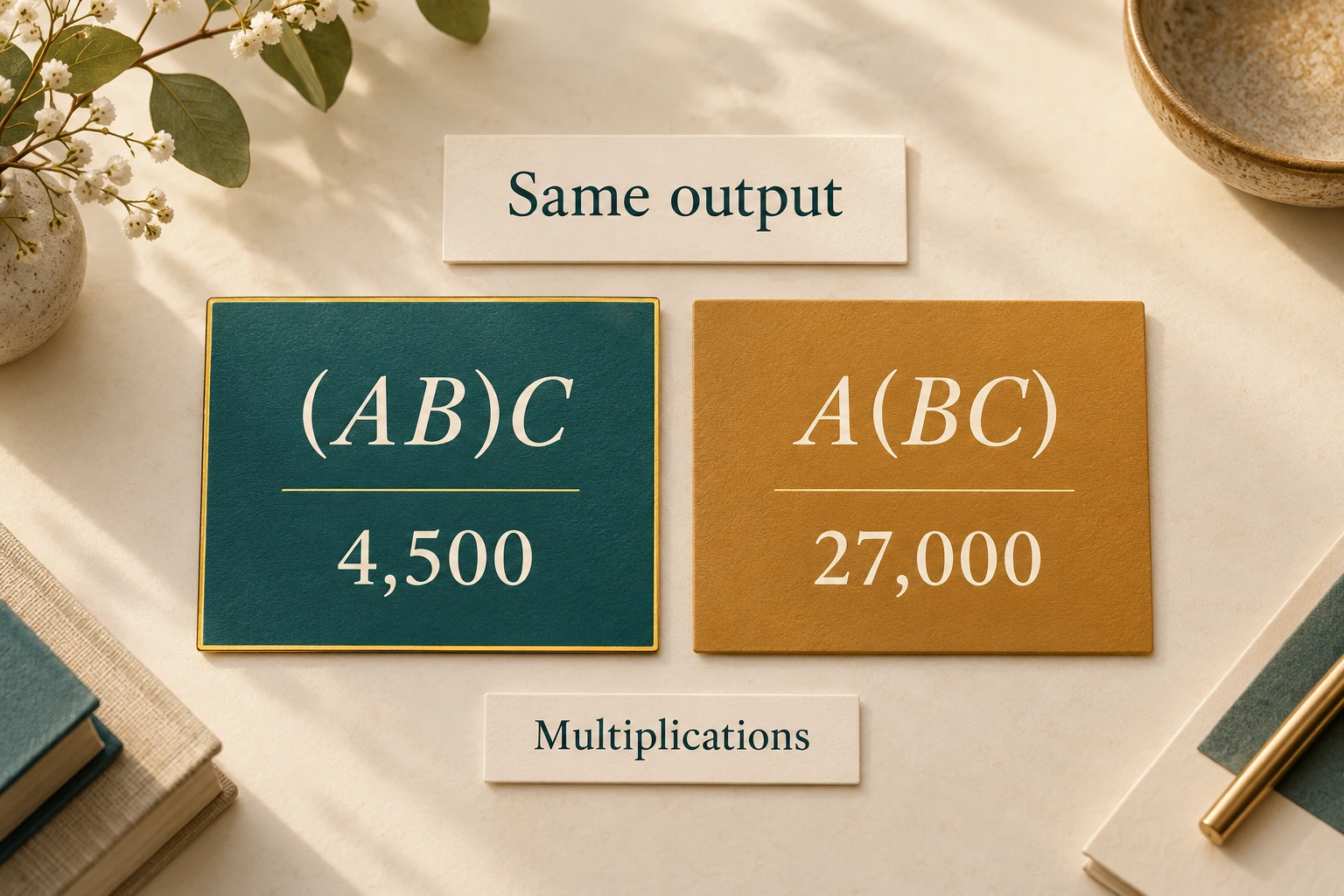
Matrix chain operation cost can change when parentheses move, even while the matrix order and final mathematical output stay fixed. This original worksheet compares two legal ways to multiply three conformable real arrays. Count one unit for each scalar multiplication in a specified full row-column routine. For the chosen dimensions, computing the first two arrays together costs 4,500 units in total, while computing the last two together costs 27,000. The difference is 22,500 declared multiplication units, without a claim about money or measured execution time.
The blue desktop paper-punch account is separate catalog context. Its sparse file-organizer title and school-supplies category are retained, while its description identifies a paper punch. The sole photograph shows a complete blue-and-white device. Conflicting hole-count wording remains unresolved, and no hole count, sheet capacity, spacing, material, performance or maker authenticity is adopted. This item supplies none of the matrix dimensions below.
Fix the three shapes and the permitted routine
Let A have ten rows and thirty columns. Let B have thirty rows and five columns. Let C have five rows and sixty columns. All entries are real numbers. The dimensions are stipulated worksheet inputs, rather than measurements of printed grids or product capacities. Keep the order A, then B, then C. The only decision under consideration is whether to form AB first or BC first. Swapping A and B, moving C to the front, or changing an operand's dimensions would create another problem.
Define the multiplication routine explicitly. To multiply an m-by-n array by an n-by-p array, calculate each output entry from one complete left row and one complete right column. There are m times p output positions, and each uses n scalar multiplications before its products are added. The declared count is therefore m times n times p. Every required product is counted, including a product whose supplied entry is zero or one. No shortcut based on special entry values belongs to this routine.
The count excludes additions, memory use, data movement, setup work and every actual device characteristic. Calling it a cost means only that each counted multiplication contributes one unit to this mathematical objective. The comparison is not an estimate of elapsed time, energy, a software invoice or a product's efficiency. Those quantities would need separate evidence and rules. Keeping the count definition visible prevents a smaller arithmetic total from becoming an unsupported claim about a real system.
Form AB first and retain its shape
A is ten by thirty and B is thirty by five, so their shared inner size is thirty. AB has ten rows and five columns. The routine computes ten times five, or fifty, output entries. Each requires thirty scalar multiplications. The first stage therefore costs fifty times thirty, or 1,500 units. Record the intermediate shape ten by five alongside that count. The number fifty describes output positions; it is not the complete multiplication count.
Now multiply the ten-by-five intermediate AB by C, which is five by sixty. The inner fives match. The resulting array has ten rows and sixty columns, giving six hundred output entries. Each entry uses five products in this stage. The second-stage count is six hundred times five, or 3,000. Both the stage's input shape and its count differ from the first stage, so carrying forward only the first multiplication total would leave the comparison unfinished.
Add the stage counts to obtain the total for the grouping (AB)C: 1,500 plus 3,000 equals 4,500. The parentheses identify the first completed product. They do not mean that the intermediate is another supplied operand or that the first stage's work can be omitted. Save a two-line record containing AB, ten by five, 1,500; then (AB)C, ten by sixty, 3,000. The total belongs to those two stages together.
Form BC first under the same count rule
For A(BC), begin with B, thirty by five, and C, five by sixty. The inner fives match, producing a thirty-by-sixty intermediate. There are eighteen hundred output positions, each using five scalar multiplications. This first stage costs 9,000 units. The order within the product is still B followed by C. Moving the parentheses has changed the intermediate shape from the ten-by-five AB above to this thirty-by-sixty BC.
Next multiply A, ten by thirty, by that thirty-by-sixty intermediate. The inner thirties match and the output is ten by sixty. Six hundred output positions now each require thirty multiplications, so this stage costs 18,000 units. The final shape is the same as before, but reaching it through this intermediate requires a different number of counted products. Identical output dimensions do not force identical amounts of intermediate arithmetic under the stated routine.
The total for A(BC) is 9,000 plus 18,000, or 27,000. Subtract the other grouping's total: 27,000 minus 4,500 equals 22,500. Thus (AB)C uses 22,500 fewer declared multiplication units for these dimensions. This is a comparison between two complete counts calculated with the same rule. It does not subtract an unrelated setup charge, count only the last stage, or treat an intermediate's number of entries as if that alone were the work required to produce it.
Explain why the mathematical output agrees
Matching final shapes is necessary but does not by itself prove matching entry values. Check a fixed output position, with row index i and column index l. In (AB)C, the entry is formed by summing over a C row index j. Each AB entry already contains a sum over an A column index k. Expanding gives terms of the form A at i,k times B at k,j times C at j,l, with j running through five positions and k through thirty.
In A(BC), expand the selected BC entries instead. The same products appear, now organized with k in the outer sum and j in the inner sum. Each k,j pair occurs once in both expansions. Distributivity and rearranging a finite sum of real numbers make the values equal. This is a change in grouping and organization of the same terms, not a permission to commute the matrices or change their order. The conclusion concerns exact real arithmetic under the declared product definition.
A computer implementation with rounding would need its own analysis before claiming bit-for-bit equality. Likewise, a method that exploits special values or uses another multiplication algorithm would need a different operation count. Neither issue is part of this exact worksheet. The output-agreement argument establishes why the two legal parenthesizations answer the same mathematical product question while the separate stage counts establish why their declared costs differ.
The matrix shape compatibility guide checks a two-array product and explains why reversing its operands can make the requested pairing undefined. Both groupings here pass their shape checks. The new decision compares their complete operation counts while retaining the original operand order.
State exactly which minimum was established
With three operands in the fixed order A, B, C and a binary multiplication at each stage, there are two possible first products of adjacent operands: AB or BC. Completing either first product leaves one final multiplication. These give exactly the two parenthesizations already counted. Since 4,500 is strictly smaller than 27,000, (AB)C is the unique cheaper grouping among those two choices for the stated routine and dimensions. That conclusion has a precisely bounded comparison set.
It is not a minimum over every conceivable way of evaluating the entries. An all-ones input, for example, has a simple mathematical pattern, but the declared routine still counts every required row-column product. Replacing it with a method that derives entries from that pattern would change the permitted routine. Similarly, a claim about an optimal grouping for a longer chain would require additional possibilities to be enumerated or justified. The two-choice proof does not silently establish such a broader result.
Change the dimensions before making a general rule
For general positive dimensions a, b, c and d, take shapes a by b, b by c and c by d. The left grouping's count is abc plus acd, because its intermediate is a by c. The right grouping's count is bcd plus abd, because its intermediate is b by d. Both final outputs are a by d. These expressions show which dimensions affect each stage and why the original comparison cannot be reduced to a rule that the left grouping is always better.
Consider the separate dimension list thirty, ten, sixty, five. The left grouping now costs thirty times ten times sixty, or 18,000, followed by thirty times sixty times five, or 9,000. Its total is 27,000. The right grouping costs ten times sixty times five, or 3,000, followed by thirty times ten times five, or 1,500. Its total is 4,500. For these different inputs, the right grouping is cheaper. Keep this example distinct from the original ten, thirty, five, sixty record.
If all four dimension sizes are two, each stage costs eight multiplications and both groupings total sixteen. That is a tie, so the cost rule does not identify a unique better grouping there. These boundary comparisons retain the same count definition while changing only the supplied dimensions. They demonstrate why a cost decision needs the actual shape list and the complete two-stage sums, rather than a preferred placement of parentheses chosen in advance.
Use exact controls without changing the claim
A finite control checked every four-dimension combination with each size one through three, giving eighty-one shape cases. For each case, explicitly supplied rational entries were multiplied with nested row-column loops. Actual scalar products were counted, the two final arrays agreed exactly, and the counted totals matched the two formulas above. A separate all-ones calculation with the original larger dimensions produced a ten-by-sixty array whose entries were all 150, with stage counts 1,500, 3,000, 9,000 and 18,000.
Those tests inspect the defined routine over their stated inputs. They do not measure a runtime or establish a universal algorithm ranking. The row-column counting argument explains the stage formulas, and the finite-sum expansion explains the equality for real entries beyond the finite control set. Preserve the exact inputs and the count convention beside any test output. Otherwise a shortcut introduced during a later calculation could make a result incomparable with the totals in this worksheet.
The EZ Squeeze hole-punch account has a sparse title and description. Its sole original image shows a complete black-and-silver lever punch with a visible BOSTITCH handle label. That label does not authenticate a maker or model. Sheet capacity, punch count, material, force and performance remain unverified, and no paper or other supplied stock is inferred.
The fixed interval cover cost guide minimizes covers for listed points using an exchange and a separated-point lower bound. This worksheet instead enumerates two legal parenthesizations and counts their scalar products. A minimum certificate for interval coverage supplies no matrix-operation total.
A reader considering a real item order on republeq.com should examine the particular offer and checkout independently of this arithmetic exercise. The multiplication units are declared mathematical counts, not prices, payment amounts or merchant commitments. If USDT is being considered, first verify whether the current checkout actually offers that cryptocurrency method for the intended purchase. A mention here supplies no availability evidence. Before authorizing a transfer, clarify the requested asset, network, amount, receiving destination and order reference with the responsible service. Review the actual item identity, quantity, delivery details, total charge and applicable terms for that order. Any fee, conversion term or exchange rate requires its own current evidence; none is supplied by the matrix dimensions or counted products. Determine the applicable cancellation, return and refund process before relying on one, including how a refund would be handled for the chosen payment method. Keep the relevant instructions and transaction records, including dates and confirmed references. Retain any acknowledgement with the exact order details. Any changed basket requires checking the resulting terms again. If an order or payment status remains uncertain, reconcile that status with the responsible service before considering another transfer. A smaller arithmetic count cannot verify a receiving destination or establish that an order was accepted. This exercise gives no wallet address, transfer guarantee, recovery procedure or assessment of a counterparty. Completing the worksheet requires no purchase and no payment. Decide whether to proceed only after the relevant conditions for that particular transaction are clear, and keep its records separate from the invented shape list and operation totals.
Keep both stage counts with the chosen grouping
For the original ten, thirty, five, sixty dimensions, retain the two complete totals: (AB)C costs 4,500 and A(BC) costs 27,000. Both produce the same exact ten-by-sixty mathematical output, while the first saves 22,500 units under the fixed dense multiplication routine. The shapes, first-product choice, stage counts and output-identity argument together support that bounded decision. Preserve the exclusions on shortcuts and uncounted work whenever the result is reused.