Office Supplies & Stationery
Read manual stapler labels by power and activation
Separate a stapler power account from its activation wording. Read the actual product description before treating a manual mode label as an unpowered-tool claim.
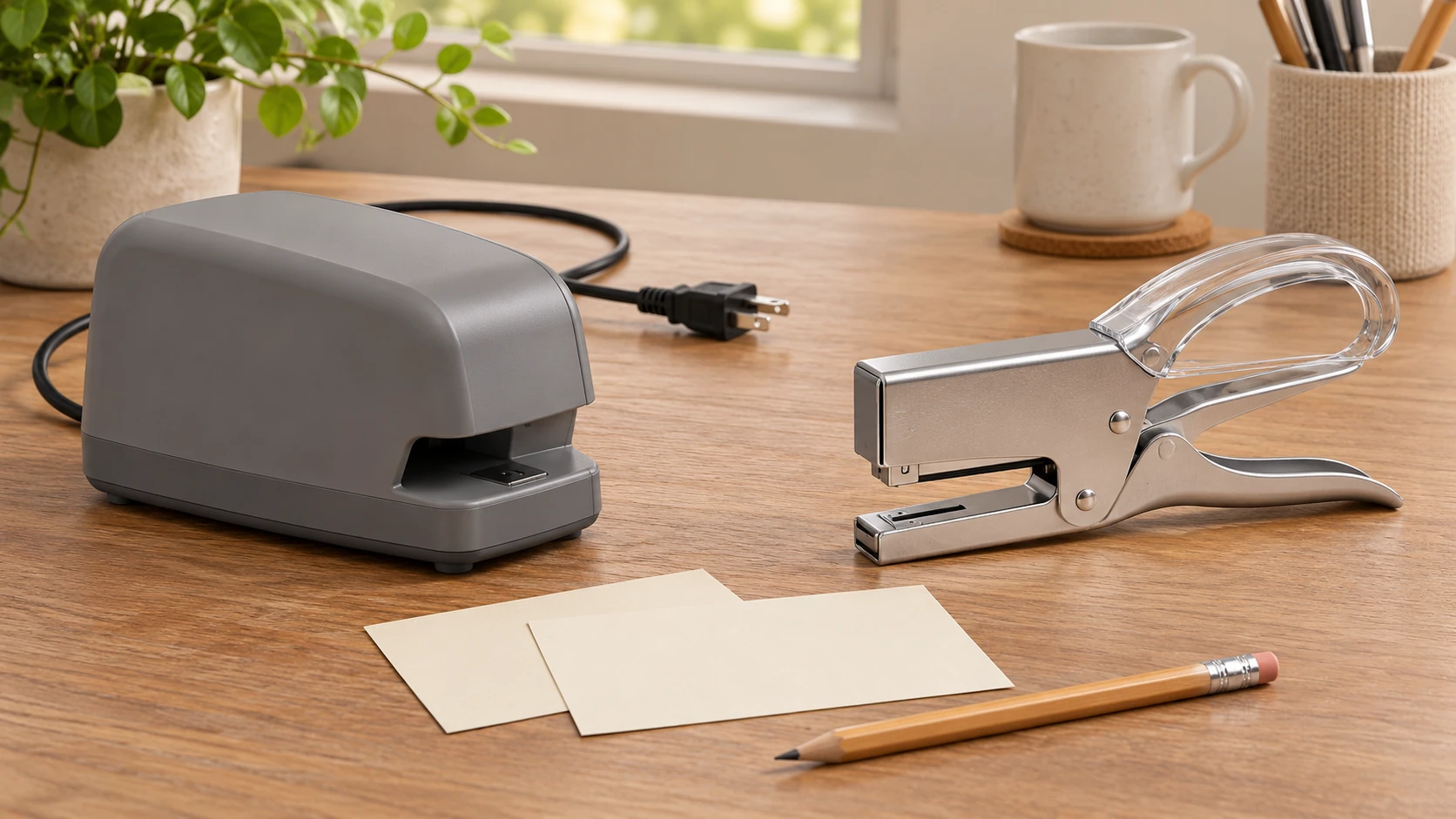
Reading manual stapler labels can leave a practical question unanswered: does the offer describe the power supply, a way to activate the tool, or a hand-tool form? Before choosing equipment for a desk or shared work area, identify which question the wording addresses. Use the actual power account for a power requirement, and keep an activation label with its own description.
A short product heading cannot answer every purchasing question. You may want to know whether an electrical supply is needed, whether the description offers different activation modes, or which fastener information belongs to the item. Ask those questions separately. Combining them into the single word manual can make a partially described product look more fully specified than it is.
Read the two offers as separate accounts
The electric auto/manual stapler offer describes battery or plug-in operation and automatic or manual stapling. Its catalog title says Unbranded, while the gallery shows Swingline and Optima 20 lettering beside an Auto/Manual control label. Those catalog and pictured labels remain distinct; they do not authenticate a manufacturer or factory model.
The Arrow manual plier stapler offer shows a complete metal plier-form tool with a curved hand loop. Its pictured wording says to use genuine ARROW P-35 staples. In that wording, P-35 identifies the named staple series. The photograph does not independently authenticate a factory device model or establish that a staple pack is supplied.
Keep the description attached to the question it can answer. A statement about power addresses one requirement. Wording beside an activation option addresses another. Fastener information has its own purpose. You can compare the accounts without turning a similar word, a product photograph or a category heading into a complete operating specification.
For a named manufacturer example, ACCO Canada's Optima 20 page describes a manual mode that activates a motor on command. The current US Optima 20 page renders SKU S7048208D, although its URL retains a C suffix. Those references do not authenticate the unbranded retail offer, establish an equivalent version or supply instructions for a unit you own.
Arrow's current P35 manufacturer page describes a handheld plier stapler and states that P35 staples are sold separately. Keep that statement with its named product. The retail photograph's staple-series wording is not an order inventory. Neither the shared Arrow lettering nor the pictured form establishes that the selected offer has every specification or supplied component in the manufacturer's account.
Find the stapler power source statement
When electricity is the purchasing concern, look for the stapler power source information itself. State what you need to learn before reading a mode name as an answer. For instance, you may be deciding whether the equipment description establishes an electrical requirement for the place where you plan to use it. Leave that requirement open when the relevant information is missing.
Read the power statement without borrowing an accessory list from another offer. A description of a possible power arrangement and a statement about what comes in an order answer different questions. Keep any actual included-stock wording with the selected offer. If you need an additional item, establish that need from applicable information instead of treating a familiar photograph as a complete contents list.
Carry the question through a comparison in the same terms. If one candidate has a clear power account and another leaves it unclear, record that difference in your understanding. The unclear account has not acquired the first candidate's characteristics. You can decide to seek clarification, choose a more fully described option or postpone the choice without inventing the missing answer.
Keep a power statement separate from a performance ranking. Knowing what the description says about power does not settle your whole purchase. Keep the task you need to perform and the remaining product requirements in view. This article makes no matched fastening test or recommendation about which offer would perform better on your documents.
Read manual stapling mode in its own context
A manual stapling mode phrase needs the description surrounding it. Identify whether the source presents it as a mode on the named equipment, and retain any explanation the source actually gives. A mode word should not erase the separate power account. Equally, it should not be expanded into an operating sequence that the description has not supplied.
For manual stapler labels, a useful reading question is simply, "What is manual modifying here?" It may be part of the offered title, a category name or wording next to a control. Keep those locations distinguishable while you read. A term used in one place does not automatically explain every other use of the same term across a shopping page.
Do not make a trial operation part of this reading task. Comparing descriptions can establish what the descriptions say while leaving actual operation to the applicable instructions. You need not press a control, squeeze a handle, connect a supply or load a fastener to decide that a word has been used without enough explanation for your purchase question.
If a description includes a performance claim beside the mode wording, retain the claim's own conditions. Avoid using it to fill a gap in the power or activation information. A sentence can contain several features without explaining the relationship between all of them. You can leave a relationship unanswered while still understanding the individual statements that are clear.
Keep fastener information beside its own requirement
A separate fastener question can remain after you understand the stapler power source account. Keep the actual tool reference with the fastener wording you are considering. Do not choose a refill from a shared use of manual, a resemblance between handles or a familiar-looking package. This guide does not select a compatible staple for either offer.
Also distinguish a fastener mentioned in a description from fasteners included in the order. For a purchase, you need the selected offer's actual contents information. If the source only names a compatible item, keep your contents question open. You can ask for the missing information without revising a compatibility statement into a claim that an extra pack is supplied.
These distinctions can stay brief. A comparison note might give the power question its own line, followed by the activation wording and the unresolved fastener question. Use the actual source wording where it matters. Leave out an empty field rather than supplying a plausible value from memory; the purpose is to identify what you know before making the choice.
If another person will make the purchase, explain the requirement in full before forwarding a shortlist. "We want something manual" can conceal the question the buyer needs answered. You can say that the work area needs an item whose account establishes no electrical supply requirement, or that you are still considering a described activation option. Keep that explanation with the product reference so the buyer does not have to guess which meaning you intended.
Retain the complete sentence that supplied the information you are using. A cropped mode name can lose the description that gave it a purpose. When a listing offers another option or a different reference page, read that account on its own terms before carrying over the first note. You do not need to combine several descriptions into one imagined product to prepare a useful shortlist. Mark which account you read and which purchasing question it actually answered.
A fictional choice for a shared work area
Consider a fictional example. Leah is helping choose equipment for a small shared work area. She has two possible locations in mind: a fixed desk and a supply drawer that colleagues carry to another table. Her first requirement for the drawer is equipment whose description clearly establishes hand operation without an electrical supply. She has not chosen a real model or tried either item.
One fictional candidate description calls its device electric and separately names a manual activation mode. Leah keeps both statements in the comparison. She does not rewrite the first statement because the second contains manual. Her drawer requirement still needs an answer from the power account. The mode phrase can remain useful information about the description without becoming the answer to that requirement.
The other fictional candidate is expressly described in the example as an unpowered hand tool. That is a stipulated fact of this invented comparison, not a conclusion about the retail Arrow offer. Leah can use it to distinguish the two fictional accounts. She still has separate questions about the task and fastener information before deciding whether that candidate suits the work area.
Leah's colleague then asks whether the word manual means they can use staples already in the drawer. Leah returns to the fastener question. Neither candidate's activation wording supplies that answer. She keeps the existing staple reference in a separate part of the note and leaves compatibility unconfirmed. No refill is selected, and no package is opened for a test.
For the fixed desk, Leah is willing to consider an electric account, provided the actual power and supplied-stock information meets the eventual requirement. That preference does not make the first fictional candidate a better-performing device. It tells her which product information she needs next. The manual stapling mode wording remains attached to its activation question throughout the comparison.
The example ends before a purchase or an operating trial. Leah has separated a power requirement from a mode word and retained an unanswered fastener question. She can compare a suitable description with the remaining needs of the work area. The story supplies no fastening result, actual compatibility finding or demonstration of a real product's controls.
Keep this reading task separate from troubleshooting
The office stapler paper-result and status-light guide covers recording an unexpected fastening result and finding the applicable indicator meaning. That is a different starting question from interpreting a product's manual wording before a choice. A clearer product description here supplies no status-light legend or fault diagnosis for equipment already in use.
The manual stapler jam-release and loading-slot guide distinguishes a named clearing feature from a loading opening on its selected offers. Keep that mechanism-purpose task with its own applicable instructions. Understanding a mode word does not identify a release location, authorise intervention or provide a loading sequence.
Return to your purchase question with the distinctions intact. Use the stated power account for the power requirement, keep the activation wording with its explanation and obtain the fastener information separately. If the selected description leaves one of those questions open, retain the gap in the comparison. You can make a narrower choice without giving the word manual more work than its source supports.
If choosing a replacement or an additional tool later brings you to republeq.com, consider a crypto payment only through an applicable method actually offered for that order. The mention of USDT here does not establish that a checkout supports it, that a particular network or wallet is accepted, or that any transfer has succeeded. Keep the exact selected offer and order details beside the payment information presented for that transaction. Before authorizing a transfer, verify the asset, network, recipient and requested amount through the applicable checkout rather than borrowing details from another purchase. If a payment instruction leaves something unclear, obtain clarification through the responsible merchant channel before proceeding. A token name alone is not a network instruction. Any conversion, wallet requirement or transfer fee needs its own current assessment; this article supplies no quote, saving, processing-time promise or supported-chain list. Read the order's actual cancellation, return and refund terms as part of the purchase decision, without assuming how a crypto payment would be handled. Preserve the merchant confirmation and any payment reference you receive, and reconcile an uncertain status before sending another payment. A pending wallet entry should not be treated as proof that the merchant accepted the order. None of these payment questions resolves the earlier distinction between a stapler power account and an activation label, and a completed payment would not establish fastener compatibility or an operating result. Decide whether to buy using the product information and transaction terms you can actually verify, keeping any unanswered equipment question visible instead of treating an available payment option as a reason to overlook it.
Conceptual inactive desktop and plier-form staplers beside separate note cards; no exact retail model or operating instruction is shown.