Crypto Commerce
Makita DRC200Z robot vacuum vs Whudwhu XM32 robots for large floors or low furniture
Compare Makita DRC200Z robot vacuum by floor coverage, body clearance, batteries, navigation, controls, and upkeep.
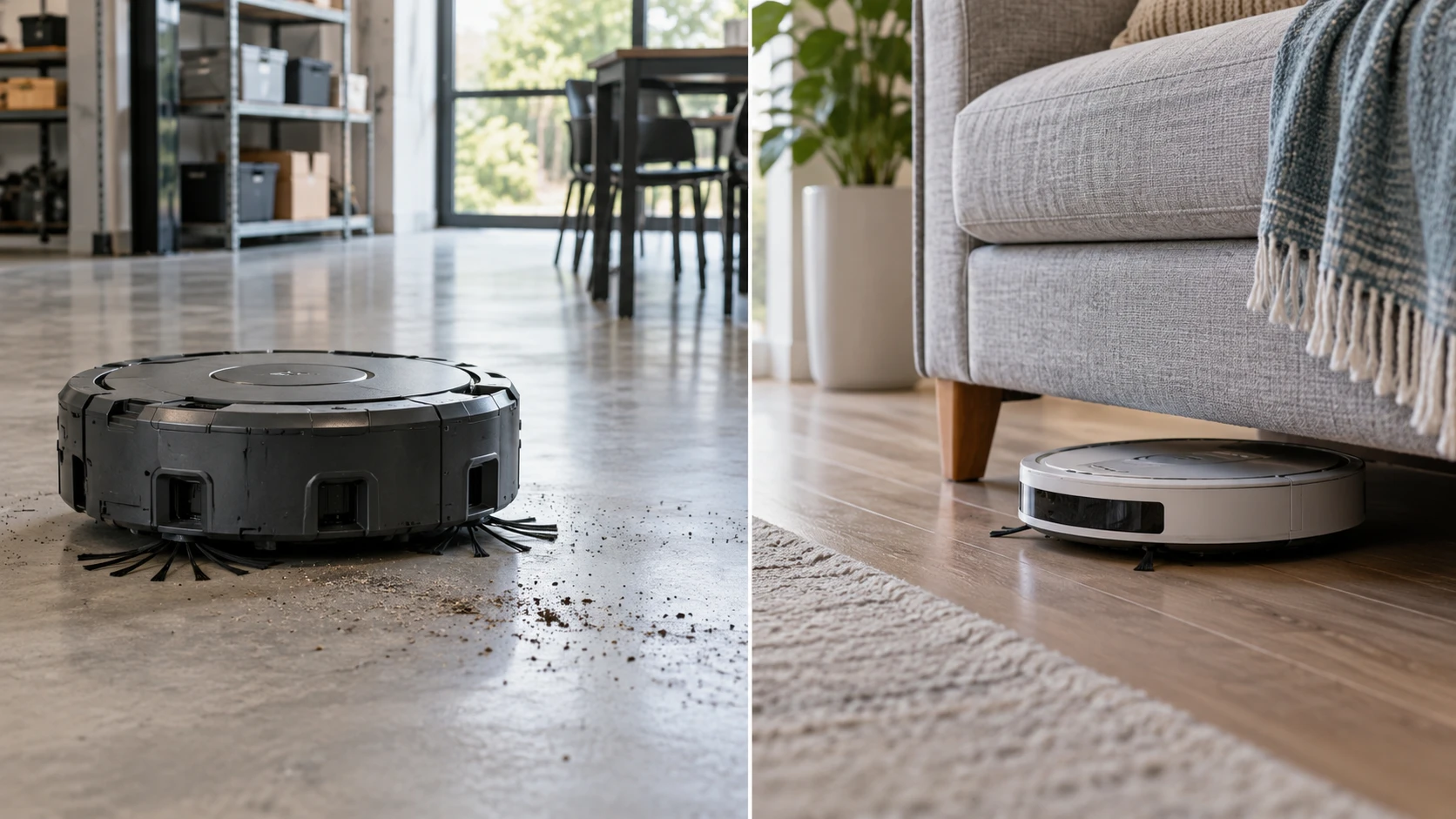
The Makita DRC200Z robot vacuum is described for commercial hard-floor cleaning, with a path over 18 inches wide, a large dust box, and a long quoted runtime. Whudwhu XM32 is a much smaller robot vacuum and mop with a 2.5-inch body, four cleaning modes, and a remote control. The difference starts with where each machine can fit. Makita has a broad cleaning path for open hard floors. Whudwhu has a lower body that may reach under furniture and comes with a mop accessory. Measure the tightest space on the route, then estimate the area the robot would actually clean.
A published guide on robot vacuum route planning explains what to ask about routes, boundaries, and room controls. The guide does not test either machine. Before relying on the catalog figures, walk the floor and note thresholds, cords, stairs, chair legs, and places where a wet mop would be unwelcome. Neither saved description names a persistent room map or app-drawn no-go zones. Makita describes boundary tape lines and sensors; Whudwhu describes a bow-shaped route and manual direction control. A run on your floor, or a demonstration with the exact model, would answer more than the route labels alone.
Match body size to the floor plan — Whudwhu XM32 robot vacuum mop
Makita's saved description gives dimensions of 18.125 by 18.125 by 7.125 inches and a weight of 17.2 pounds. At more than seven inches tall, it may miss spaces that a smaller robot can enter. Its broad path is better suited to open hard flooring. Its main brush and two side brushes are described as collecting debris along walls and corners. A doorway or aisle between furniture has to accommodate the full 18.125-inch body. A machine that moves easily down a wide corridor may still miss the strip beside a cabinet.
Whudwhu lists a 2.5-inch body intended to fit beneath sofas and beds. The source does not give its complete width or diameter. Measure under the sofa or bed at its lowest point, including carpet pile and any fabric that hangs down. Its extended side brush is described as reaching edges and corners, but the saved excerpt gives no measured edge-cleaning result. A robot can clear the furniture vertically yet lack room to turn. Ask for its full dimensions and try the tightest gap. The listings establish a large height difference between these models, but they cannot establish which parts of your home each one will reach.
The Makita source says the DRC200Z cleans about 5,380 square feet of hard flooring and runs up to 200 minutes on hard floors in its Main Brush plus Vacuum mode. Those figures describe the listed hard-floor conditions. Furniture, doors, and debris could change the result in another building. Whudwhu lists 60 to 90 minutes from a 7.4-volt, 1800-mAh lithium-ion battery. It does not give an area-coverage figure or specify which mode produces each endpoint of that range. Calculate the accessible floor after accounting for furniture and closed doors. A long runtime has limited value if the robot spends much of it working around obstructions.
Whudwhu is described for hard floors and low-pile carpets. Makita's saved performance figure is specifically for hard floors, and its excerpt does not describe carpet cleaning. If rugs cover much of the route, ask whether either exact model is approved for them and how its brushes behave at the rug edge. Whudwhu's mop should not be assumed to cross a rug safely while wet; find the current instructions. A mixed floor plan may call for separate dry and wet passes or a physical boundary. The short product descriptions do not settle floor compatibility in every room.
Understand the route and boundaries — robot vacuum route planning
Makita lists sensors that detect obstacles and cliffs, along with boundary tape lines. In an open workspace, tape may define an area to avoid without an app. Confirm how the tape is placed and whether it comes with the exact offer. Test cliff detection at the real stairs or loading edge before leaving a robot unattended. The saved source does not state that it builds a room map or that it can resume a paused route from a saved location. A remote sets operating functions, but its short description does not map every remote button to a behavior.
Whudwhu's source describes bow-shaped route planning and four modes: auto, edge, spot, and manual. The remote can be used from up to 33 feet away according to the listing, and there is a one-touch start. Manual direction control may help move the robot toward a missed patch without carrying it. The source does not say that the robot remembers rooms or excludes a virtual area. The bow-shaped pattern sounds suited to open floor, although chair legs and thresholds may interrupt it. Judge it in the normal room layout, with the obstacles it will meet on an ordinary day.
Before a run, lift loose cords and move fragile items. Leave the path to the charging or storage point clear, following the manual for the model. A sensor description is not a promise that every small object will be recognized. If the floor changes through the day, consider when a run will encounter the fewest obstacles. A commercial hall may be easiest to clean after closing; a living room may need toys moved first. The product descriptions do not give enough evidence to rank obstacle avoidance in a shared test. A representative run will reveal whether either machine can complete the route consistently.
Check power, accessories, and total setup — Whudwhu XM32 robot vacuum mop
Makita uses 18V X2 LXT lithium-ion battery power, and its saved listing says batteries are not included. Budget for the missing power components. Confirm the compatible battery models, charger, and number of batteries needed for the quoted runtime before comparing this offer with a ready-to-run robot. The description credits an electronically controlled brushless motor with up to 50 percent longer runtime per charge, but gives no comparison model or test basis in the short excerpt. Ask what the 50 percent comparison uses as its baseline. It cannot simply be added to the quoted 200 minutes.
Whudwhu's source gives the 7.4-volt battery capacity and a 60-to-90-minute range but does not give charging time or replacement-battery details. Its accessory list includes a micro-dust filter, two side brushes, a mop, a cleaning tool, and a remote. Check the exact box contents and whether replacements remain available. A remote may also require its own batteries, which the saved text does not address. Consult the current manual for charging and storage instructions. Weekly handling of batteries and accessories belongs in the comparison alongside runtime.
Makita describes a five-eighths-gallon dust box that is accessible for emptying. That capacity may reduce emptying frequency on a large floor, though the actual interval depends on how much debris the robot collects. Whudwhu calls its dustbin large without giving volume. With pet hair or workshop dust, the bin opening and filter position may matter more than the label "large." See how the bin empties without releasing dust back into the room. Makita's larger body may be easier to service in some ways, but it is also heavier to lift. Whudwhu's small body may be easier to move yet its filter and mop still need attention.
Whudwhu's mop accessory adds another step to the routine. The saved source lists a mop among the accessories but does not explain water capacity, pad wetting, or whether the robot can lift the pad at a rug. Confirm whether "vacuum and mop" means simultaneous operation or separate passes on this exact unit. Check what floor cleaners the manual permits and how the pad should be washed and dried. Makita's saved description describes vacuuming only, so do not assume it can mop because another robot in the category does. If mopping is useful only in one room, weigh that task against Makita's larger dry-cleaning area.
Consider noise and support — Whudwhu XM32 robot vacuum mop
Makita gives a working sound level of 64 dB(A). The saved source does not specify the measurement distance or mode, so the number does not predict exactly what a person at a desk will hear. Whudwhu provides no numeric sound figure in its short description. If the robot will run during calls or while people sleep, seek a model-specific sound test at the intended mode. A robot crossing tile joints or touching furniture can produce intermittent noise beyond the motor hum. Scheduling a run when the area is empty may matter more than a small difference in quoted sound level.
Makita's listing states a one-year manufacturer warranty. It labels the color Blue while the description calls it Teal, a minor but visible mismatch to confirm if appearance matters to the order. Whudwhu's short source does not give warranty terms. For both, check who supplies filters, brushes, and repairs in your area. If Makita is bought without batteries, determine whether warranty terms apply separately to the power components you choose. If Whudwhu's remote or mop is essential, verify that those parts can be replaced. Parts availability and service will matter long after the first week of cleaning.
The Whudwhu XM32 robot vacuum mop is the compact choice on its stated height and includes a mop accessory, with a shorter quoted runtime. Makita offers a wider dry-cleaning path and a larger stated hard-floor workload, but the batteries required to operate it are excluded from the saved offer. Measure clearance and accessible floor area, confirm the complete power and accessory package, then see how each robot handles a representative route. The result should make the tradeoff between open-floor coverage and access beneath furniture easier to judge.