Crypto Commerce
M optimized 4.3-cu-ft mini fridge mini fridge or DEMULLER chest freezer for limited space
Compare M optimized 4.3-cu-ft mini fridge by storage role, access, temperature control, and fit.
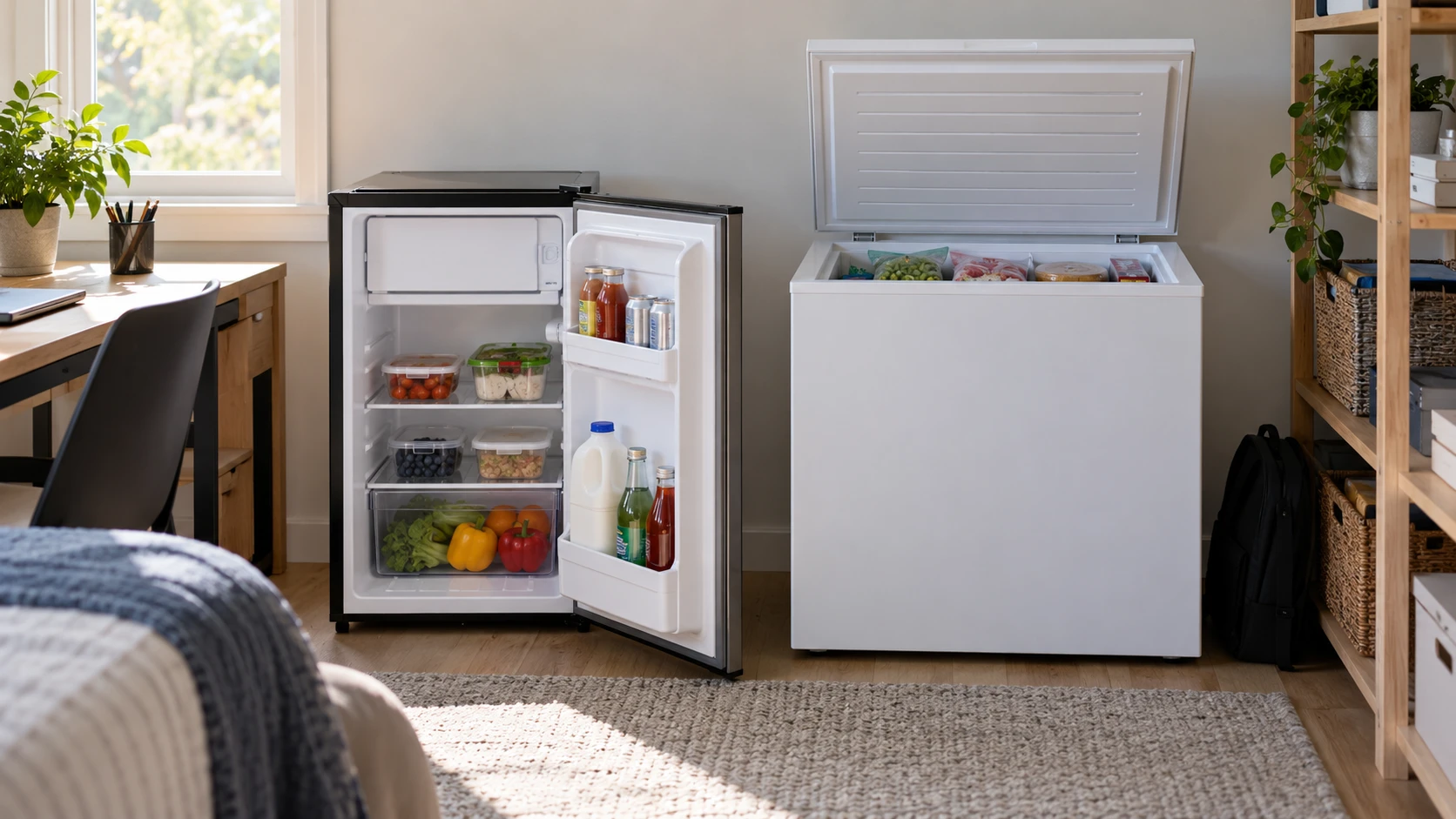
The M optimized 4.3-cu-ft mini fridge has a front-opening refrigerator section and a small listed freezer compartment. The published guide on compact fridge or freezer planning uses different models to examine the same basic decision. The DEMULLER 3.5-cu-ft chest freezer is described as a top-opening freezer. These products have similar-sounding small-appliance titles, but they serve different daily needs. Decide whether chilled food and drinks or extra frozen storage is the shortage in your room.
Start with a one-week inventory. If the current refrigerator is crowded with lunches, produce, or beverages, a fridge section may solve the problem. If frozen meals and bulk ingredients are the overflow, a chest freezer offers a different kind of space. The DEMULLER product URL and title use the phrase mini fridge with freezer, while the detailed listing repeatedly calls the item a chest freezer with a top-opening lid. Confirm the exact model and interior layout before treating it as a refrigerator. A labeling mismatch should be resolved with the Republeq's catalog, not guessed from a photograph.
Measure door and lid access — compact fridge or freezer planning
M optimized states outside dimensions of 20.63 inches wide, 20.94 inches deep, and 32.72 inches high. Its front door needs space to swing and room in front for a person to crouch or reach the lowest shelf. The saved Republeq catalog record does not provide hinge-side clearance or an open-door depth. Mark the proposed position on the floor and open a cardboard mock door through the likely arc. If the unit sits near a wall, cabinet handle, or desk leg, confirm that shelves and the crisper can still be removed for cleaning.
DEMULLER lists 17 inches deep, 21 inches wide, and 30 inches high. Its top-opening door is described as staying open between 40 and 75 degrees. Plan free space above the cabinet along with its footprint on the floor. A low shelf or counter overhang could make the lid unusable even if the freezer slides neatly underneath. Ask for the manufacturer's diagram showing maximum lid height and the clearance needed at the hinge. Also check how far the top-loading basket or contents can be lifted without striking a shelf.
Neither exterior measurement tells the whole installation story. Ask for ventilation clearances, outlet location, cord length, and the surface required to support the loaded appliance. A compact unit can still be a poor fit in a closed closet if it cannot release heat according to its manual. Measure the route through the doorway and around any tight turn, including the packaging if delivery space is limited. Confirm whether the units can be moved on their sides; the saved descriptions do not settle safe transport or the waiting period before plugging in after a move.
Compare the space you can actually use — DEMULLER 3.5-cu-ft chest freezer
M optimized breaks its 4.3-cubic-foot total into a 3.88-cubic-foot refrigerated section and a 0.42-cubic-foot freezer section. It lists three glass shelves and a crisper drawer. That small freezer area may handle a few items, but it will not serve the same role as a separate 3.5-cubic-foot chest freezer. Make a rough sketch of the items currently taking space in the main fridge. Tall bottles, meal containers, and a crisper full of produce use shelves differently from an all-can capacity figure.
The DEMULLER listing calls the cabinet a 3.5-cubic-foot mini chest freezer. It does not give basket count, interior dimensions, or a usable capacity after the walls and compressor enclosure are accounted for. A chest can hold a range of packages, yet reaching a small item at the bottom may require shifting the contents above it. Request an interior drawing or photograph with measurements. Plan a shallow category system for the foods you expect to freeze, leaving room for air circulation and the manufacturer's loading instructions.
Capacity labels do not establish how much will fit when items come in their real packaging. Place a frozen pizza box, a stack of meal containers, and the awkward tall item on a tape-measure sketch. Then consider how you will retrieve each one. A larger freezer on paper may save little time if the frequently used food is buried. A front-opening fridge can make daily items visible on shelves, while a top-opening freezer may be efficient for less frequent bulk storage if the inventory is kept organized.
Treat temperature controls as settings to verify — DEMULLER 3.5-cu-ft chest freezer
M optimized describes a seven-position adjustable thermostat and a listed refrigerator range from 32 to 46.4 degrees Fahrenheit. The Republeq's product-page text also gives a narrower suggested range for perishables. The fact that the control can be set across a broad range does not mean every position is appropriate for every food. Use an independent refrigerator thermometer and follow current food-safety guidance for the items you store. Test several locations after the appliance stabilizes, especially if the freezer compartment changes conditions on the nearby shelf.
DEMULLER describes a digital panel with a claimed range from minus 12 to 50 degrees Fahrenheit. That spans both freezing and above-freezing settings, a surprising range for an item sold as a chest freezer. Verify the manufacturer's current specification and what the display actually measures before loading frozen food. A set point is not proof that the center of a full package has reached or maintained that temperature. Use a freezer thermometer, allow stabilization, and follow established guidance for safe frozen storage. The row's claim of one-degree accuracy is a statement in Republeq's catalog, not a measured performance receipt.
Opening pattern matters. A frequently opened front fridge may warm its shelves during a busy meal. A chest freezer may be opened less often, but a long search for something at the bottom keeps its lid up. Keep an inventory or simple bin labels to shorten searches. After a large grocery load, check the thermometer over the next period specified by the manual rather than assuming the display set point describes all the new items immediately. Neither product row supplies a matched temperature-recovery test.
Examine energy, sound, and upkeep — DEMULLER 3.5-cu-ft chest freezer
M optimized claims energy use as low as 0.6 kWh per day and sound around 40 dB. Those are listing figures, with no test conditions in the saved excerpt. DEMULLER names an R600 compressor and an insulating construction but gives no matched daily energy or sound figure. Ask for current model-specific energy information if the appliance will run all year. The operating cost depends on the verified consumption and local electricity price, not merely on which appliance has fewer cubic feet.
Placement affects what a quiet figure means. A compressor cycling beside a desk may be more noticeable than the same unit in a kitchen. Confirm that the floor is level and the unit has the clearances its maker requires; pressing it tightly against a wall to save an inch can cause vibration or impede ventilation. DEMULLER's adjustable legs may help level its cabinet. M optimized's row does not describe an equivalent adjustment. Check the manual before adding pads or changing the appliance's stance.
Ask how both units defrost and where water goes. The M optimized row names a freezer compartment and removable shelves, but the saved excerpt does not settle defrost method or drain access. The DEMULLER row likewise omits a complete defrost procedure. In a small dorm room or office, the easiest time to handle ice buildup may be before the compartment is full. Keep a plan for temporary safe food storage during any required defrost, and follow the manufacturer's cleaning instructions. Do not scrape ice with a sharp tool simply because access is tight.
Consider who will maintain the appliance. A shared office fridge may need regular checks for forgotten food and spills, while a chest freezer needs a system for dating packages that would otherwise disappear at the bottom. Put a thermometer where it can be read without moving half the contents. Leave room to clean around the compressor area as the manufacturer directs. If the room is unattended for several days, make sure someone knows what to do after a power interruption. Neither listing promises that food remains safe through an outage. Check the recorded temperature, follow food-safety guidance, and avoid relying on a display that shows only the setting after power returns.
Make the purchase match the missing capacity — DEMULLER 3.5-cu-ft chest freezer
M optimized is the better kind of appliance to examine when daily refrigerated space is short and only a little frozen space is needed. Its shelf and crisper layout should be checked against the exact groceries, and its temperature setting should be verified with a thermometer. DEMULLER makes sense to investigate when frozen items are the shortage and there is overhead clearance for a chest lid. Resolve its mini-fridge wording and unusually broad temperature claim before ordering.
On arrival, check the exact model label, door or lid seal, included shelves or baskets, and current manual. Set up the unit in its intended place, let it stabilize, and measure interior temperatures before filling it. Those checks make the small appliance useful for the actual storage gap rather than leaving a nearly full main fridge and a new freezer that solved the wrong problem.