Writing & Documents
Read litotes in a sentence about a welcome
Nell is glad when Jude returns her forgotten notebook. The author compares an understated narrator sentence with direct welcome wording in the same invented visit.
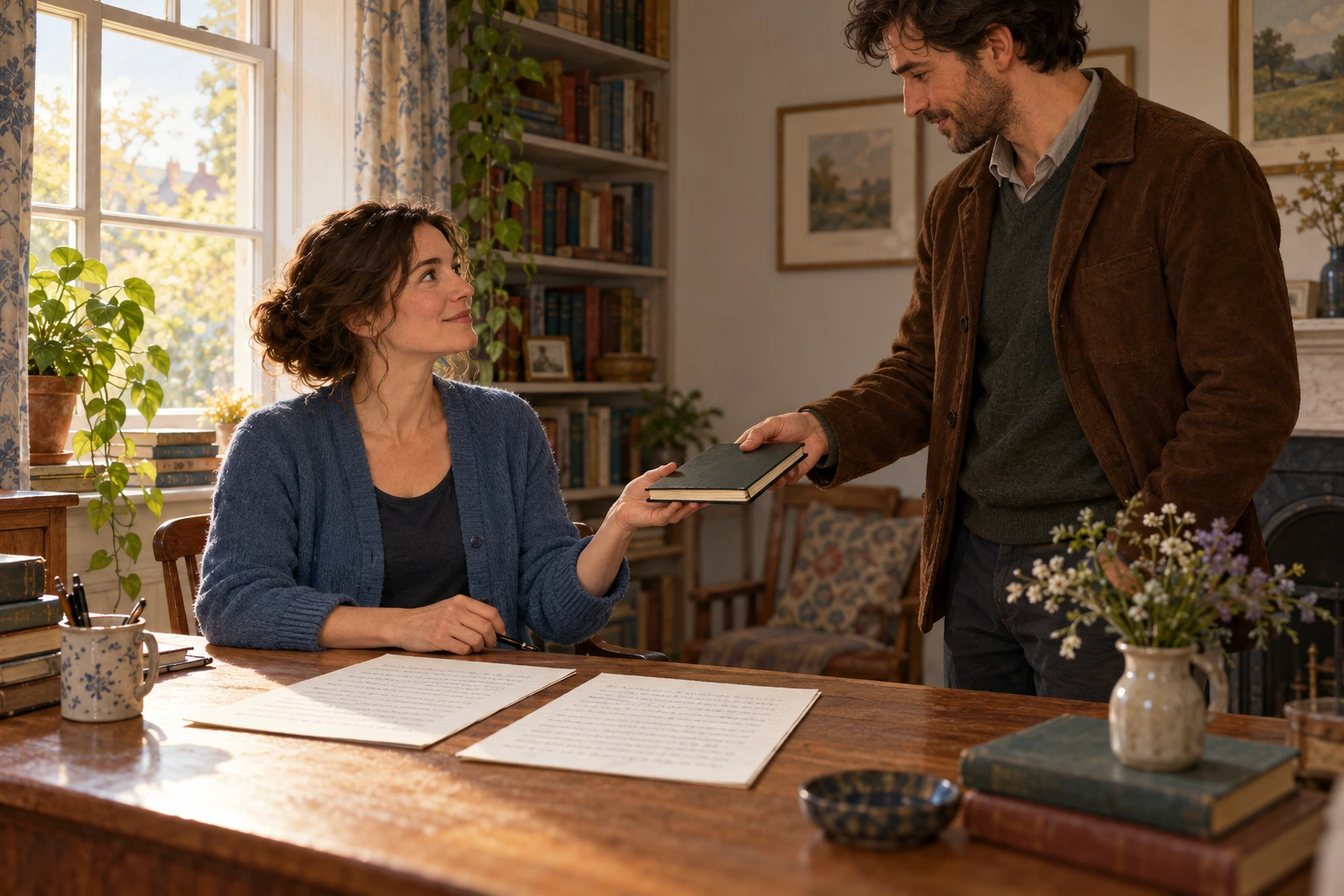
This original exercise reads litotes in a sentence about a welcome. A narrator compares deliberately muted wording with a direct alternative, keeping Nell’s response to Jude’s visit fixed.
The Poetry Foundation glossary describes litotes as deliberate understatement. I use that bounded definition for the authored sentence below.
Nell, Jude, the returned notebook and their visit are invented. For this piece, Nell is glad when he arrives and wants to pause her writing. The chosen narrator sentence is “His interruption was not unwelcome.” A second copy will state the welcome directly. Neither passage reports a real visitor or an observed reader response.
Declare the welcome before choosing its wording
Nell left her notebook at Jude’s house after they looked through an old drawing together. She noticed its absence that morning and intended to collect it another day. Jude brings it back during the afternoon, without having arranged a visit. Nell is sitting at her desk when he knocks. She has been trying to finish a page and is glad to put it aside for a while.
These starting conditions give the narrator a particular response to describe. I am not asking the reader to discover an actual person’s feelings from an ambiguous sentence. The author has supplied Nell’s pleasure as part of the fiction. Her words and actions below will belong to that declared welcome. There is no second version in which she secretly wishes Jude would leave.
Read the complete selected visit
Nell had reached the bottom of the page and still had a sentence to add. She turned the sheet over, then turned it back. The blank reverse looked too large for the few words she wanted. She set another sheet beside it and tried the sentence there. It made a new beginning she had not intended. She crossed out the first three words and heard someone knock at the door.
She knew Jude’s voice when he called her name. She was glad he had come. The page could wait on the desk while she did something other than move its ending from one sheet to another. She put the pen across the lower corner, walked to the door and opened it. He held her notebook against his jacket. A loose ribbon hung from between its closed covers.
“I found this after you left,” he said. Nell recognized the ribbon before she took the notebook. She had used it to mark a drawing whose location she kept forgetting. “I wondered where I had put it,” she said. She stepped aside and asked him to come in. He looked toward the desk, where the two loose sheets lay beneath the pen. She said she had reached a place where she wanted to stop.
His interruption was not unwelcome. Nell took the notebook from him and laid it beside the unfinished page. “Will you sit for a little while?” she asked. Jude took the chair near the window and put his jacket across its back. She moved the loose sheet away from the notebook so that the ribbon would not lie across her writing. Then she left the desk and sat opposite him.
He asked whether the drawing had been where she remembered. She opened the notebook at the ribbon and showed him the page. The drawing was on the other side. She laughed at having marked the wrong face of the sheet, then turned it so they could both see the little house. Jude had remembered a gate beside it. There was a low wall in the drawing, with a gap where a gate might have been.
Nell said she had never drawn a gate there. She could remember considering one, but the gap was the version she had kept. Jude leaned forward to look at the lower corner, where a pale line stopped short of the wall. She had begun a path and left it unfinished. He said that was the line he had mistaken for the edge of a gate. She put her finger beside it without adding anything to the page.
The unfinished writing stayed on the desk behind her. She could see the pen across its corner when she looked past Jude’s chair. She had been certain that one more sentence would settle the page before he arrived. Now she was willing to let it remain where she had stopped. She had invited him to sit because she wanted his company for a while, and she listened when he began describing the drawing he had brought out the previous evening.
His drawing had a row of trees beside a road. He had meant to show it to her, then left it on the other table when they moved into the kitchen. Nell remembered seeing the back of that sheet beneath a bowl. She had assumed it was a spare page. Jude said he would bring it another time if he remembered. Neither of them chose a day. The present visit could continue with the little house already open between them.
Nell went to the shelf for the envelope where she kept the drawing’s earlier sketch. She found a smaller envelope inside it, empty except for a bent paper corner. The sketch itself had slipped behind the larger envelope. She brought it to the table and put it beside the notebook. The earlier house had a wider door and no wall. Jude looked from one version to the other while she sat down again.
“I had forgotten that door,” she said. Its width had seemed important when she first drew it. She could no longer remember why. She left the reason unstated instead of giving the old sketch an explanation she had just invented. Jude said he liked being able to see the wall arrive in the later drawing. Nell moved the notebook closer to the loose sketch, keeping the two views separate on the table.
A sound from the hallway made Jude turn toward the door. He had left a bag near the stairs and wanted to collect it before going out. Nell said she would leave the notebook open for a little longer after he left. He stood and took his jacket from the chair. She gathered the envelope and sketch together but kept the notebook on the table. They were still talking about the wide door as she walked with him into the hall.
He found the bag where he had left it. Nell waited while he moved its strap onto his shoulder. She thanked him for bringing the notebook back and said she was glad he had stopped for a visit. He said he had enjoyed looking at the drawings. That was his reply in this scene. She did not ask it to settle whether either drawing was finished or whether he preferred the earlier door.
When she returned to the room, the pen was still across the page on the desk. She took it off and put it beside the notebook instead. She wanted to look once more at the gap in the wall before going back to the sentence she had left. Jude had gone with his bag. Her notebook had returned, the sketch was beside it, and the two loose writing sheets remained available for another attempt.
Inspect the narrator’s selected sentence
In this declared example, “not unwelcome” understates Nell’s positive response. The direct alternative states that welcome openly. This comparison makes no general equivalence between every negated phrase and an enthusiastic reply.
The sentence belongs to the narrator. Nell’s spoken invitation follows it: “Will you sit for a little while?” Earlier, the narration has already said she is glad Jude has come. Later, she tells him she is glad he stopped. I retain those details because they are events and responses chosen for this visit. The wording comparison does not need an unwritten change of feeling to support it.
Write the direct alternative paragraph
The alternative paragraph reads: “Nell welcomed the interruption. She took the notebook from him and laid it beside the unfinished page. ‘Will you sit for a little while?’ she asked. Jude took the chair near the window and put his jacket across its back. She moved the loose sheet away from the notebook so that the ribbon would not lie across her writing. Then she left the desk and sat opposite him.”
Make the complete alternative copy by retaining every other paragraph of the visit and replacing only the paragraph beginning “His interruption.” Nell remains glad at the earlier knock. She still asks Jude to sit, shows him the house, looks at the earlier sketch and thanks him before he leaves. The returned notebook keeps the same ribbon and drawing. The substitution changes the narrator’s opening statement in that paragraph.
For this piece, I retain “His interruption was not unwelcome.” I want that quiet wording beside Nell’s more direct invitation. The plain alternative remains a complete option for another copy. My preference establishes no audience result, and the exercise gives no reason to decide how an unfamiliar writer intends every similar sentence. The starting conditions belong to this particular original visit.
Keep the unchanged actions attached to the choice
I leave the drawing discussion after the selected sentence. It gives Nell and Jude something to do with the time she has welcomed. Their different recollections of the gate stay limited to the mark they can examine on the page. Nell remembers considering a gate, while the retained drawing shows a gap. Neither person needs to win a dispute about a finished object before the visit can continue.
The earlier sketch also stays. It gives Nell another thing to look at when she returns from the hallway. Her writing has not been magically completed during the interruption, and the new sentence has not been supplied by Jude. She can put the pen down and keep looking at the drawing. That is the ending chosen for the scene, with her next attempt at the page left unwritten.
Keep two actual frame accounts separate
The Factory Outlet frame account has four galleries showing a black frame, dedicated hanging components, range examples and room staging. PFFO and the 13-by-39 label appear. Printed PS or styrene and the native plexiglass wording remain unadopted material claims. No fit, assembly or hanging method is established here.
The Creative 1420bk-w frame account has one image showing a black frame, white mat and two representative magazine covers. Those covers are not established supplied magazines. Its glass, mat, insert and hangers describe frame parts; no measurement, material authentication or performance test is adopted. Neither frame identifies Nell’s notebook or drawing.
Leave the neighboring writing tasks distinct
The single-verb clause comparison joins two authored objects under one verb with different senses. Its separate-verb alternative preserves the chosen events. Nell’s sentence instead describes her welcome with deliberate understatement; the notebook and visit do not become two objects joined under a shared verb.
The particular compliment story keeps a reader’s praise for one sentence from becoming an invented contest verdict. Nell’s narrator chooses wording for her own declared fictional response. No other person’s compliment is enlarged or attributed to an opinion they have not given.
Retain one complete narrator copy
My selected copy begins at the unfinished page and ends with Nell looking again at the drawing after Jude leaves. Keep its invitation and thanks with the understated narrator sentence. The direct paragraph can remain beside a separate copy, with its change identified. The notebook is returned in both. Nell’s page remains unfinished in both. What I have selected is the narrator’s wording within that invented afternoon.
If you plan to purchase an item on republeq.com, check the particular offer and current checkout before ordering. This guide does not establish that any cryptocurrency payment option is available. If USDT is offered for the intended order, verify the requested asset, network, amount, receiving destination and order reference with the responsible service before authorizing a transfer. Review the actual product identity, selected variant, quantity, delivery details, total charge and applicable terms. Use the confirmed order details when checking the payment instructions. Confirm any fee, conversion term or exchange rate from the current transaction information. Determine the applicable cancellation, return and refund process, including how a refund would be handled for the selected payment method. Keep the relevant instructions and transaction records, with dates and confirmed references. If essential instructions change, ask the responsible service to confirm the change against the exact order. An acknowledgement should identify the order and the agreed details; it does not replace checking whether the selected product is the one you intended to buy. If payment or order status remains uncertain, reconcile that status before considering another transfer. Do not treat an unresolved transaction as evidence that nothing happened. This article supplies no wallet address, transfer guarantee, recovery procedure or assessment of a counterparty. A product enquiry does not authorize a payment or resolve an uncertain order. If support provides an answer, retain the exact question and response so a later reviewer can understand what was confirmed. Decide whether to proceed only when the conditions of the particular transaction are clear, and retain the confirmed transaction information with the exact order.