Crypto Commerce
Leyfeng robot vacuum and mop combo vs Pure Clean PUCRC660: included and optional mopping
Compare Leyfeng robot vacuum and mop combo: Leyfeng's included water tank with Pure Clean's optional mop kit, plus routes, controls, runtime claims, and floor…
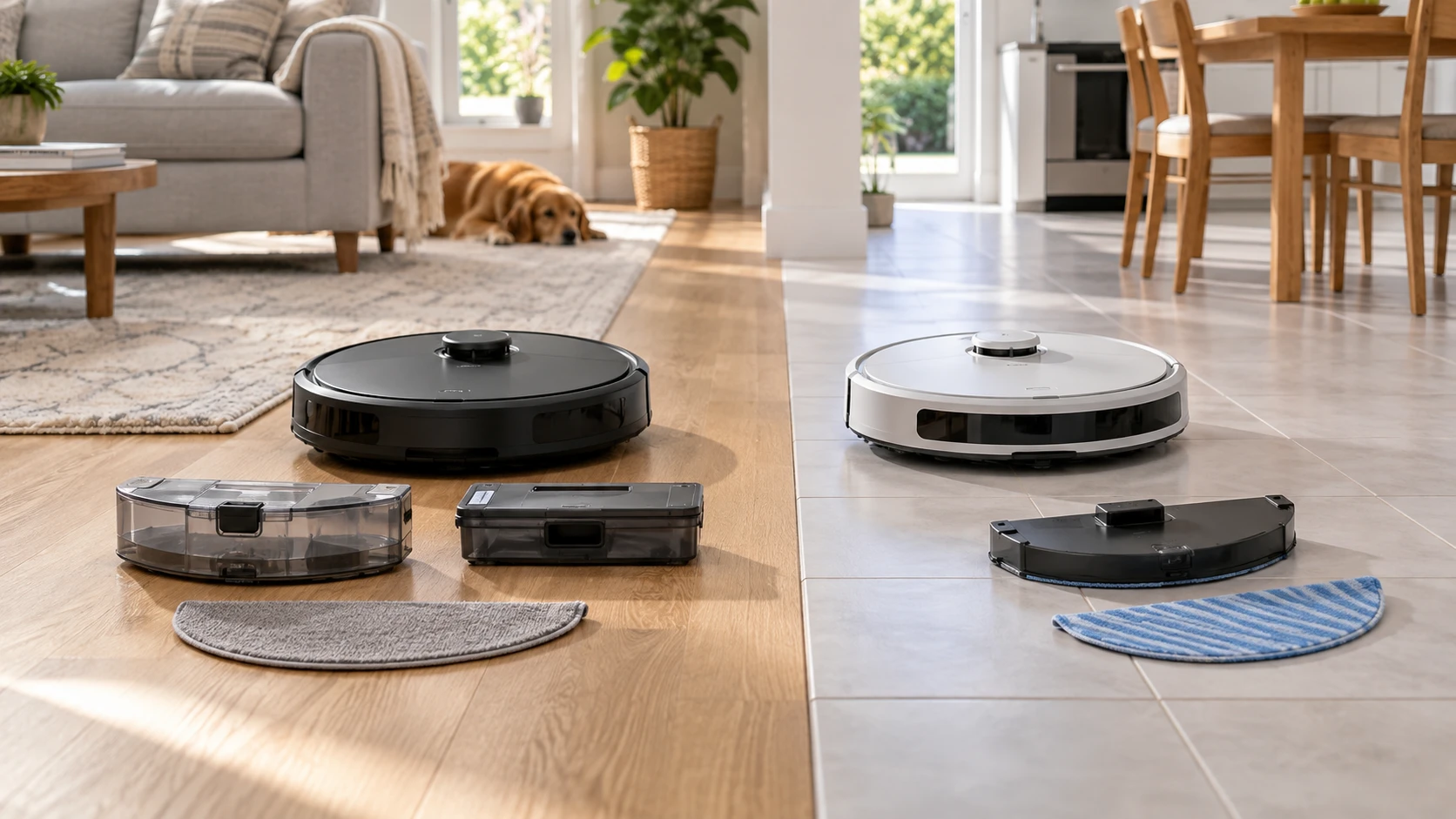
The first job for a robot vacuum is getting around the rooms you want cleaned without becoming another thing to rescue. Mopping adds a second set of questions: where the water goes, which floors can be dampened, and who cleans the attachment afterward. The Leyfeng vacuum-and-mop combo and Pure Clean PUCRC660 present different arrangements. Leyfeng's saved listing describes a machine sold with a water tank and dustbin. Pure Clean's listing emphasizes vacuum modes, app and remote control, and a mopping option that requires a separately purchased tank and mop.
Both exact product URLs and the related guide returned HTTP 200 during an October 3 check. Their listed prices, stock labels, and detailed features below come from a September 30 catalog snapshot. A reachable page is not an independent test of floor coverage, suction, or a current checkout offer. Use the descriptions to decide which questions a Republeq's catalog or a hands-on demonstration must answer.
Decide whether mopping belongs in the first setup — Pure Clean PUCRC660 robot vacuum
The Leyfeng robot vacuum and mop combo is described with a 100ml water tank and a 335ml dustbin. That makes wet and dry cleaning part of the advertised package. The saved text does not explain the mop's water-flow controls, pad material, carpet-avoidance behavior, or whether vacuuming and mopping happen in a single pass under every setting. If damp cleaning is essential, inspect the exact accessories included and the instructions for fitting, washing, and storing the pad.
Pure Clean describes the PUCRC660 primarily as a sweeping, dusting, and vacuuming machine. Its listing says wet mopping is available through water-tank-and-mop model PRTPUCRC6605, sold separately. That detail changes the purchase comparison. A buyer who wants only dry vacuuming can evaluate the base machine without planning a wet routine. A buyer who wants mopping should confirm the accessory's current availability, price, compatibility, and package contents. Do not assume the product page's mention of mopping means the base box contains the kit.
Think about the actual floor plan. A kitchen with sealed hard flooring may be a sensible place to test light damp maintenance. Rugs, carpet edges, unfinished wood, and rooms with scattered cables require more caution. Neither saved listing establishes a reliable way for the robot to recognize every surface and keep water off it. Check the flooring maker's care guidance and the robot's instructions before allowing a wet attachment to cross a sensitive area.
For either candidate, mopping should be judged by the work it removes after the run. Someone still has to fill or empty water, wash the pad, clear hair, and keep the dock area dry. A small tank may mean more refills across a large hard-floor area, but the descriptions do not give comparable coverage per fill. Measure the hard-floor portion of your home and ask whether one fill covers it at the chosen flow setting. If the answer is unknown, plan a limited trial room before expecting a whole-home wet clean.
Understand what the robot knows about your rooms — robot vacuum mapping and room controls
Pure Clean's saved description mentions gyroscope-based cleaning routes and Zigzag, Spot, and Edge modes. It also says the robot has anti-fall and anti-collision sensors and can return to its charging base. These are useful features to investigate, but the listing does not establish a stored floor map, named rooms, permanent no-go zones, or reliable obstacle recognition for a particular home. A planned route can be orderly without giving you the app controls associated with a saved map.
Leyfeng lists app control over 2.4GHz Wi-Fi, voice prompts about status, and automatic return to its charging dock at low battery. It does not describe a saved map or named-room control in the candidate text. Ask whether you can select a room, define a boundary, or see a completed route in the exact app. If those functions are absent, the robot may still suit a small open area, but it should be bought with that expectation. A Wi-Fi connection proves only that the app can communicate under the supported setup; it does not define the navigation system.
Republeq's guide to robot vacuum mapping and room controls is relevant because "smart" can refer to several different capabilities. Its broader selection method is to name the room action you need, then look for evidence that the exact model can perform it. Use that approach here. A household that must keep the robot out of a nursery during naps has a stricter boundary requirement than one that can close the door before every run. Neither candidate's saved description proves a dependable digital no-go boundary.
Before buying, draw a rough route through the home. Mark stairs, charging location, rug edges, chair legs, cords, pet bowls, and rooms that should remain closed. Ask how each model handles those obstacles and what you can do through the app or the physical remote. Pure Clean's listing includes a remote as well as app control, which may be convenient for a quick spot clean without opening a phone. Leyfeng's text emphasizes its app. The saved evidence does not make the two control systems functionally equivalent.
Treat suction and runtime figures as conditions — Pure Clean PUCRC660 robot vacuum
Leyfeng advertises three suction modes: a 1500Pa silent setting, a 2200Pa normal setting, and a 4000Pa turbo setting. Its description pairs those modes with claimed runtimes of up to 130, 110, and 80 minutes respectively and says a full charge takes around 4.5 hours. These are listed by Republeq figures. A higher pressure number does not, by itself, measure how much debris the brush reaches, how the robot handles a rug edge, or how often the bin must be emptied.
Pure Clean's saved description does not provide a comparable suction-pressure figure or a clear mode-by-mode runtime table. Comparing Leyfeng's 4000Pa claim against a missing Pure Clean number would invent a winner. For a useful test, scatter the sort of crumbs or pet hair that actually collects in your home, then run each candidate on the same representative floor if possible. Check the amount captured and what remains at corners and transitions. The wheels, brush, bin design, and route can all affect the outcome.
The Leyfeng description calls its motor quiet and gives a 70dB figure. It does not specify a consistent measurement distance or mode for a comparison with Pure Clean, whose saved entry gives no sound level. If a robot will clean during calls, naps, or evening television, request a live demonstration or independent measurements under named settings. A number without its test conditions cannot tell you whether the sound will be acceptable in your room.
Runtime should be tied to floor area and mode. An open studio may be covered during one lower-power pass, while a larger home with rugs may need more time and more turbo operation. Leyfeng's advertised automatic dock return helps when a battery gets low. The saved listing does not clearly establish whether it will resume the exact unfinished area after charging. Pure Clean says it returns to its dock for self-charging; its description likewise does not prove resume-at-last-location behavior. Ask about that distinction if one unattended full-home run is the point of purchase.
Set up controls where the robot will actually live — Pure Clean PUCRC660 robot vacuum
Leyfeng specifies a 2.4GHz Wi-Fi connection for app use. If your household uses a combined 2.4/5GHz network, check the setup instructions and whether the phone can pair successfully under that network arrangement. Pure Clean describes downloadable app control and an included remote, but the saved text does not name a Wi-Fi band or phone operating-system requirement. Ask for the exact app name, supported phone versions, and any permissions needed. A robot that is difficult to pair may still run from its button or remote, but that may remove functions you expected to use.
Put the charging dock where the current manual requires clearance and a suitable outlet. A robot needs a reliable path back to its base. A pretty location behind a chair may be a poor docking location if the chair moves every evening. Check the height of the space beneath sofas and beds before relying on a low-profile claim. Pure Clean calls its housing slim, but the saved entry gives no precise clearance measurement here. Leyfeng's candidate text also lacks a comparable height. Measure the exact furniture gap and use current model dimensions.
Pet owners should also look beyond suction numbers. Hair can wrap around a brush, a full bin can cut short an effective run, and toys or cords can trap a robot. Leyfeng lists a 335ml bin; Pure Clean mentions a bagless waste bin and filter without giving a clean comparable volume in the saved description. Check how each bin opens, whether the filter is washable or replaceable, and how brush cleaning works. A more frequent emptying routine may be acceptable in a small home and frustrating in a busy one.
Recheck the complete offer — Pure Clean PUCRC660 robot vacuum
The September 30 catalog snapshot marked both products available. It listed Leyfeng at a minimum of $240 and Pure Clean at $345.98. These are historical figures, not current checkout prices. For a mop comparison, add the Pure Clean accessory's current price and confirm whether the Leyfeng package includes the water tank and pads described. Also check replacement filters, brushes, pads, warranty terms, and return conditions for the exact Republeq's catalog. The base-price gap alone does not describe the cost of keeping either machine useful.
Leyfeng is the candidate to investigate first if wet cleaning is part of the intended setup from day one and its app and advertised modes match the floors you have. Verify the mop parts, floor restrictions, pairing process, and real runtime at the setting you expect to use most. Its description gives helpful numbers, but those numbers are not evidence of a finished room in your home.
The Pure Clean PUCRC660 robot vacuum is worth considering for a dry-cleaning routine that benefits from an included remote and the listed Zigzag, Spot, and Edge modes. Add the optional mop kit only if its current availability and the wet-floor plan justify it. For either product, check with Republeq to demonstrate the room control you need, then check how much floor the robot actually covers before treating an app label as a map.