How-To Guides & Tutorials
How to knit a practice swatch: cast on, knit and bind off
Knit a practice swatch with a sourced English-style sequence, worked stitch counts and actual medium acrylic yarn information. No finished size is assumed.
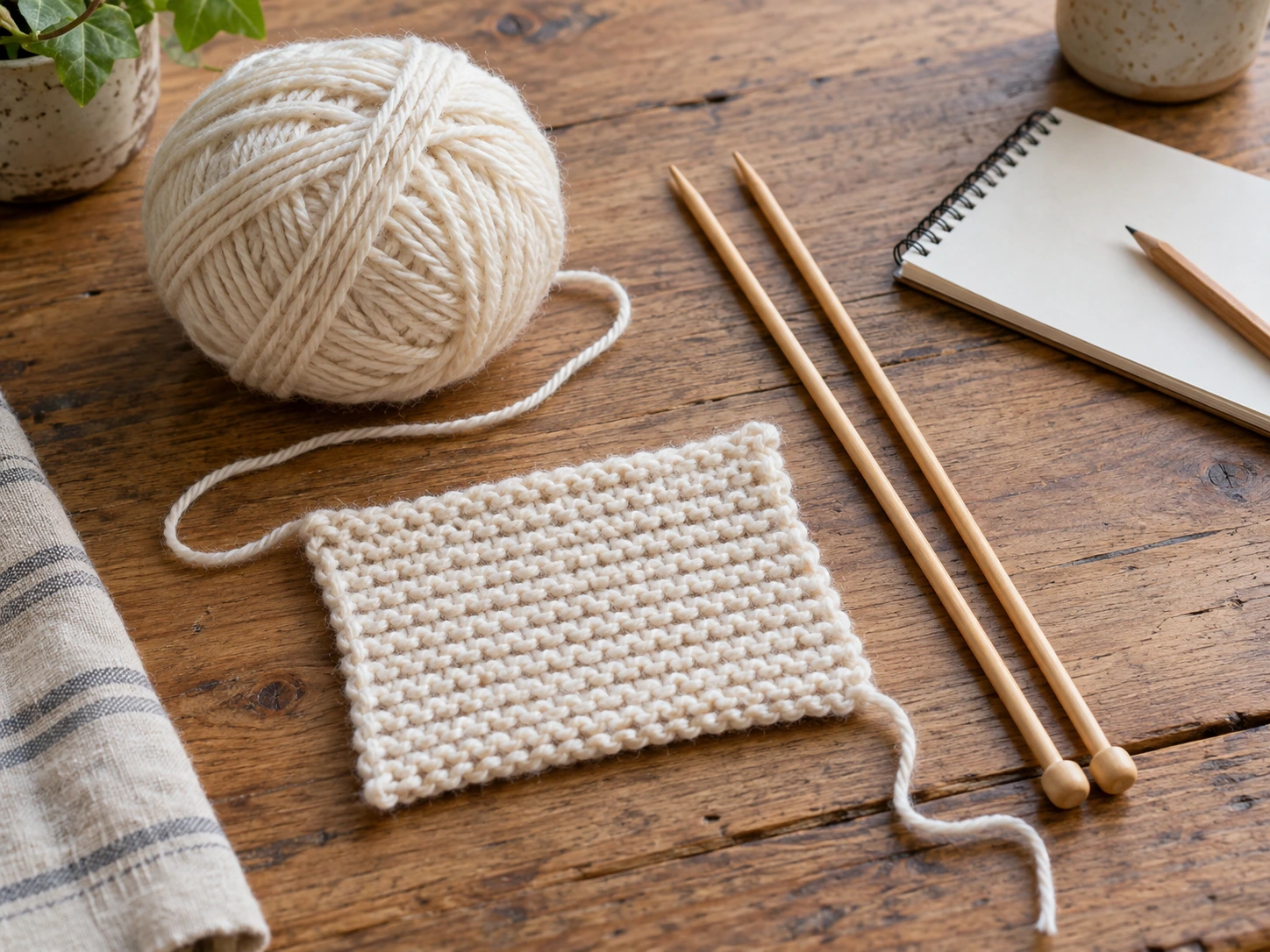
To knit a practice swatch, give yourself a small, countable task: cast on twelve stitches, knit eight rows and bind off. These counts define the exercise in this guide. They are not a manufacturer pattern, a measured sample result or a promise that the piece will have a particular finished size.
The method follows Lion Brand's illustrated English-style knitted cast-on and knit-stitch lessons, then its basic bind-off and finishing sequence. English-style here means the working yarn is controlled with the right hand. Follow that complete method together; a separate left-handed or Continental lesson can use a different handling arrangement.
Choose the actual yarn and needles for this sample
The Red Heart Bitty Stripes E900.0105P06 offer supplies a concrete setup to investigate. It describes number-four medium worsted yarn made from one hundred percent acrylic and explicitly recommends a five-millimetre knitting needle. Its six-pack account gives each ball as ten ounces, 283 grams and 515 yards.
The native name lists Yellow, while the description names Pink Lemonade. Retain that colour discrepancy if the exact appearance affects your choice. The exercise concerns forming and counting stitches, and makes no prediction about where a stripe or colour change will appear within the small piece.
Have one suitable ball and a pair of knitting needles ready, using the actual yarn label's guidance. For the selected Bitty Stripes account, the stated knitting recommendation is five millimetres. Its separate 5.5-millimetre crochet-hook recommendation belongs to crochet. A hook is not one of the two knitting needles used in this method.
The Coats & Clark UK E300B.0631.UK Light Sage offer is another actual material account: a three-pack of Red Heart Super Saver, described as medium-weight, one hundred percent acrylic yarn. It identifies UPC 726465500533. Its captured description gives no knitting-needle recommendation, so obtain its own applicable label information before choosing that alternative setup.
Make a small working record
Write the yarn identity, actual needle size and the exercise counts on a piece of paper. Leave space for eight completed rows. The twelve-stitch number tells you how many stitches belong across a full practice row; the eight-row number tells you when to move to binding off. They describe different parts of the task.
Keep scissors available for the finishing stage. The selected yarn descriptions do not say that needles or scissors are supplied with either pack. A six-pack of yarn and a three-pack of yarn therefore remain supply descriptions, rather than complete equipment lists for this exercise.
Place the ball so you can follow the connected strand, called the working yarn. The short free end is the tail. Identify both before wrapping the yarn so you can keep using the strand connected to the ball.
Begin the knitted cast-on for a practice piece
Begin the knitted cast-on for a practice piece on a flat surface, ball to your left. Make a loose loop five or six inches from the tail. Pass the tail behind the ball strand, lift it through the loop with a needle and tighten gently around the needle.
Hold that needle in your left hand, tip up, ball strand behind and tail in front. Insert the empty right needle front to back through the loop, underneath the left. Hold both needles in your left hand; control the ball strand with your right.
Bring the working yarn under the right needle from the right, around the back to the left, then over it to the right. Draw a new loop toward you through the original. Insert the left needle into the new loop, then slip it off the right. Repeat until twelve.
Count the foundation before the first row
The initial loop counts as the first cast-on stitch in this exercise. After making and transferring the next loop, there are two on the left needle. Eleven additional loops after the first give twelve altogether. Count the actual loops before beginning the first knitted row, while they are all on the same needle.
Starting with one loop and adding five gives six altogether. You would still need six more to reach twelve. Marking five additions as five total stitches would lose the starting loop from your record.
Work the first knit stitch
Hold the needle carrying the twelve cast-on stitches in your left hand and the empty needle in your right. Keep the working yarn controlled by the right hand. Insert the right needle through the next stitch from front to back beneath the left needle, following the same physical wrapping path used for the cast-on.
Draw the new loop through the old stitch onto the right needle. Then slide the old stitch completely off the left needle. That completes one knit stitch. For this row, leave the new stitch on the right needle instead of returning it to the left as you did during casting on.
Continue through the remaining stitches until the left needle is empty. Lion Brand's English-style lesson treats casting on as separate from the row count. The row you have just knitted is row one, so mark one completed row on the paper after you have worked across all twelve stitches.
Use counting stitches while knitting as a checkpoint
For counting stitches while knitting, this twelve-stitch exercise gives a simple worked example. After completing one knit stitch, the expected positions are eleven stitches waiting on the left and one completed on the right. After four completed stitches, the corresponding counts are eight on the left and four on the right.
At that point, eight plus four still accounts for twelve. The eight are waiting to be worked in the current row; the four have already been worked. Counting them as separate groups helps you describe where you stopped without calling a partly completed row a finished one.
Suppose a hypothetical note says row two, four stitches worked. That records progress within the row. A tally showing two completed rows would say something else. Add the row mark only after the remaining eight stitches have been worked and the left needle is empty.
If your actual count differs, pause the exercise and identify the discrepancy before continuing the tally. The arithmetic is a record check, not a technique for repairing an extra or missing loop. Return to the matching illustrated lesson or suitable instruction for the actual stitch issue rather than rewriting the planned twelve as though nothing changed.
Turn and knit the next row
At the end of the row, exchange the needles so the needle carrying the work is again in your left hand and the empty needle in your right. Knit across the next row with the same sequence. Continue this way, knitting every row, until your record shows eight completed rows.
Lion Brand calls fabric made by knitting every row garter stitch. Its lesson describes ridges on both sides and says each ridge is formed by two knitted rows. The planned eight rows therefore represent four two-row groups. That is a count relationship for the exercise, without a measured width or height supplied here.
For a pause between rows, finish the current row before recording it as complete. If you instead stop within a row, write the partial progress explicitly, as in the worked example above. On returning, compare that note with the actual work before starting another row tally.
Read the gauge statement after the practice count
The Bitty Stripes description gives a knitting gauge of seventeen stitches and twenty-three rows over four by four inches, with a five-millimetre needle. This is the offer's stated reference. It has not been measured in a sample made for this article, and it does not report the size of your twelve-stitch practice piece.
Write that reference separately from your own row record. Seventeen by twenty-three describes the listed gauge sample, while twelve by eight describes this exercise's planned stitch and row counts. A record can preserve both without silently replacing one set of numbers with the other.
The same product account gives a different crochet gauge: twelve single crochets by fifteen rows with a 5.5-millimetre hook. Those figures describe another craft. Their shared appearance as stitch-and-row counts does not make them the instructions for the knitted piece on your needles.
Bind off after the eighth row
To bind off, knit the first two stitches. Lift the older of those two right-needle stitches over the newer stitch and off the needle, leaving one. Knit the next stitch, then lift the older right-needle stitch over the newly knitted one again. Continue until one loop remains.
Lion Brand's basic finishing sequence leaves about six inches of yarn when cutting the working strand. Draw the cut end through the last loop and pull it through to secure that loop. Retain the ends for the applicable weaving-in stage; this small exercise is a bound-off practice piece, without a wearable or fitted project specified.
The first two knitted stitches begin the bind-off sequence; after the first pass-over, one remains on the right needle. Each subsequent knit-and-pass-over returns that side to one. Keep this progression distinct from an ordinary practice row, where completed stitches accumulate on the right until all twelve have moved across.
In the twelve-stitch example, the first pass-over leaves ten waiting stitches and one right-needle loop, totalling eleven. After the next knit-and-pass-over, nine wait on the left and one remains on the right, totalling ten. The live bind-off count decreases, unlike the unchanged twelve-stitch total within an ordinary row.
Keep the yarn pack separate from the working count
The Bitty Stripes offer's six balls and the Light Sage offer's three-pack do not set the number of stitches to cast on. Nor does the planned twelve-stitch row require twelve balls. The exercise uses a selected working ball, while the retail account describes the supply offered for purchase.
The yarn unit-cost guide works with actual Sensy Candy and SENSY CAKE per-ball lengths and complete-package quantities. Its purchase arithmetic belongs to those offers. This practice sequence supplies no garment yardage or claim that either selected pack will produce a particular number of finished items.
For the Bitty Stripes account, 515 yards belongs to each stated ball. The twelve and eight in your practice note belong to stitches and rows. Retaining the label beside each number lets you return to the project record without mistaking an inventory quantity for a crafting instruction.
Leave the bracelet method with its own materials
The braided friendship-bracelet guide prepares nine cut floss lengths and groups them for a different making method. Its actual rainbow and Anniversary floss accounts describe supplied thread. Those working lengths, braid positions and knot closure do not replace the needles, cast-on loops or bind-off sequence in this exercise.
A sample note after you knit a practice swatch can read: "Bitty Stripes E900.0105P06; five-millimetre needles; twelve cast-on stitches; eight knit rows; bound off." Add your observations after making the piece. Leave its measurements open until you actually measure it, retaining the setup beside that later result.