Crypto Commerce
KNDKO dual-zone food dehydrator vs YASHE: plan the batch before counting trays
Compare KNDKO dual-zone food dehydrator by usable tray space, controls, cleanup and batch planning.
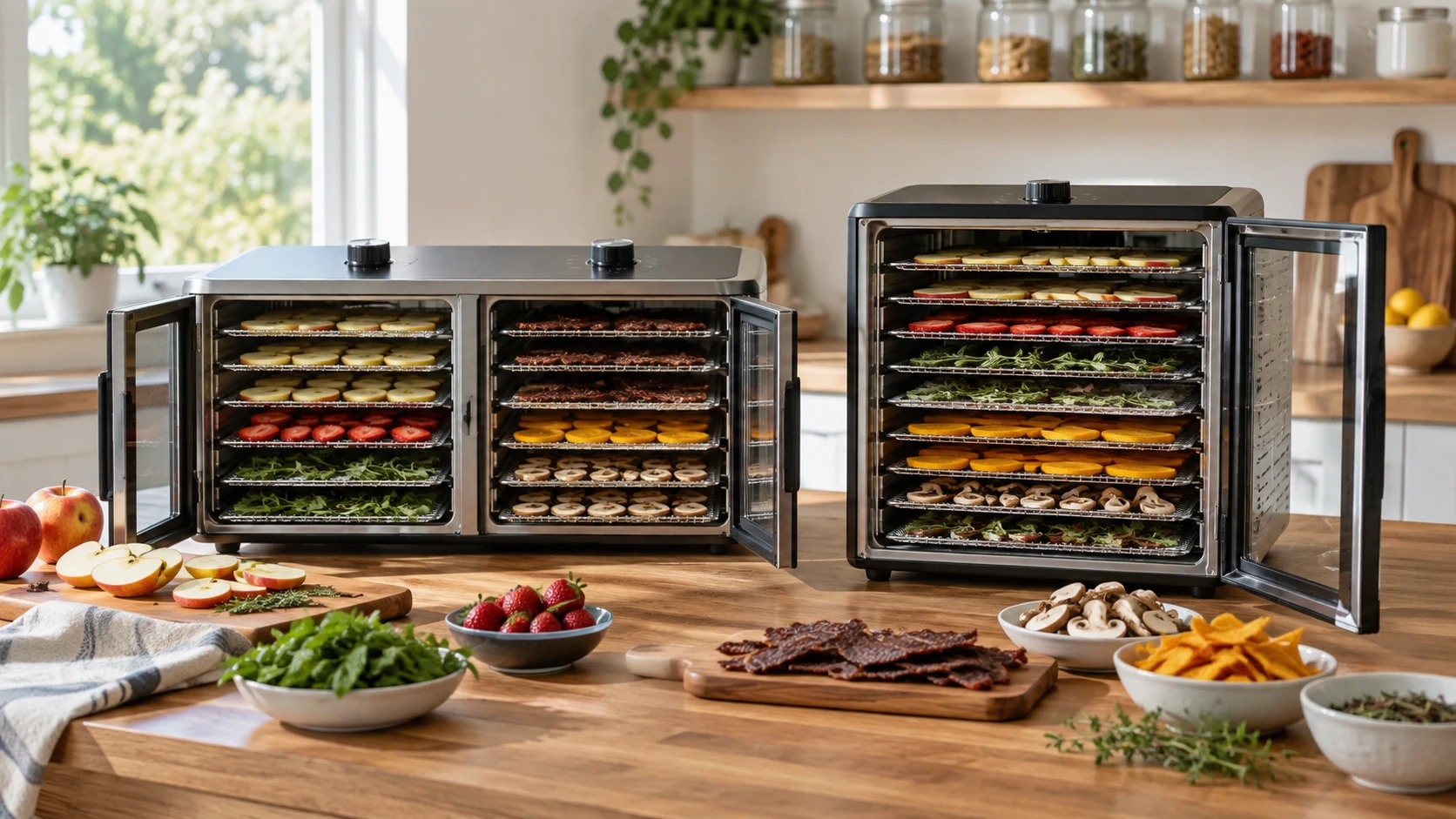
The KNDKO dual-zone food dehydrator is listed with two independently controlled chambers and sixteen trays in total. YASHE describes a twelve-tray cabinet with presets and a single set of time and temperature controls. Both are pitched for fruit, herbs and jerky, but the useful difference is how you would divide an actual batch. Separate chambers may help when foods need different settings; a single cabinet may be simpler when everything follows one plan.
These are saved Republeq's product descriptions, not verified drying tests. They do not give comparable exterior dimensions, noise measurements, actual electricity used per batch or a food-safety validation for any recipe. Use them to identify what the controls and accessories appear to offer, then check the current manuals before treating a temperature range or automatic mode as a safe drying procedure.
Count usable tray area and chamber access — checking dehydrator tray-rotation requirements
KNDKO says each of its two chambers holds eight stainless steel trays, for sixteen altogether. The listed tray size is 25 by 23 centimeters. That lets you estimate a nominal surface area per tray, though food needs space around pieces and trays have edges that reduce usable area. The source does not give a complete exterior dimension set or the height available between installed trays. A tall slice or a jar used for a special preparation may fit very differently from thin fruit pieces.
YASHE lists twelve adjustable trays and describes them as stainless steel. Its saved text does not supply tray length and width. Twelve trays could provide more or less total usable surface than expected from count alone. Request tray measurements, spacing options and the cabinet footprint. If the YASHE trays can be repositioned, find out how many can remain in place when you need extra vertical clearance for a thicker food.
Think through unloading as well as loading. KNDKO has two doors, so opening one chamber may leave the other closed. YASHE has one main drying space in its description. Ask whether a tray can be removed without pulling several above it, and where a hot tray can be set while checking food. The best capacity is the amount you can prepare, check and store without crowding or forgetting a tray at the back.
Draw a batch plan using the food you actually dry. Write down the prepared weight or the number of slices, tray area required and expected checks during the run. If you routinely make two small recipes at once, sixteen trays split across two chambers can be more useful than one larger open cavity. If most batches are a single food, the ability to fill twelve trays under one control panel may be easier to manage. A tray count by itself does not reveal how evenly either machine dries a fully loaded cabinet.
Decide whether two zones solve a real problem — YASHE 12-tray food dehydrator
KNDKO describes independent time, temperature, keep-warm and light settings for each chamber. That arrangement is the clearest reason to investigate it if you often dry foods with different schedules. You could start one batch while another is already underway without resetting both sides. Confirm whether each chamber can run alone and how power draw changes when only one operates; the saved listing gives total rated power but not a one-zone figure.
The KNDKO text claims its double-door design completely isolates flavors and prevents cross-contamination. The source does not provide a test of airflow, seals or allergen transfer. Treat separate chambers as a layout feature, not a food-safety guarantee. Shared utensils, hands and tray handling can still move material between foods. If you process an ingredient that must be kept apart for allergy or other reasons, seek specific manufacturer guidance and use appropriate cleaning and handling practices.
YASHE describes ten convenient presets, naming apples, blueberries, tomatoes and beef among them, plus manual adjustment. A preset may save button presses for a familiar recipe, but it does not establish that pieces of every thickness finish at the same time. Ask for the exact preset table and instructions. The source does not state that a preset measures the food's internal condition or compensates automatically for how heavily a tray is loaded.
The published guide on checking dehydrator tray-rotation requirements is a related planning reference. It does not test either of these two units. KNDKO claims rear heating and even results; YASHE claims rear-mounted fans and airflow that eliminates the need to rotate trays. Those are assertions from their listings. Use the guide to ask how each maker expects trays to be arranged and checked at full capacity, then follow the current manual rather than assuming a marketing phrase applies to every food.
Read time and temperature controls carefully — YASHE 12-tray food dehydrator
KNDKO lists an adjustable range from 95°F to 176°F and a maximum timer of 72 hours, with half-hour time increments. Its description mentions automatic movement into a keep-warm mode after drying. That may be convenient for timing, but the saved row does not explain how long the unit stays in that mode or whether it is appropriate for any particular food. Confirm the actual temperature steps and the behavior at the end of a cycle before planning an overnight or unattended run.
YASHE lists a temperature range from 95°F to 165°F and a timer from one to 48 hours, adjusted through an LED control panel. These ranges overlap substantially with KNDKO's. A higher maximum on the KNDKO listing does not prove faster or safer jerky, and a longer timer does not mean every batch should run for days. Drying guidance depends on the food, preparation, thickness and storage plan. Use a trusted food-preservation procedure and the appliance manual for each recipe.
The KNDKO title gives 1,200 watts, while YASHE lists 850 watts. These figures are electrical ratings or claims in Republeq's catalog, not direct measurements of drying speed. Different cabinet sizes, heaters, fans and thermostat cycling affect the time and energy needed for a batch. Ask for input requirements and measure the outlet available on the intended counter. Avoid stacking other high-demand appliances on the same circuit without checking the electrical instructions.
For foods where safe preparation matters, a control-panel setting is only one part of the process. Neither saved description supplies a validated jerky method or a way to judge safe final moisture. The machines should be assessed against the instructions you will actually use, including any preparation step outside the dehydrator. If the maker's manual is unavailable, do not infer food-safety procedures from the product title or a temperature range.
Compare the supplied tools and cleaning work — YASHE 12-tray food dehydrator
KNDKO lists a drip tray and mesh screen in each chamber, alongside the eight trays per side. That could help organize foods that might drip or have small pieces. Confirm the exact accessory count and which pieces are approved for washing by hand or in a dishwasher. The saved row says the trays are easy to detach and clean, but does not identify dishwasher-safe parts or cleaning agents for the interior.
YASHE lists twelve trays, four mesh screens, a fruit-roll sheet, recipe book and user manual. Its description calls the trays dishwasher safe and also describes them as stainless steel. Check the current manual for which parts that statement covers and any rack or cycle restrictions. Fruit-roll preparations may use the supplied sheet and a different cleanup routine from sliced fruit on an open tray. Keep the mesh screens and small accessories together so they do not disappear between batches.
Both descriptions mention built-in lighting. KNDKO says each chamber has a light setting; YASHE says a light helps monitor drying. A window or interior light can make quick checks easier, but neither listing establishes that you can judge dryness without opening the machine and inspecting the food. Find out whether the light turns off automatically and whether it can be used while heat is running. Those details matter if the unit will sit in a shared kitchen overnight.
KNDKO advertises overheat protection, while YASHE advertises side handles, bottom cord storage and quiet operation. These features address different parts of ownership. Protection language is not a substitute for required clearance and supervision instructions. Handles help only if the machine can be moved safely after it cools, and a quiet claim without a measured test distance cannot predict how it will sound in your room. Check the exterior dimensions and ventilation requirements for both before choosing a counter position.
After each batch, expect to wash trays and any screens or sheets, wipe accessible surfaces and store fully dry parts. A two-chamber machine may require cleaning two doors and two sets of seals even after a one-zone run. A single-cabinet model may have fewer divisions but a larger stack of trays to sort. Think about where sixteen or twelve washed trays will dry. Cleanup space can be the limiting factor in a small kitchen even when the dehydrator fits while operating.
Choose the layout that matches your batches — YASHE 12-tray food dehydrator
KNDKO is the candidate to inspect if you regularly want two independent schedules or need more listed tray positions. Verify the 25-by-23-centimeter tray measurements, chamber clearance, one-zone operation and end-of-cycle behavior. Its claims about no flavor transfer and uniformly dried food require more evidence than the listing provides, particularly for mixed or sensitive batches.
The YASHE 12-tray food dehydrator is the candidate to inspect if one batch plan, presets and the listed accessory package suit your routine. Confirm tray area, preset values, cleaning instructions and the actual need to rotate trays at full load. Its advertised airflow and quiet operation are useful questions to take to a demonstration or manual, not guaranteed results in every kitchen.
Before ordering, write down your three most common batches and the prepared tray space each one needs. Mark which foods must run at different settings and how often you will check them. That plan will show whether two chambers and sixteen trays solve a real scheduling problem or whether twelve trays with one set of controls are enough for the work you expect to do.