Crypto Commerce
KitchenAid K45SSWH Classic stand mixer vs KSM70SKXXWH for home baking
Compare KitchenAid K45SSWH Classic stand mixer by bowl capacity, tilt-head or bowl-lift access, included tools, and regular recipes.
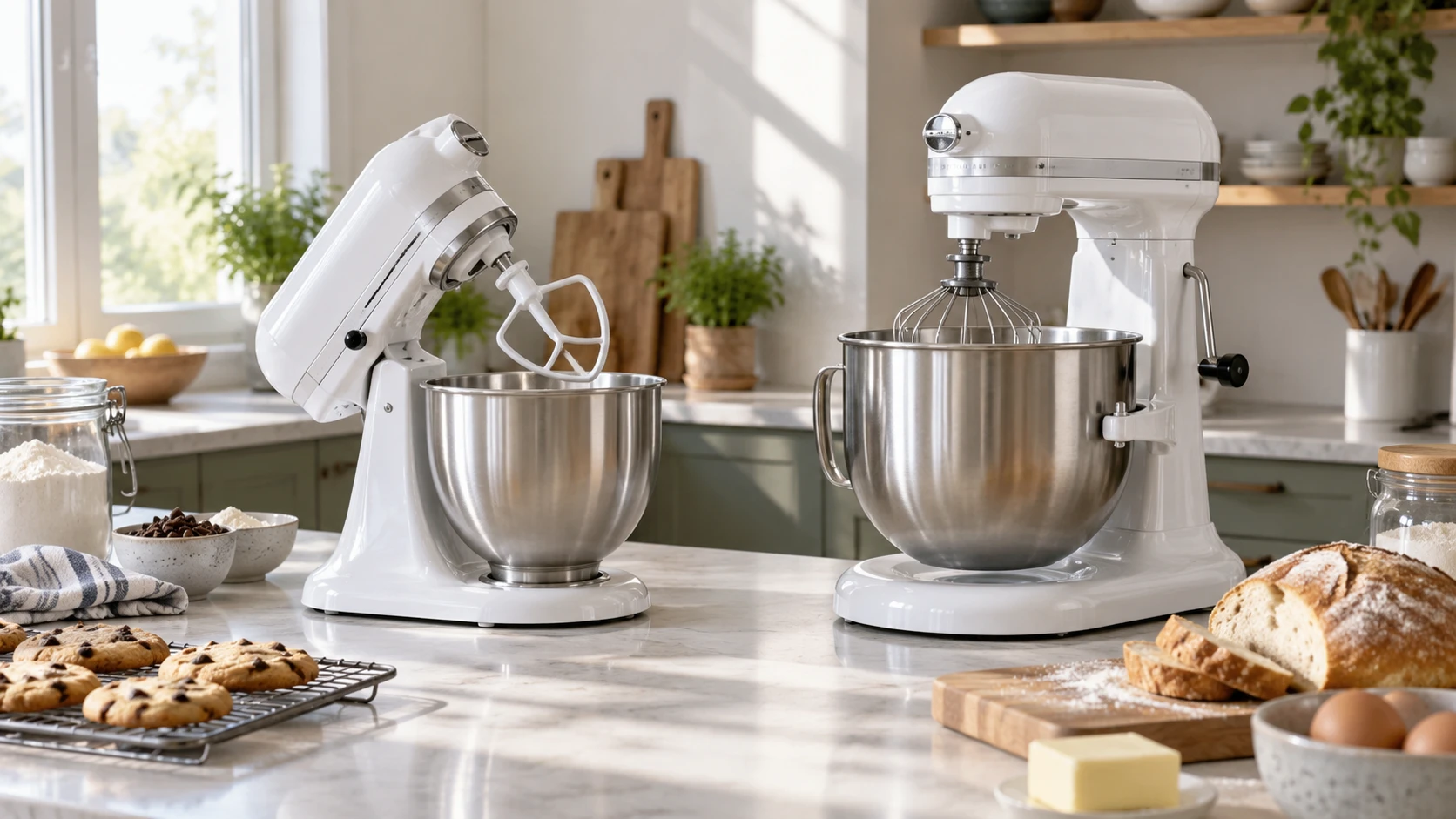
A small weekly batch and a crowded holiday counter place different demands on a stand mixer. The KitchenAid Classic K45SSWH is listed with a 4.5-quart bowl and a tilt head. The KSM70SKXXWH is a 7-quart bowl-lift model with eleven speeds and a longer list of named tools. Both are KitchenAid machines, but the saved listings give uneven detail. Compare the way each bowl opens, the recipes you repeat, and the actual package contents before treating the larger capacity as an automatic upgrade.
The KitchenAid K45SSWH Classic stand mixer row names metal construction, a stainless steel bowl, and a tilt-head design that gives access for ingredients. It says the bowl is dishwasher-safe and advertises up to eight dozen cookies in one batch, based on 28-gram portions made with a flat beater. The saved description becomes unclear when it lists speeds and included parts, so verify those details from the current manual and box inventory. Do not turn a broken catalog phrase into a specification for this exact unit.
The KSM70SKXXWH row describes a three-point bowl lock and a 7-quart stainless steel bowl. It lists eleven speeds, including a low half-speed setting intended to fold in delicate additions such as blueberries or egg whites. Its stated box contents include a double flex-edge beater, coated flat beater, coated dough hook, eleven-wire whip, and pouring shield. The row also advertises capacities for cookies, bread dough, and mashed potatoes. Those are listing claims tied to particular uses, not a guarantee for every recipe.
Start with the batch you make most often — KitchenAid KSM70SKXXWH bowl-lift mixer
A 4.5-quart bowl can be enough for regular cookies or a single cake, while a 7-quart bowl may leave more room for a large batch. The volume printed on each bowl does not tell you how a whisk performs with one egg white or how much dense dough the motor can work continuously. Write down the ingredient weights for your usual recipe. Compare them with the exact models' permitted loads and run-time guidance, especially for bread. The saved K45SSWH row gives no bread-dough limit; its cookie claim cannot stand in for one.
The KSM70SKXXWH listing says it can make thirteen dozen cookies per batch, knead more than 8.5 pounds of bread, or mash more than 7.5 pounds of potatoes. Those figures sound generous, but the saved row does not supply the test recipe, attachment setting, or duty cycle behind them. Use them as questions for the manual and a model-specific demonstration. A stiff, low-hydration dough may stress a mixer differently from a soft dough of the same weight. Ingredients, attachment choice, and rest intervals still matter.
KitchenAid's Classic cookie count is more narrowly explained: up to eight dozen cookies with the flat beater and 28-gram dough portions. That note makes the number easier to interpret, but it does not tell you whether your heavier cookie dough or larger scoops fit the same claim. If you bake for a small household, the eight-dozen ceiling may be far above a normal session anyway. A mixer that handles a half batch neatly can be more useful than one with a high maximum you reach once a year.
Work out how the bowl opens in your kitchen — stand mixer bowl access guide
The Classic's tilt head rises above the bowl for scraping, attachment changes, and adding ingredients. Measure the clearance to a wall cabinet with the head fully raised. A machine can slide beneath a cabinet when closed and still need to be pulled forward for every batch. Check the exact model drawing for the raised height, body footprint, and the space needed to remove a full bowl. The saved listing does not provide those dimensions.
The KSM70SKXXWH is a bowl-lift design with a stated three-point bowl lock. The bowl moves into mixing position while the motor head stays in place. Verify how low it sits when unlocked and how much room is needed to attach the beater or remove a heavy batch. A bowl-lift arrangement may avoid a tall head swing while creating different hand access around the bowl. Try the motions on a display unit if possible, or use a model-specific manual and measured counter sketch.
The published stand mixer bowl access guide concerns another tilt-head KitchenAid model. It is useful for thinking through where your hands and ingredients go, but its measurements and fittings should not be copied to either unit in this comparison. For the Classic, test the head arc; for the KSM70SKXXWH, test the bowl's lowered position and locking action. If flour is added under a low cabinet, each design can require a different routine.
Also account for where the bowl goes after mixing. A 7-quart steel bowl filled with dough may be awkward to lift and carry to the sink, even if the mixer handles the recipe well. The saved listings do not give bowl weights or handle details for a direct comparison. Check how securely each bowl attaches and where you can set it down without blocking other cooking. If the mixer itself must be stored in a cupboard after use, verify the base weight and a safe route before deciding that either footprint works for a weekly bake.
Read the tool list as a shopping list — KitchenAid KSM70SKXXWH bowl-lift mixer
The KSM70SKXXWH has a detailed accessory list in its saved row. The double flex-edge beater has two flexible edges intended to mix and scrape. Its separate coated flat beater, coated dough hook, eleven-wire whip, and pouring shield give a buyer several tools to match to recipes. Confirm that all are included with the exact KSM70SKXXWH SKU being offered, and read each tool's cleaning instructions. A shield can help with gradual additions only if its opening is convenient in the space where you mix.
The Classic description mentions a flat beater in the note attached to its cookie claim, but the saved contents text is garbled. Do not assume a particular whisk, dough hook, or shield is in the box from this row. Request a current package list and exact accessory model numbers. The same brand may sell several bowl sizes and attachment fittings. If you plan to add a second bowl or replace a tool later, check compatibility by the full model number, not by appearance in a photograph.
Dishwasher care is another place to verify each piece. The Classic row explicitly says its stainless bowl is dishwasher-safe. That does not automatically include the beater, whip, or any accessory whose finish is not clearly documented. The KSM70SKXXWH description lists coated tools but gives no matched dishwasher-care table. Read both manuals before cleaning a coating or a wire whip. A tool that needs hand washing may be a small burden if it is used every week and a larger one if several tools are used in a long baking session.
Optional attachments deserve their own check, separate from the tools in the box. The saved KSM70 row does not give a compatibility list, and the Classic row becomes unclear where it mentions additional fittings. If pasta, grinding, or another task is part of your budget, find the accessory's exact part number and the maker's compatibility chart for each full mixer model. Add its cost and storage needs to the comparison. A promise that a mixer can do more later has little value until the specific accessory you want is confirmed to fit.
Treat speeds and power claims in context — KitchenAid KSM70SKXXWH bowl-lift mixer
The KSM70SKXXWH lists eleven speeds and a half-speed setting for folding ingredients. That low setting could be useful when a recipe calls for gentle additions, but it needs a real trial with the bowl and tool you will use. The saved K45SSWH text does not provide a dependable speed count, so a numerical comparison would be misleading. Ask for its current speed chart. For either mixer, practice beginning with dry flour in the bowl and increasing speed without scattering ingredients across the counter.
The KSM70SKXXWH row includes a "2x in-bowl power" claim referenced to a tilt-head mixer. It does not identify the exact comparison machine or test conditions in the saved description. Do not treat it as proof that this KSM70 is twice as strong as the K45SSWH. If power under load matters, find a defined comparison or test the dough and batch you actually make. The Classic row's metal construction is a material claim, not a measured performance result.
Neither saved listing provides a directly comparable noise test, long-run temperature record, or complete operating-limit table. Those gaps matter most when the mixer will knead dense dough repeatedly or run in a shared apartment. Seek the maker's guidance and a return policy that permits a normal recipe trial. A brief empty-bowl video does not show how a machine behaves with a full bread dough. Evaluate the controls, stability, and cleanup together.
Choose from the regular session — KitchenAid KSM70SKXXWH bowl-lift mixer
Set a measuring tape on the counter and work through one familiar recipe from ingredients to washing up. Confirm the exact included tools and the bowl position while you add flour. For a small batch, check whisk and beater reach. For bread, compare the dough amount and run time with the manual. A large capacity claim is useful only when the machine's approved use matches your recipe and you can lift the result out comfortably.
The KitchenAid KSM70SKXXWH bowl-lift mixer deserves attention if large batches, its stated accessory set, and bowl-lift access suit your kitchen. The Classic deserves attention when its 4.5-quart bowl and tilt-head routine fit the baking you do most. Verify the Classic's current speed and package details, the KSM70's load guidance, and the counter clearance for both before paying for a capacity number you may rarely use.