Home & Living
A kitchen radio story on Sunday
Marta keeps a familiar programme running when her adult son visits. Their complete original Sunday encounter finds a different place for the plant and their conversation.
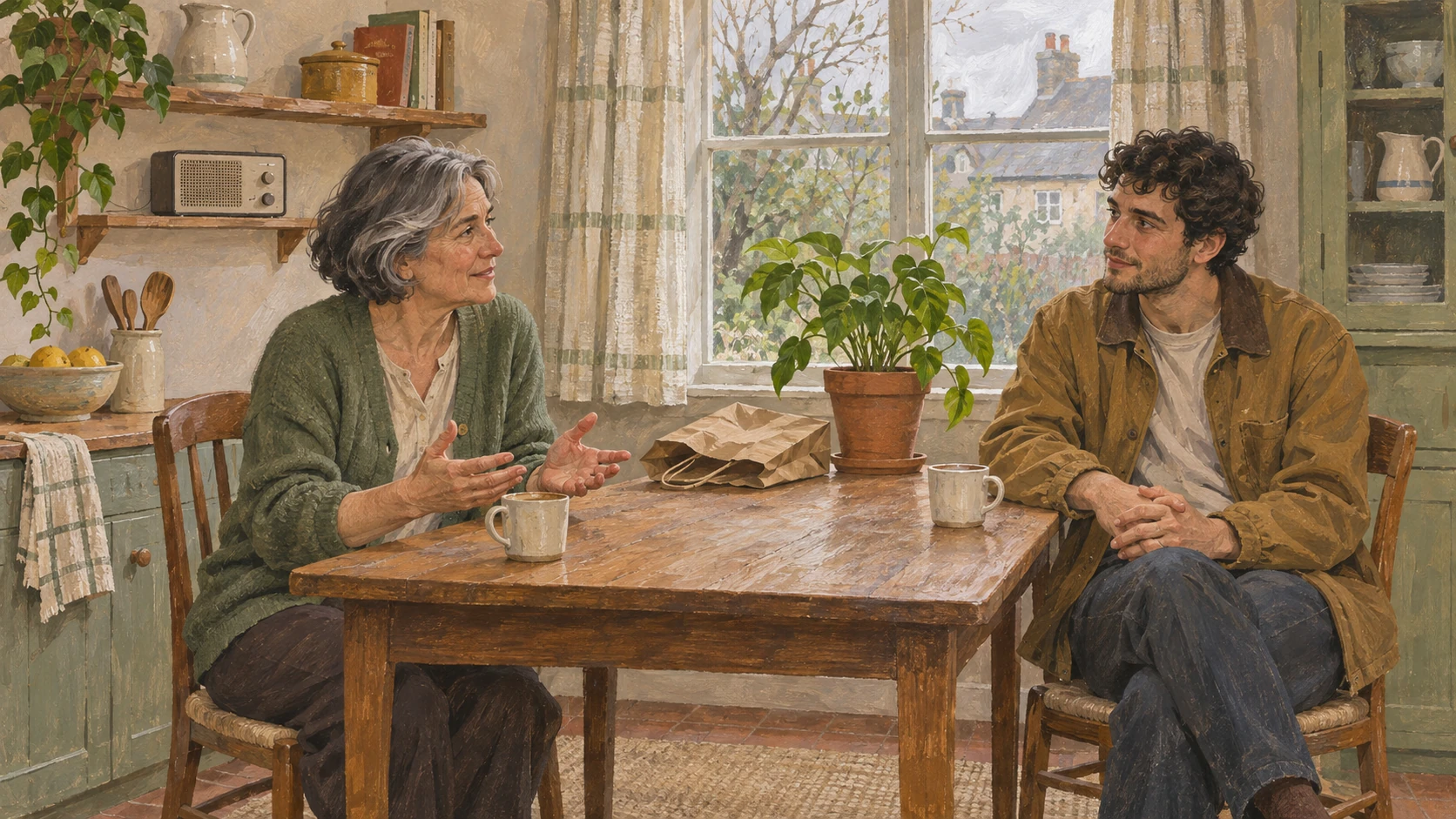
This kitchen radio story follows Marta through a Sunday visit from her adult son, Ruben. An unfinished programme stays in the background while a plant finds a new place in the room. The complete encounter is original fiction. Its people, broadcast and household are invented; it gives no equipment or plant-care instructions.
The plant in the paper bag
Marta had left the radio on when she heard Ruben at the front door. She recognised the small pause between his key entering the lock and the door opening. He still lifted the handle before turning it, though she had told him it no longer needed lifting. The sound gave her time to move a folded newspaper from his usual chair.
He came into the kitchen carrying a plant in a paper bag. The handles had stretched into thin loops above the leaves. Marta looked past him for another bag, then at the floor beside his feet. He had brought nothing else. He put the plant down where the newspaper had been and asked whether she had heard the programme from the beginning.
She said she had. In fact she had been in the other room when it started, looking for an envelope she no longer needed. She knew the voices well enough to feel she had heard them even when she had missed a part. Ruben stood beside the chair with his coat still on. One leaf leaned against his sleeve until he moved away.
“I thought you might keep that for a while,” he said. Marta asked how long a while was. Ruben unbuttoned his coat. He had not expected the question to require an answer yet. He said he would see how things went. She took the empty paper bag when he lifted the pot out, folded it along its old creases and laid it beneath the newspaper.
He had moved to a flat a few streets away. Marta could describe the walk without having made it. She had seen the front door in a photograph and knew there was a narrow window beside it, through which he said he could see people's shoes before opening. The photograph showed a bicycle against the wall. She had not asked whether it was his.
The radio stood on the little shelf beside the bread tin. On Sundays it had occupied the kitchen for as long as Ruben could remember. When he was younger, he had sometimes asked Marta to turn it down while he looked for something. She usually asked what he had lost, as if knowing that might make the missing thing audible beneath the programme.
Now he took off his coat and hung it over the chair. Marta told him there was room on the hook in the hall. He looked toward the door but left it where it was. She nearly moved it herself. Instead she went to the bread tin and opened the lid, discovering the same loaf she had put there that morning. She closed it without taking anything out.
The Sunday visit
The Sunday visit had not been arranged. Ruben had sent a message while she was eating breakfast, asking whether she was in. She had written that she would be. Then she had spent the morning behaving as though she might be called away at any moment. She had not wanted him to think she had kept the day empty for him, though he had asked no such question.
He moved the plant from the chair to the table and sat down. Marta could see him more clearly without the leaves in front of his face. He had a small mark near his chin where he had cut himself shaving. She almost pointed it out. He was already touching it with one finger, so she asked about the bicycle in the photograph instead.
It belonged to the neighbour upstairs. Ruben said he had helped carry it through the door when they met. The neighbour had removed one wheel, which made the bicycle seem less manageable rather than more. Marta imagined both of them standing in the passage with different pieces, trying to be helpful in opposite directions. She laughed, and Ruben looked pleased that he had told it properly.
On the radio somebody began a story about a train. Marta knew there would be a reply from another voice before the music returned. She found herself waiting for the reply while Ruben was saying something about his kitchen. His last word disappeared beneath a burst of laughter from the shelf. She asked him to say it again, then reached for the volume before he could.
He said there was a drawer that opened only when the oven door was shut. Marta pictured the arrangement and asked who had put it there. Ruben said he had not met them. He pulled his own chair farther under the table, and she noticed that he was sitting on the side where her father used to sit. It had simply been the nearest empty chair.
“You could have put it in your room,” she said, nodding toward the plant. Ruben glanced toward the hall. She meant his old room upstairs. The words had come out before she could decide whether to call it something else. He said he would rather leave it where somebody could see it. Marta looked at the leaves between them and could not tell whether he meant himself or the plant.
Upstairs she had moved a box of winter clothes into the space beneath his old desk. His books still stood on the shelf. She had left the small lamp where he could reach it from the bed, then felt foolish for thinking of him reaching for it. It was a room she passed every day, full of arrangements made for a person who now slept somewhere else.
Ruben asked whether she had found the envelope. Marta looked at him. She had forgotten telling him about it earlier in the week. It had contained a photograph he wanted to take with him. She said she had found the photograph without finding the envelope, which was why the search had become difficult to stop. He asked where it was. She pointed to the shelf below the radio.
An unfinished programme
The unfinished programme continued above their heads. Marta could still hear the voices, low enough now that she had to listen deliberately to follow them. She had been waiting for its familiar ending since before Ruben arrived. The ending had often been her reason to stand up and begin doing something else. This afternoon it seemed to be holding her between the table and the shelf.
She stood and turned the radio off. Ruben looked up, then moved his hand from the mark on his chin. The kitchen had not become silent. A car passed outside. Something clicked in the wall, and from the flat beyond theirs came the faint scrape of a chair. Marta took the photograph from the shelf and brought it to the table.
It showed Ruben beside a small tree, holding a bucket by its handle. He had asked for that photograph because he remembered the bucket. Marta remembered the coat he was wearing and could not place the tree. They turned it over to see whether anyone had written on the back. There was a date in her handwriting, without the year. She said that was not much help.
Ruben thought the tree had belonged to a holiday house. Marta said they had never stayed in a house with a tree like that. He pointed to the edge of the picture, where a strip of wall appeared behind him. She remembered the wall then. It was beside a house they had visited for one afternoon, and the bucket had belonged to somebody else's child.
He laughed at how firmly he had remembered owning it. Marta told him he had refused to leave without it until its actual owner came looking. Ruben said he hoped he had been polite. She said he had offered the other child a biscuit. He looked at the photograph again, searching his own small face for some sign that the arrangement had seemed fair.
“Do you want the frame?” she asked. The photograph had been leaning against a plain frame on the shelf. Ruben said he had a place for it but had not decided about a frame. Marta began to suggest that it would stand more easily in one, then stopped. He put it beside his coat with the careful movement he used when he meant to remember something.
She sat down opposite him. The empty place on the shelf was visible above his shoulder. She asked what he saw from the kitchen window at the flat. Ruben said mostly a brick wall, but there was a ledge where a bird kept leaving things. He had found a long piece of string there that morning. He did not know where it had come from.
Marta asked whether that was why he had brought the plant. He shook his head. It had belonged to a friend who was going away, and he had said he could keep it until she returned. Then he had looked around his kitchen and thought of the table here. He had meant to ask Marta first. Carrying it over had made the question look more settled than it was.
She said it could stay. Ruben said she did not have to put it upstairs. Marta looked around the kitchen as if the plant had arrived with several possible addresses written on its leaves. She moved it from the middle of the table to the end nearest the window. From there it left both of them room to rest their hands. Neither reached to move it again.
He asked whether she had eaten. She told him about breakfast, which was not what he had asked. He said he could make something if there was bread. Marta pointed to the tin. He opened it and found the loaf without her telling him which shelf held the plates. She remained at the table while he took out two. His coat stayed over the chair.
They ate with the photograph beside Ruben's elbow. He told her about the first night at the flat, when he had put his keys in a bowl and then spent the morning looking in the pocket where he usually kept them. Marta said she would have looked in the bowl. Ruben asked whether she would have remembered putting them there. She considered that and took another piece of bread.
When he stood to go, she did not ask what time he would come back. He put the photograph inside his coat, then checked that it lay flat. At the kitchen door he turned toward the radio shelf and looked at the empty place below it. Marta said she had never found out how the train story ended. Ruben asked whether she wanted to hear his version.
He told it from the doorway, adding a station he had plainly invented. Marta objected to the hat he gave one of the travellers. He changed the hat and kept the rest. When he had gone, she returned to the table, moved the folded paper bag from beneath the newspaper and opened it out. Beside her, one leaf of the plant reached over the place where his plate had been.
Separate native door-stop accounts
The Rockwood 490.26D account depicts a roller receiver and a mating striker on mounting bases. They form one source-generic stop-and-holder assembly, not two separate units or independent extra stock. Catalog material, finish, mounting, model and protective performance are not authenticated or tested. No installation or holding-force result is supplied here.
The Shepherd wall-stop account has the short description “WALL DOOR STOP VINYL.” Its sole image shows a translucent circular flange with a raised rounded bumper, without a readable maker or model label. Material, measured size, attachment method, supplied mounting items and delivered condition remain unauthenticated. Neither native account identifies a device or prop in Marta's kitchen.
Two distinct listening neighbours
The earlier album-side listening evening owns a shared gathering format with record choices and conversation between selections. Marta organises no such evening. Her particular Sunday encounter concerns a changed parent-and-adult-child visit, with no playback plan or group activity.
The earlier music box listening moment concerns decorated keepsakes, a familiar tune and the context accompanying a gift. Ruben brings no musical keepsake, and no real song is identified here. The invented radio programme remains background to the conversation.
Conditional purchasing context
A household story gives no evidence of the checkout methods available for a separate order on republeq.com. Consult the selected order's actual options before deciding to use cryptocurrency. This text cannot establish that crypto is accepted for the intended item, that USDT is supported or that any particular network is available. Where an order offers that choice, obtain its current instructions from the responsible service and keep them beside the exact product, variant, quantity, delivery information and full charge. A token name cannot supply a missing receiving address, network designation, fee or order reference. Resolve conflicting details through the supported order process before authorizing a transfer, rather than substituting information from an unsolicited message or another person's transaction. Save the instructions used, the order confirmation and the payment reference so that a later question can be checked against the same attempt. Those records have different purposes. A transfer acknowledgement does not itself establish that merchandise has been dispatched, and an order page does not itself establish that a payment succeeded. Review the applicable cancellation, return and refund terms for the method you are considering, including currency or conversion conditions actually stated by the service. Investigate an unclear result against the existing records before considering another transfer. Do not infer that nothing happened merely because the result remains unresolved. If essential information cannot be confirmed, leave the order unfinished or consider another method the service actually offers. No receiving address, payment guarantee, recovery promise, token recommendation or financial outcome is provided here. Marta and Ruben make no purchase or transfer, and the events of their invented visit authorize no real transaction.