Crypto Commerce
KIPLINK 26 lb portable ice maker vs RHKT: plan portable ice around water and power
Compare KIPLINK 26 lb portable ice maker by output claims, water tanks, power, and travel setup.
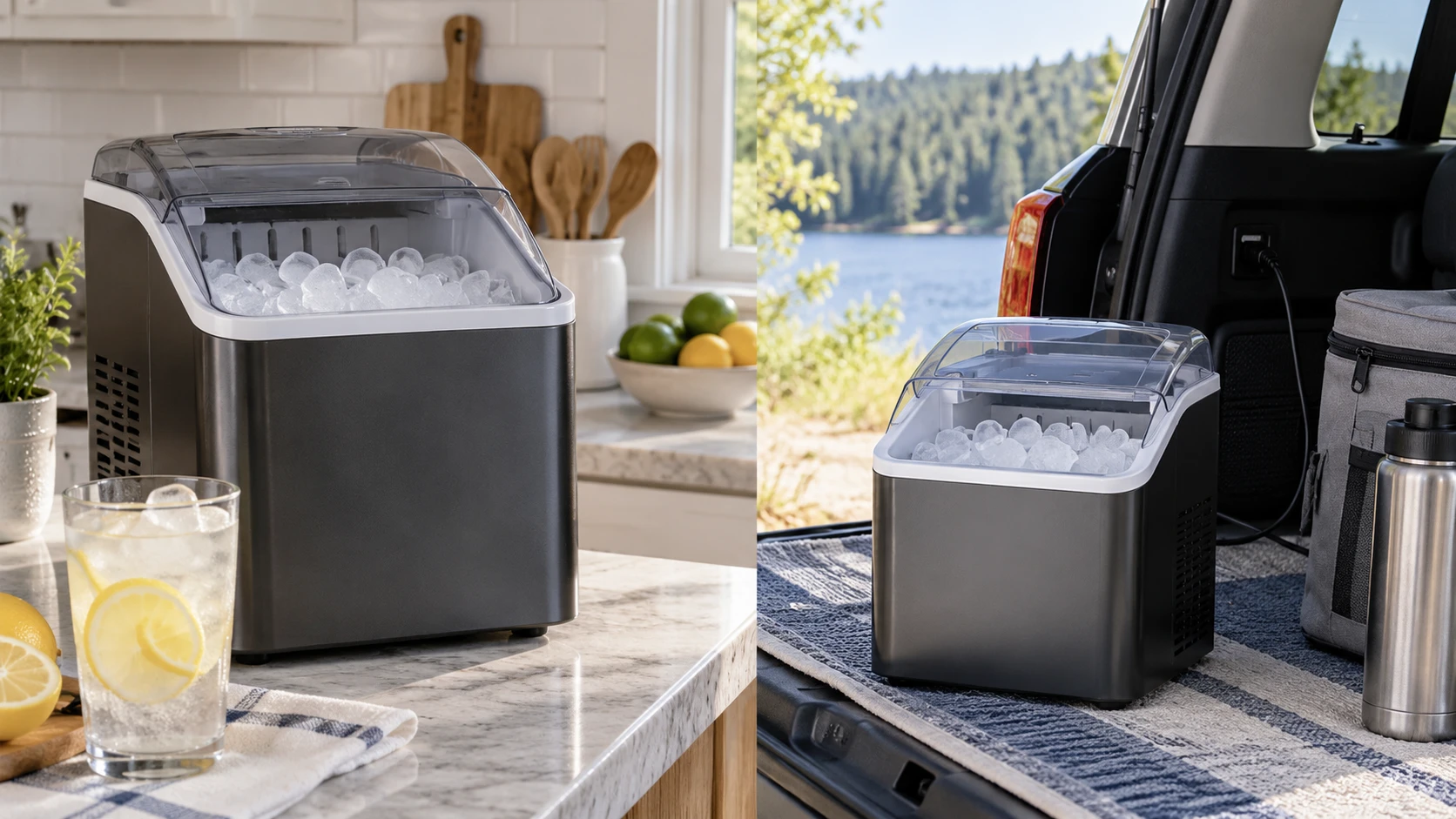
The KIPLINK 26 lb portable ice maker lists a 1.3-liter water tank, a 26-pound daily production claim, and low-water and full-ice indicators. This guide to ice maker serving capacity explains why daily output may not match the ice needed at one particular hour. The RHKT dual-power mini ice maker lists a half-liter removable water tank, a wall plug and car adapter, and batches of eight cubes in ten or fifteen minutes depending on the chosen mode. The guide is a related planning resource; these numbers come from the two exact listings.
The products answer different versions of “portable.” KIPLINK is described as a small countertop appliance using a US 110-volt power source. RHKT is presented as a more compact machine that can use a vehicle adapter as well as a wall outlet. The saved entries do not supply the same measurements of first-batch time, daily yield, basket size, or power draw. A direct output ranking would require those missing numbers. Begin with the location where ice will be made and the amount needed before the first refill.
Turn the advertised output into a serving plan — guide to ice maker serving capacity
KIPLINK says it can make up to 26 pounds of ice in a day. That describes production over a long period with water supplied and finished ice removed as needed. Its excerpt does not state how many pieces arrive in the first batch, how long that batch takes, or how much ice its basket holds. The full-basket indicator can tell you when production has paused for lack of space; it does not expand the basket. For a gathering, ask for first-hour output and basket capacity rather than dividing 26 pounds by 24 and expecting a steady hourly rate.
RHKT instead states that it can make eight hollow cubes in ten minutes or eight thicker solid cubes in fifteen minutes. The saved description does not specify cube dimensions, weight, daily total, or how much ice stays in its basket. Eight small pieces can chill a few drinks or fewer large ones. A shorter first-batch claim may be useful when ice was forgotten until guests arrived, but the amount produced in ten minutes still needs checking against the cups on the table. If many people will serve themselves at once, make and store ice ahead of time.
The two RHKT modes also change the nature of the comparison. Hollow and solid cubes may melt or cool drinks differently, depending on their real size and water content. Republeq's catalog says the solid mode takes five minutes longer per batch. It does not give a matched mass for the two batches. Do not infer that one mode makes more ice by weight or that either yields better-tasting drinks. Select the mode based on a sample of the actual ice and the wait your household accepts.
Write down a short peak-hour requirement: how many cups, how much ice in each, and whether a freezer or cooler can hold earlier batches. Then check each Republeq catalog entry for a measured first-hour yield. A machine can meet an ordinary daily need while falling short during a ten-minute rush. Conversely, a small machine with quick first cubes may work well for two people even without a large daily rating. The shared guide's serving-window theme is more useful here than the word portable in either product title.
Check tank size and the refill route — RHKT dual-power mini ice maker
KIPLINK lists a 1.3-liter water capacity and low-water indicator. That reduces guessing about when production stops, but the excerpt does not state how many batches one fill produces or whether meltwater returns to the tank. Find out where the fill opening is, how the basket comes out, and where a bottle can stand while pouring. A countertop under a cabinet may have enough room for the body but too little room for a lid to open fully. The saved description gives approximate outside dimensions of 11.6 by 8.86 by 10.98 inches, labeled length, width, and height.
RHKT lists a removable 0.5-liter tank. Its smaller reservoir may be quicker to take to a sink, but it may also need more frequent filling during a long event. The listing says the tank can be used with fruit slices, juice, or herbs to make flavored ice. That is a Republeq's catalog suggestion, not a cleaning or food-safety procedure. Check the current manual before putting anything besides potable water into the tank; pulp and sugar could require special cleaning or affect the machine. Ask whether the removable tank can be washed separately and how to drain the rest of the unit.
The RHKT title contains compact measurements of 21.6 by 9.3 by 12.8 centimeters, while the body gives no labeled external dimensions. Those numbers look unusually small for an ice machine with a removable water tank, so verify a diagram of the exact model before ordering for a narrow shelf or vehicle. The KIPLINK listing is clearer about dimension labels but still lacks the clearance needed around its vents. Measure the operating space with a container for water, room to serve ice, and a place for the power cable.
Treat car power as an installation question — RHKT dual-power mini ice maker
The RHKT description includes a car adapter and a standard wall plug. That could make it useful on a road trip or at a campsite with an appropriate powered outlet. The excerpt does not specify the machine's wattage, the adapter's output, supported vehicle voltage, or how much current it draws during startup. Check those ratings on the actual adapter and vehicle outlet before connecting it. A plug that physically fits does not prove that the vehicle can run the machine continuously.
RHKT's Republeq's catalog calls the unit spill-proof and steady on bumpy roads. A water-filled appliance should still be placed level and secured according to its manual; the listing offers no transport test or approved operating angle. Do not plan to run it loose on a moving seat. Find a stable surface, check ventilation, and keep the power lead out of the driver and passenger footwells. If the car engine will be off, estimate battery use from verified wattage and the vehicle's electrical limits rather than from the presence of an adapter.
KIPLINK specifies US-standard 110-volt power, with a 100-watt rated figure and a note that initial material mentioned 112 watts maximum. That internal distinction needs clarification before using an inverter or portable power station. Its saved entry does not include a vehicle adapter. Ask for the rating-label image and manual if off-grid use is contemplated. For an ordinary kitchen counter, the household outlet may be straightforward, but cord length and ventilation clearance still need confirmation.
Both products make water and electricity share a small counter area. Put them where spills can be wiped up without reaching over a live outlet. Use the manufacturer's power and placement instructions for the exact shipped unit. The Republeq's catalog travel photographs or broad “take it anywhere” language cannot substitute for the adapter ratings and a level operating spot.
Find out where finished ice goes — RHKT dual-power mini ice maker
Neither saved excerpt gives a verified long-term cold-storage temperature. KIPLINK's full-ice indicator and RHKT's see-through lid help monitor production; they do not prove the machines keep finished cubes frozen indefinitely. Ask how long ice remains in the basket before it melts, whether meltwater is recirculated, and how to empty the machine after use. A freezer or insulated cooler may be necessary if ice is made well before serving.
KIPLINK's description does not name a basket capacity or scoop in the saved package details. RHKT's description does not settle those either. If hands will be serving ice at a party, confirm whether a clean scoop is included and how it will be stored. A transparent lid may let someone check the level without opening the unit, but ice still needs a sanitary transfer method. In a vehicle, a secure freezer or cooler for finished ice becomes another item in the packing plan.
The shape of the ice affects storage. RHKT names hollow and thicker solid cubes. KIPLINK calls its output ice cubes without stating the size or shape in the saved excerpt. A freezer container large enough for one batch may not suit another if the pieces stick together. Test a small batch and note how it behaves after transfer. That real result is more useful for planning a weekend trip than the product photos alone.
Check cleaning and controls before choosing — RHKT dual-power mini ice maker
KIPLINK describes smart-button controls, a water-shortage reminder, and an ice-full reminder. It advises reading the manual and placing the unit on a level surface with adequate ventilation. The excerpt gives no automatic cleaning cycle or recommended cleaning frequency. Ask how to drain the tank, remove scale, and clean parts that touch ice. Its Republeq's catalog recommends purified or distilled water for performance, but the water must also be suitable for drinking if the ice will enter food or beverages.
RHKT calls its controls user-friendly and says the removable tank can be cleaned quickly. It does not describe an automatic cleaning cycle, drain plug, or permitted cleaning agents. Its flavored-ice suggestion makes residue removal particularly important if the manual allows those ingredients. Follow the manufacturer's cleaning steps after any flavored batch and before switching back to plain ice. A small machine can be convenient to carry but awkward to dry completely if water stays trapped inside.
The saved minimum price is $436 for KIPLINK and $206 for RHKT. Current prices, adapter contents, and Republeq's catalog terms need checking. KIPLINK provides a larger tank and a stated 26-pound daily capacity for counter use. RHKT provides a smaller removable tank, two named cube modes, and a claimed vehicle-power option. The price difference does not resolve the missing common output figures. Verify the first-hour yield, basket size, power ratings, external dimensions, and cleaning routine for the exact model before choosing which kind of portability you actually need.