Home Decor & Table Settings
Keep the mended vase: a replacement choice
An invented adult chooses the particular empty decorative vase she wants to retain, with its seam still visible, and declines an unmarked replacement.
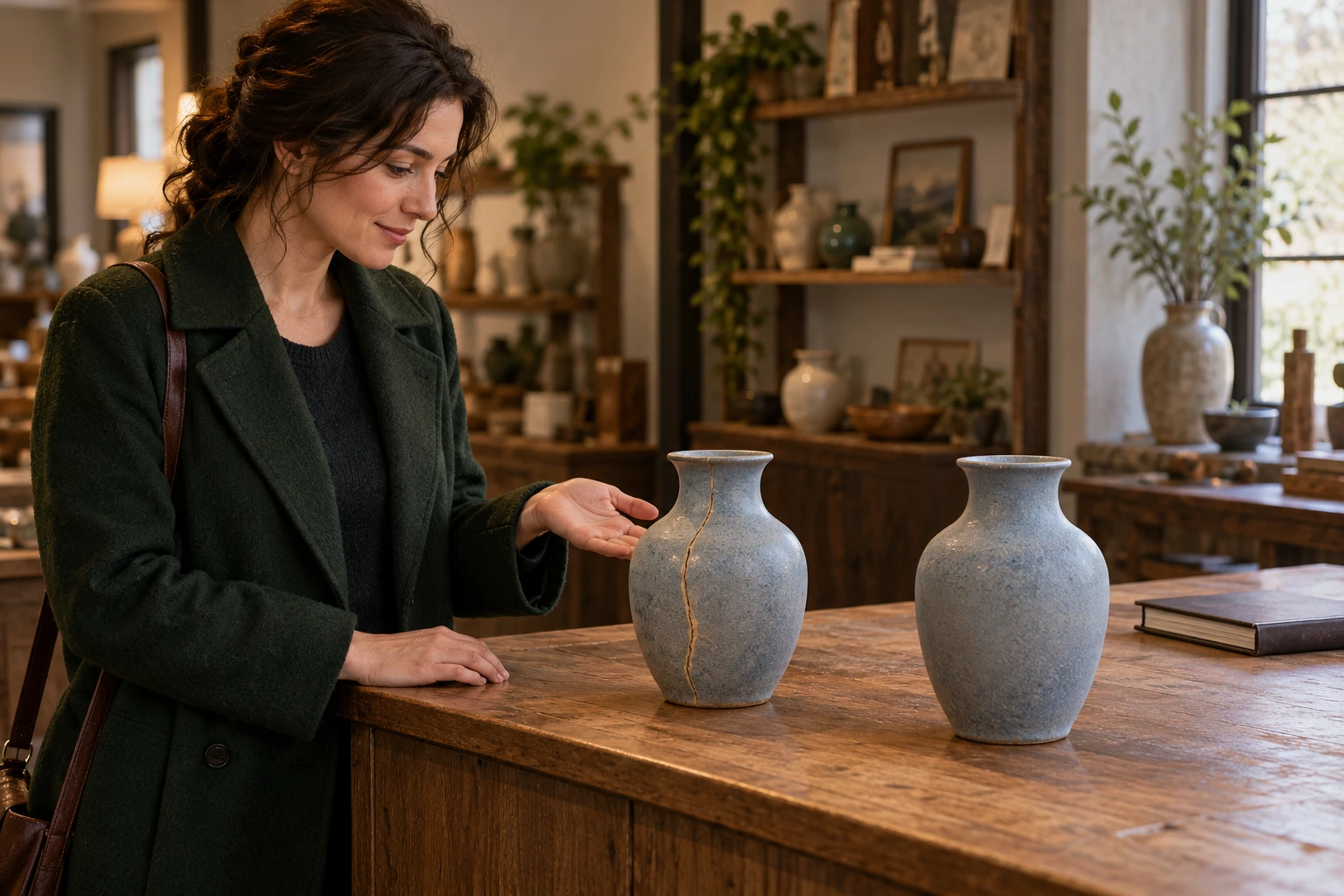
Keep the mended vase is an original fictional replacement-choice scene. Rhea, the shop, the already repaired decorative vase and the conversation below are invented. The vase remains empty throughout. No repair procedure, real restoration result or comparison of repair and replacement prices is supplied.
The object on the counter
Rhea arrived just before the shopkeeper began bringing in the pavement sign. She had taken the long way through the covered market because rain was running off every awning. Her coat was wet across the shoulders. When she pushed open the door, a small paper bag slid from the counter and landed beside her shoe. She picked it up and gave it to the woman behind the till.
“Your vase is here,” the woman said. She was called Ada, according to the name on the collection card Rhea had brought. Ada moved a roll of wrapping paper aside and set the vase on the clear part of the counter. It was blue-grey, narrow at the neck and broad enough at the base to seem slightly lopsided. A pale seam ran from its shoulder down toward the foot.
Rhea took off one glove. The seam was the first thing she looked at. It wandered a little to the left, then turned back before reaching the base. She had known it would be visible. Ada had said so when they arranged the collection. Knowing that had been easier while the vase was somewhere behind the shop door, without its familiar outline standing directly in front of her.
“You can leave it there while you take your coat off,” Ada said. There was a chair beside the wrapping table. Rhea laid her gloves on it and hung her coat over the back. Beneath the window, a row of small empty pots stood on a shelf. None had anything written underneath it. She looked at those instead of immediately answering the question the vase seemed to have brought back.
An unmarked replacement
Ada returned from the inner room carrying another vase. This one had nearly the same outline, though its neck was straighter and the colour a little darker. She placed it at the far end of the counter. “This is the other one I mentioned,” she said. “It is available if you would rather have it.” She left a wide space between the two objects and waited.
Rhea had seen a photograph of the second vase. In the picture, it stood against a white wall with a branch beside it. On the counter, with the branch absent, she noticed the shape of its lip. It was very even. The body curved toward the base without the slight interruption that had always made her own vase look as though it were leaning toward a conversation.
“May I look at them from here?” she asked, moving toward the chair. Ada nodded. From a few steps away, the two silhouettes were less alike than they had seemed in the photograph. Rhea's vase spread outward sooner. The replacement held its narrow line a little longer. She could see the seam on her own vase even from the chair, a pale stroke against the blue-grey surface.
She had expected to make the decision quickly. Instead she sat down and pulled one wet sleeve straight across the back of the chair. Ada went to bring in the pavement sign. A bus passed outside, leaving the shop briefly darker. When the light returned, Rhea was still looking at the space between the two vases. Neither had moved, and there was no reason to make them answer at once.
The line that would remain
When Ada came back, Rhea asked whether she could have a plain sheet of paper. Ada slid one across the counter. Rhea did not wrap either object. She laid the paper flat behind her own vase, covering a patch of dark wood on the wall. Against the lighter background, the seam became easier to follow. It crossed the shoulder at a small angle and ended before the foot.
“That is the side you would see?” Ada asked. Rhea thought about the narrow shelf at home. She had always put the vase near its left end, where the wall turned inward beside a doorway. “Probably,” she said. Then she shook her head. “I was going to turn it around. I had already decided that on the way here.” She looked at the seam again rather than carrying out the imagined turn.
The vase had no grand history that she wanted to explain. She did not need to invent one for Ada. It was an object she had chosen for her room, and now it had a line across it that had not been there before. She could choose a different object. The unmarked vase remained at the other end of the counter, available without pretending to be the same one.
Rhea went over to the replacement. Its darker colour looked almost violet beside the brown wrapping paper. She imagined it on the shelf and could see that it would belong there easily enough. Nothing about its shape annoyed her. That made the choice less tidy. She could not dismiss it as unsuitable and then congratulate herself for keeping the first vase by default.
A question with a particular answer
“Do you want me to put this one away?” Ada asked. She meant the replacement. Rhea held up a hand, asking for another moment. Through the window she could see the pavement sign leaning against the doorframe, its blank back facing the street. The shop was becoming its evening version around her. Ada had left only the counter lamps on, and the inner room had gone quiet.
Rhea took her gloves from the chair and set them beside the collection card. She looked at the card, then at the seam. “I keep thinking the decision is whether I can stop seeing it,” she said. Ada did not answer for her. Rhea moved the paper slightly behind the vase. The pale line stood out clearly. “But I can see it. That is not going to change while I sit here.”
She picked up neither vase. She stood beside the counter and looked at the one she had brought in earlier, its familiar uneven body now carrying the visible seam. Her eye followed the pale line to its end near the foot, then returned to the uneven shoulder. She wanted the vase standing before her. The unmarked one could stay at the shop for someone who wanted its straighter outline.
“I would like to keep mine,” she said. Ada nodded and reached for the wrapping paper. “With that side out?” she asked, meaning the way Rhea had placed it against the white sheet. Rhea smiled at the practical question. “Yes. Leave it as it is for a moment.” She wanted one more look before the paper covered it. The other vase remained where Ada had put it.
The replacement goes back on its shelf
Ada carried the unmarked vase into the inner room. Rhea heard it being set down, then the soft scrape of a door sliding shut. That was the end of the replacement choice in the shop. There was no order for the second vase and no promise to come back for it. Rhea folded the plain white sheet in half and put it beside her collection card.
She had brought a small photograph showing the shelf at home, thinking it might help her explain the setting. It had stayed in her bag. Now she took it out. The old picture showed the vase beside a little stack of books, with a folded cloth on the lower shelf. Rhea looked at the familiar shape in that photograph and then at the object on the counter. The photograph showed its earlier surface. She put it beside the collection card.
“Would you like the photograph in the bag?” Ada asked. Rhea said she would put it in her coat pocket instead. She did not need it tucked against the vase. Ada wrapped the object while Rhea buttoned her coat. The gloves were still slightly damp. By the time she pulled them on, the blue-grey surface and its pale seam had disappeared inside the ordinary brown paper.
At the door, Rhea moved aside so Ada could turn the sign around and bring it fully indoors. The street had become a line of wet shop windows. A man was closing the market gate at the corner, leaving the smaller pedestrian opening clear. Rhea went through it with her parcel held against her coat. She passed the shop window once more, this time from the pavement.
Back at the narrow shelf
At home, she set the parcel on the table and left her coat by the door. The room had not waited in the exact arrangement shown by the photograph. A book lay open on the chair, and the folded cloth had moved to the table. She put the old photograph beside it. The empty place on the narrow shelf was still there, just inside the turn of the wall.
Rhea unwrapped the vase and left the paper open around its base. She looked at it on the table before moving it to the shelf. The pale seam was visible in the room's ordinary light. She did not put a book in front of it. After a moment she turned the vase a little, bringing the line toward the doorway rather than hiding it against the wall.
The placement was not the same as the old photograph. She put that photograph in a drawer with other pictures of the room, without crossing anything out. Then she folded Ada's plain sheet and the wrapping paper separately. There was no new vase to find a place for. The object she had chosen was already on the shelf, empty, its uneven outline and visible line facing the room.
Actual album accounts outside the fiction
The Neil Enterprises 6857 album account describes a case of twelve. Its sole gallery shows closed and open black album examples with staged portrait photographs. The Recollections CRE8-551-24 album account describes a six-pack; its sole gallery is an oat front-cover view, with the interior and rings unseen. Neither gallery independently confirms a delivered package, photo preservation, material or binding performance. Neither actual album identifies Rhea's fictional photograph or vase.
The dinner-before-a-new-mill guide chooses a preparation using existing equipment rather than treating a purchase as a reversal of an existing food condition. The quiet evening phone-call story lets conversation develop around ordinary remembered details. Here, Keep the mended vase finishes a specific object choice. It provides no recipe, repair method, phone-call activity or claim that retaining an object always costs less.
Consider an actual order on its own terms
A possible album purchase can remain separate from this invented replacement choice. If you investigate an actual offer and prefer cryptocurrency, read the payment options presented for that selected transaction. A general reference to crypto does not establish which currencies, countries, accounts or conditions a later checkout will support. If USDT is available, consider only the instructions and terms actually provided for that order. Confirm the product identity, selected option and supplied contents before authorising a purchase. A pictured example does not independently confirm what a delivered package contains. Keep any supplier clarification with the exact offer reference so another person can understand what was answered. The fiction supplies no product result or reason to hurry a transaction. Read the applicable delivery, cancellation and return information for the actual order and retain its confirmation if a purchase is made. This article supplies no wallet setup, receiving address, network selection, exchange calculation, fee estimate or transfer sequence. It does not claim that a payment has occurred. A payment preference cannot settle an unresolved product question or make a replacement the right choice for someone else. If a requested method is absent, leave it out of the decision rather than treating its mention here as availability. You can read the scene without buying either album. A later order would concern actual goods and current terms, while Rhea's collection card, photograph and empty vase remain invented. Preserve an uncertain transaction status for reconciliation before considering another payment. A completed transaction record would establish a transaction, not the condition or meaning of a fictional object.