Crypto Commerce
KATIDAP 4.3-cu-ft mini fridge vs KRIB BLING mini fridges for fresh and frozen food
Compare KATIDAP 4.3-cu-ft mini fridge by fresh-food and freezer space, cabinet fit, temperature claims, doors, and source details to verify.
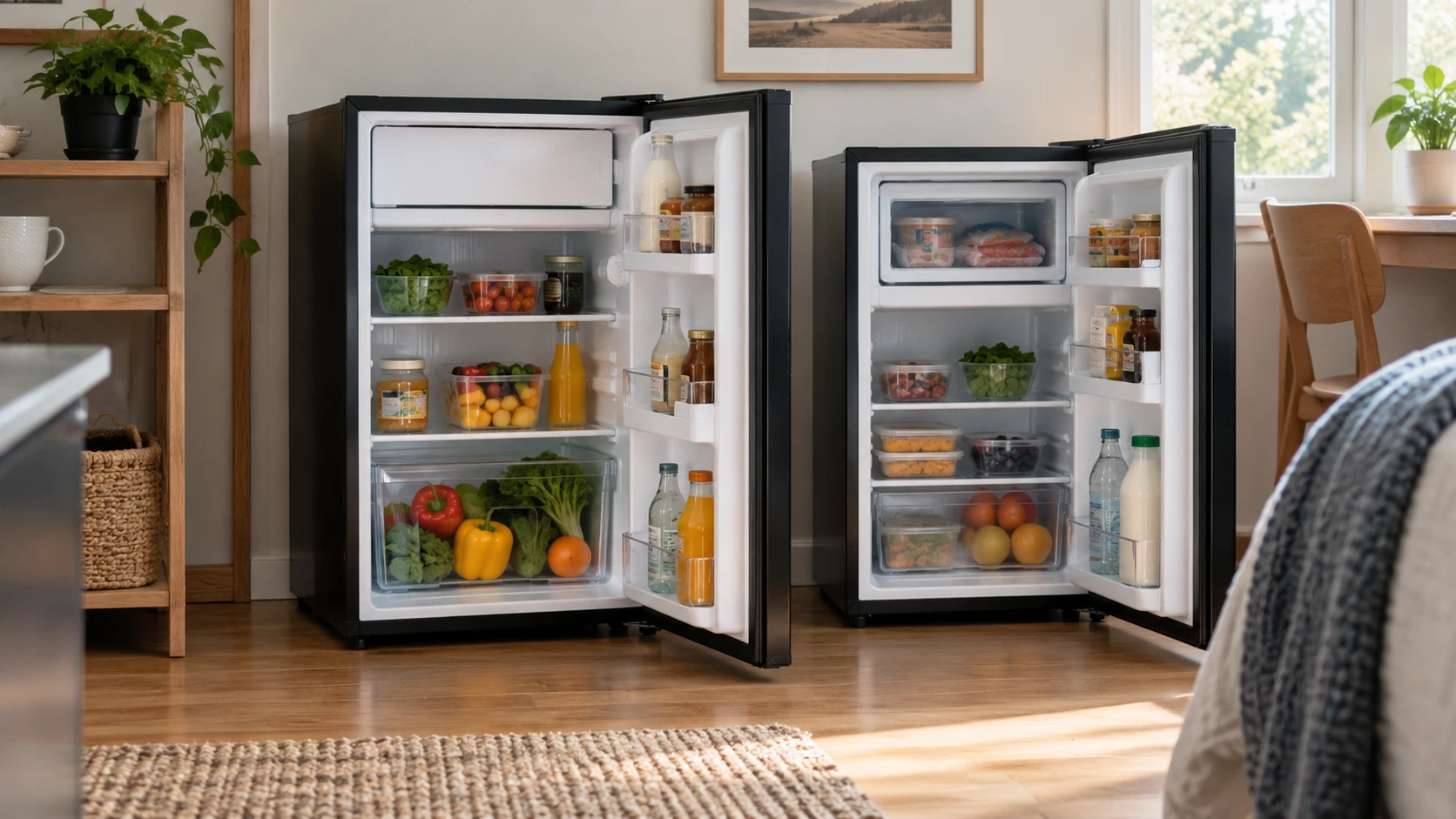
The KATIDAP 4.3-cu-ft mini fridge lists 3.88 cubic feet of refrigerated space and 0.42 cubic feet of freezer space. The KRIB BLING description lists 2.4 cubic feet for fresh food and 1.1 cubic feet for its freezer. If those figures describe the units currently offered, KATIDAP gives much more room to chilled groceries while KRIB BLING devotes more of its cabinet to frozen food. Neither figure tells you whether your usual containers fit on a shelf or through a freezer opening, so the useful comparison starts with the food you actually store.
There is a significant source conflict to settle before buying KRIB BLING. Its product title calls it a 3.2-cubic-foot mini fridge, while the saved description calls it 3.5 cubic feet. The two compartment numbers in that description add to 3.5. Do not treat either total as confirmed for the exact model or color without a current manufacturer specification. A different batch, title error, or copied description could explain the mismatch, but the saved source does not establish which one is responsible. Check Republeq's product page for the model number and a dimensioned interior drawing before making a volume-based decision.
The published guide on mini fridge compartment capacity explains why a combined cubic-foot figure is only a starting point. Shelves, door racks, insulation, and the shape of the freezer opening all affect what you can use. Its examples are general guidance, not tests of these two refrigerators. Measure a tall bottle, your widest meal container, and the frozen package you buy most often. Then compare those measurements with current interior photos and the manufacturer's clear-opening dimensions. This exercise can rule out a unit that looks generous on paper but is awkward to load.
Choose which compartment deserves the space — mini fridge compartment capacity
KATIDAP's saved description names a crisper drawer and adjustable, removable shelves. They offer a way to make room for a taller item, though moving or removing a shelf may reduce the number of separate surfaces available. The description does not give shelf widths, drawer volume, or door-bin dimensions. If several people share the fridge, ask where drinks and lunch containers can sit without blocking the crisper. Its stated 3.88 cubic feet of refrigerated space is the stronger reason to consider it, but the layout must still work for your weekly groceries.
KRIB BLING describes two removable glass shelves in its refrigerator section, along with an egg rack and a beverage rack. Those features may help organize smaller items. Check where the racks sit and whether bottles in them protrude into the main compartment. The stated 2.4-cubic-foot fresh-food section is notably smaller than KATIDAP's. A household that keeps several days of produce, leftovers, and drinks might feel that difference. Someone who already has a full-size refrigerator and wants frozen overflow may prefer to allocate more of the mini fridge to the freezer instead.
The freezer comparison cuts the other way: KRIB BLING claims 1.1 cubic feet, while KATIDAP claims 0.42 cubic feet. A larger stated freezer section could help with frozen meals or ice, but check usable width and height before assuming a box will lie flat. The KRIB BLING listing describes a double-door cabinet with separate access to the freezer and refrigerator. The KATIDAP product URL identifies a single-door model, while its saved description does not spell out the door arrangement. Confirm both door designs from current product photos and manuals. Door access can change how much cold air escapes during a quick drink stop, but these sources do not quantify that effect.
Write down a one-week food inventory rather than guessing from a capacity figure. Include containers that need to stand upright and packages that cannot be bent. Keep some room to retrieve items without unloading an entire shelf. If your freezer is mainly for ice trays, KATIDAP's extra fresh-food volume may be more useful. If you routinely store frozen meals, KRIB BLING's advertised freezer allocation deserves a closer look, subject to resolving its total-capacity conflict. Neither unit should be chosen solely because its category says “mini fridge”; the proportions serve different habits.
Check the cabinet against the room — KRIB BLING double-door mini fridge
KATIDAP lists outside dimensions of 20.63 inches wide, 20.94 inches deep, and 32.72 inches high. KRIB BLING lists 17.91 by 15.75 by 35.28 inches, but its saved description does not label the axes. KRIB BLING appears taller from the numbers given, yet the first two measurements need a verified width-depth order before you plan a narrow alcove. Measure the path through the doorway, the final floor area, and any shelf above the intended spot. A cabinet that fits the bare rectangle may still be hard to use once its door opens.
Ask for the exact installation clearances in each current manual. Neither short description provides the full ventilation space, cord reach, or hinge swing. If the fridge will sit beside a desk or wall, tape the cabinet's proposed outline on the floor and test how the nearby furniture opens. KRIB BLING's separate freezer door adds another opening to consider. For KATIDAP, verify whether the door can be reversed before committing to a corner location. The listing's statement that it occupies about three square feet is not a substitute for clearance around the installed appliance.
A dorm room, office, and bedroom may each impose different limits. The quietest corner may lack an accessible outlet; an open floor area may put the door in a walkway. Think about where food will be prepared and where meltwater could be handled during cleaning. Leave yourself enough access to pull the fridge forward when the manual calls for maintenance. Neither product description supplies enough installation detail to approve a cramped enclosure. The room plan should come from the exact model documentation, not a generic photograph of a compact refrigerator.
Read temperature claims with care — KRIB BLING double-door mini fridge
KATIDAP advertises seven thermostat settings and a refrigerator range of 32 to 46.4 degrees F. Its description also gives 37 to 41 degrees F as a range for perishable food. KRIB BLING likewise advertises seven settings, with its refrigerator described as 32 to 50 degrees F. These ranges are broad. They do not establish that a particular dial position will hold food at the right temperature in your room. Use a thermometer in the fresh-food section after installation, allow time for temperatures to settle, and check it again after normal door openings.
The KRIB BLING freezer description gives the range in an unusual order, “3°F -1°F.” That wording is too unclear to use as a performance promise. Confirm the intended freezer range with the manufacturer and measure the compartment under ordinary use. KATIDAP's short description does not give a separate freezer temperature range. Do not infer one from its refrigerator thermostat figures. The saved sources also do not establish whether either unit has independent controls for the two sections. If one setting affects both, observe the freezer while adjusting the refrigerator.
A dial's seven positions are controls, not seven independently verified food temperatures. Room temperature, load, and door-open time can change what the compartments actually hold. Use current food-safety guidance for the foods you keep, especially meat, dairy, and frozen meals. Ask about permitted ambient conditions if the appliance will be in a garage or another space with large temperature swings. A headline cooling range does not tell you how quickly the freezer recovers after you add several warm items or open its door repeatedly.
Allow for noise, power, and upkeep — KRIB BLING double-door mini fridge
KATIDAP's listing quotes a 40 dB operating figure and energy use as low as 0.5 kWh per day. Those are claims in Republeq's catalog, not measurements made in your room. Find the current energy label or test basis for the exact model if running cost is important. KRIB BLING's saved description does not give a comparable energy-use figure, so a numeric energy comparison would be guesswork. Appliance temperature settings, ambient conditions, and door openings can all affect consumption. Use the same units and test conditions before comparing estimated bills.
KRIB BLING mentions an LED interior light that turns on when the refrigerator door opens. That may help in a dim room, but check whether the freezer has a light if that matters to you. Its description also promotes quiet operation without giving enough comparable test detail in the saved excerpt to rank it against KATIDAP's quoted sound figure. A compressor start or cabinet vibration may be more noticeable near a bed than a single sound-level number suggests. Make sure the cabinet is level and does not touch loose objects that can rattle.
Neither saved excerpt gives a complete defrost procedure. Find the manuals before you rely on either freezer for regular food storage. Ask how frost is removed, where water goes, and whether food needs temporary storage during cleaning. The size and shape of the freezer opening will affect how easily you can wipe it out. Plan a place for food during a power outage as well; neither source provides a validated holdover time. Food that feels cold after power returns is not enough evidence to judge whether it remained safe.
The KRIB BLING double-door mini fridge is the freezer-focused option on its saved compartment figures, but its 3.2-versus-3.5-cubic-foot conflict needs a Republeq's catalog answer. KATIDAP's stated split favors refrigerated groceries, and its outside dimensions have a clear width-depth-height order. Bring your food measurements and room plan to both listings, resolve the mismatched specification, and verify operating temperatures with thermometers once the chosen unit is installed.