Crypto Commerce
Jura GIGA 10 automatic espresso machine vs OutIn Nano for home and travel espresso
Compare Jura GIGA 10 automatic espresso machine by drink choices, water heating, power, carrying, cleaning, and source limits.
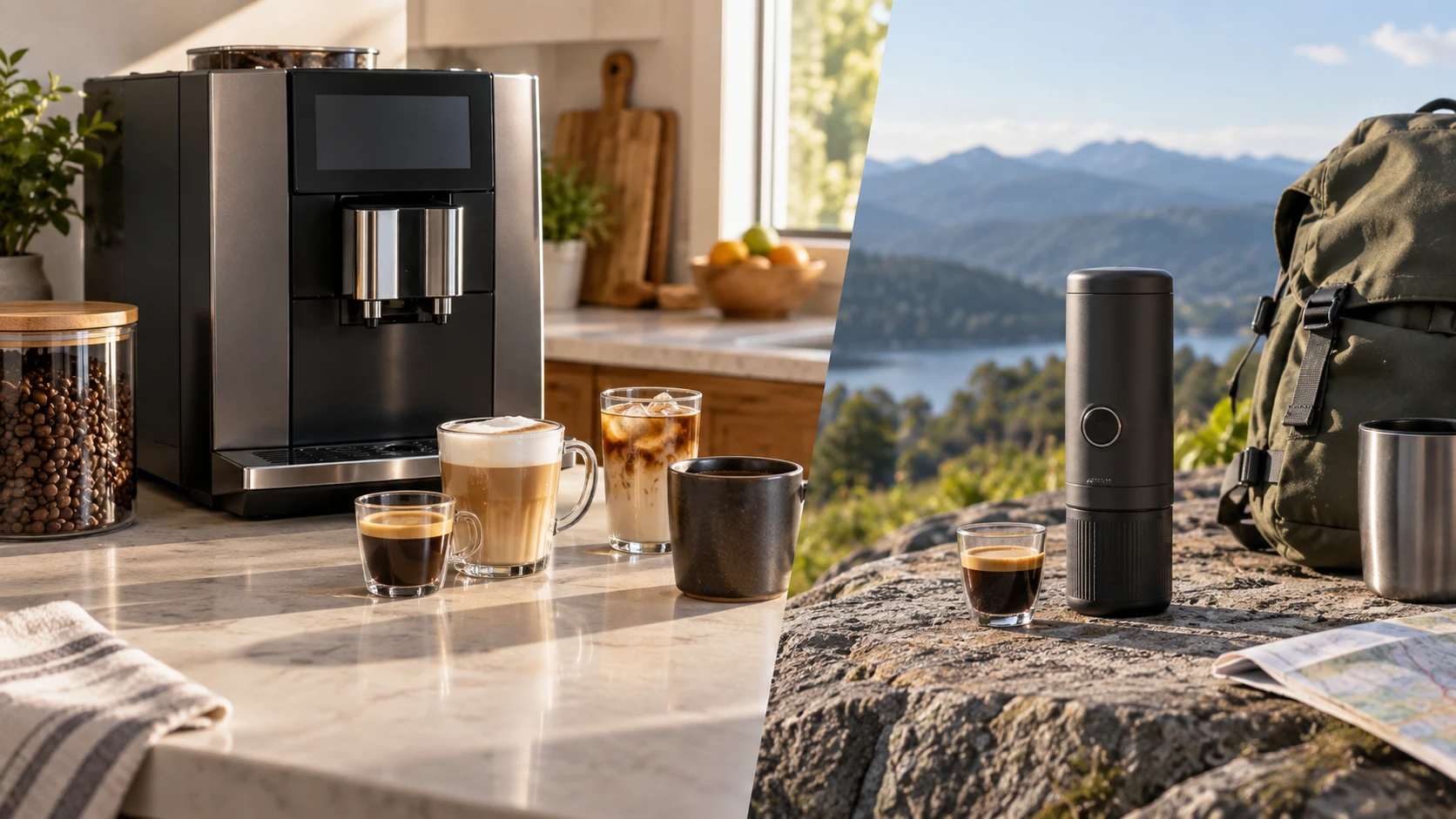
The saved listings for the Jura GIGA 10 automatic espresso machine and the OutIn Nano address different places to drink coffee. Jura describes a roughly 40-pound countertop machine with a 6.7-inch touchscreen, 35 drink possibilities, hot and cold specialties, and parallel preparation. OutIn describes a 670-gram battery-powered travel brewer that heats a small measure of water and makes individual espresso shots. A buyer might consider both when deciding whether coffee should be made at a fixed home station, carried to another location, or split between the two. Their specifications answer different questions, so a single pressure or temperature number will not identify a universal winner.
Write down the normal coffee day before shopping. How many drinks are made in a row, where are they made, and who cleans the equipment afterward? A household serving several people at breakfast may value Jura's menu and claimed parallel preparation. Someone traveling by car or carrying a kit on a hike may care about OutIn's weight, charge, and water requirement. If the coffee is made mostly at home but carried in a mug, a good home machine may be enough. If it is made at a desk or campsite without a kettle, a self-heating brewer might solve a problem that a countertop appliance cannot.
A drink menu and a single serving — OutIn Nano portable espresso machine
Jura's listing says there are 35 possibilities, including hot and cold brew specialties, and describes drinks made from freshly ground beans rather than capsules. The saved excerpt does not list all 35 choices or say how many are variations in volume, strength, temperature, or milk. Obtain the exact drink menu for the model on sale. If the household wants cappuccino or a particular cold drink, check the ingredients and accessories it requires. A menu item can be appealing while still needing a separate milk container, ice, or a cleaning step that changes the daily routine.
The Jura source also mentions parallel preparation. Ask what that means in practice: two black coffees, two milk drinks, or another combination. Check whether both drinks can be selected together and how long the machine takes to finish them. A large screen and many recipes may be useful for shared use, but the saved listing does not give a measured serving rate. A small household that makes one espresso at a time may use only a fraction of the menu. Count the actual favorites before treating 35 as a benefit.
OutIn's source focuses on a single portable extraction. It states that the machine heats 1.7 ounces of water from 77 degrees Fahrenheit to 198 degrees Fahrenheit within 200 seconds. That is a specific claim in Republeq's catalog under stated starting conditions, not an independent runtime test. Check the volume of the finished drink and whether the unit can handle the amount of water you prefer. If two people want coffee, plan for two preparation cycles and a refill. Travel convenience depends on the complete sequence, including filling, loading coffee, brewing, emptying, and cleaning.
Neither excerpt provides a controlled taste comparison. Jura's listing names 3D Brewing Technology and intelligent preheating but does not show measured extraction results. OutIn claims a 20-bar pressure system and rich crema, using language that compares it with professional desktop machines. A pump rating and crema description do not prove that the cup will taste like one from a much larger machine. Beans or capsules, grind size, dose, water, and cleaning affect the outcome. A repeatable recipe is more useful for assessment than relying on a pressure number alone.
Beans, coffee input, and the missing setup details — portable espresso versus capsule convenience
Jura says its drinks use freshly ground coffee rather than capsules, yet the saved description does not give grinder capacity, settings, or the way a second bean type is handled. Ask how beans are loaded, whether the grinder can be adjusted, and how to make decaf if one person needs it. The product title mentions Capresso coffee beans and accessories, but the excerpt does not enumerate the bundle. Confirm the exact box contents and whether those items are included by the current Republeq's catalog. An accessory pictured beside a machine should not be assumed to arrive in the box.
OutIn's saved description does not specify the coffee-loading format. It may matter greatly whether the exact package uses ground coffee, a capsule, an adapter, or an included basket. Do not infer compatibility from another OutIn product or a travel-coffee photograph. Request the manual and box list for the precise model. Check how much coffee can be loaded, whether a grinder is required before leaving home, and how spent grounds are carried away. A portable brewer saves space only if the full kit, including coffee, water, cup, and cleaning supplies, remains practical to carry.
The published guide on portable espresso versus capsule convenience is relevant to that input decision. Capsules can simplify portioning but create a compatibility and supply question; loose coffee adds preparation and cleanup. The Jura listing explicitly says it grinds beans. For OutIn, the saved excerpt leaves the input unsettled, so verify it before buying any capsules or grinder. That question also changes the comparison's running cost and the amount of waste each routine produces.
Power and water away from a kitchen — OutIn Nano portable espresso machine
OutIn says it has a 7,500 mAh battery and can be charged with a 10- to 15-watt USB-C car charger. The listing claims up to five hot shots when starting with 1.7 ounces of 77-degree water, or more than 200 shots when already using hot water. Those figures describe very different workloads: heating water consumes much more energy than pumping water that is already hot. Do not read the larger number as the travel-day capacity for self-heating shots. Ask for the maker's charge-time and battery-care instructions, and test the exact routine before relying on it far from power.
The stated 200-second heating time starts with room-temperature water. A cold bottle on a winter trip could alter the result, as could a battery that is partly discharged. The saved source does not give a low-temperature operating range or an independently tested shot count. Carry safe drinking water and follow the maker's filling instructions. Check whether it can brew while charging and which chargers are approved before planning a car-powered coffee stop. A USB-C connector alone does not show that every phone charger or power bank supplies the right power.
Jura's countertop position brings a different power question. Its saved excerpt gives an approximate 40-pound weight but no electrical rating or complete dimensions. Check the voltage and plug for the region where it will be used, place it near an appropriate outlet, and measure clearance for the water tank and bean access. A fixed coffee station needs space to remove and clean parts. If the machine is tucked under a cabinet, confirm there is enough height to open lids and reach the touchscreen comfortably. The listing's product photograph cannot settle counter fit.
Cleaning takes different forms — OutIn Nano portable espresso machine
A travel brewer may be small, but grounds or coffee residue still have to be removed between uses. OutIn says its body can be disassembled and washed. It does not identify which parts are dishwasher safe or whether a cleaning tool is included. Find the exact cleaning instructions and practice them at a sink before taking the brewer outdoors. Consider where used coffee and rinse water will go on a trip. Leaving residue sealed in a warm travel bag until evening can make the next cup and cleanup less pleasant.
Jura's saved description does not explain its rinse or descaling program. A large automatic machine may have internal paths for coffee and milk that need cleaning at different intervals. Obtain the manual and list daily, weekly, and periodic tasks, including any required tablets, filters, or milk-system supplies. Do not assume that a touchscreen reminder performs the cleaning itself. If several people use the machine, decide who empties the grounds and drip tray and who orders consumables. The ongoing routine belongs in the purchase calculation.
Water hardness can affect either machine. Follow each maker's guidance for water and descaling, and avoid improvised chemicals that may damage seals or the heating path. OutIn's small water volume may invite frequent refills from different sources when traveling. Jura may sit on a kitchen counter with a consistent tap-water supply. Ask whether a filter is supplied or recommended for the exact model, and keep the cleaning instructions available. A machine that is difficult to maintain may stop fitting the routine even when its first cup tastes good.
Weight, travel kit, and service — OutIn Nano portable espresso machine
OutIn's claimed 670-gram weight describes the brewer itself. Add the water, coffee, charger, cup, and carrying case when deciding whether it is light enough for the trip. Verify leak protection and safe storage of the wet parts in the current manual. A car kit can tolerate a different load from a small hiking bag. If the machine will be used in a workplace, check whether there is a place to rinse it after each shot. Portable size is helpful only when the whole workflow is possible at the destination.
Jura's approximately 40-pound machine is intended to stay in place. Ask whether a service visit requires shipping the entire unit and what packaging would be needed. Neither saved excerpt gives warranty duration, return terms, or local service availability. Check those terms for the Republeq's catalog and region before purchase. Batteries may eventually lose capacity, while countertop machines can need seals, grinders, or other parts serviced. Do not assume both products have the same repair path simply because they are espresso makers.
During the return period, test the thing each machine is supposed to solve. For Jura, make several of the drinks your household actually wants, including two in sequence, and perform the required cleanup. For OutIn, start with room-temperature water, make a realistic number of self-heated shots, recharge with the intended source, and clean the brewer away from the kitchen if that is where it will be used. Record any gap between listing claims and the delivered configuration while Republeq's catalog support is available.
Jura's saved listing points to a broad fixed-station drink menu and shared preparation. OutIn's listing points to a compact, battery-powered single serving with a stated heating time and shot-count assumptions. The OutIn Nano portable espresso machine is worth considering when espresso must be made away from a kettle or kitchen, provided its coffee input and travel cleanup fit the route. Jura's larger machine may suit a household using its menu often enough to justify the counter space and maintenance. The current source excerpts leave both support terms and several setup details to verify before either purchase.