Crypto Commerce
Jinsanity SLA-35A portable fridge vs NEILA 50L for road-trip cold storage
Compare Jinsanity SLA-35A portable fridge by compartment allocation, vehicle and home power, temperature claims, carrying features, controls, and trip packing.
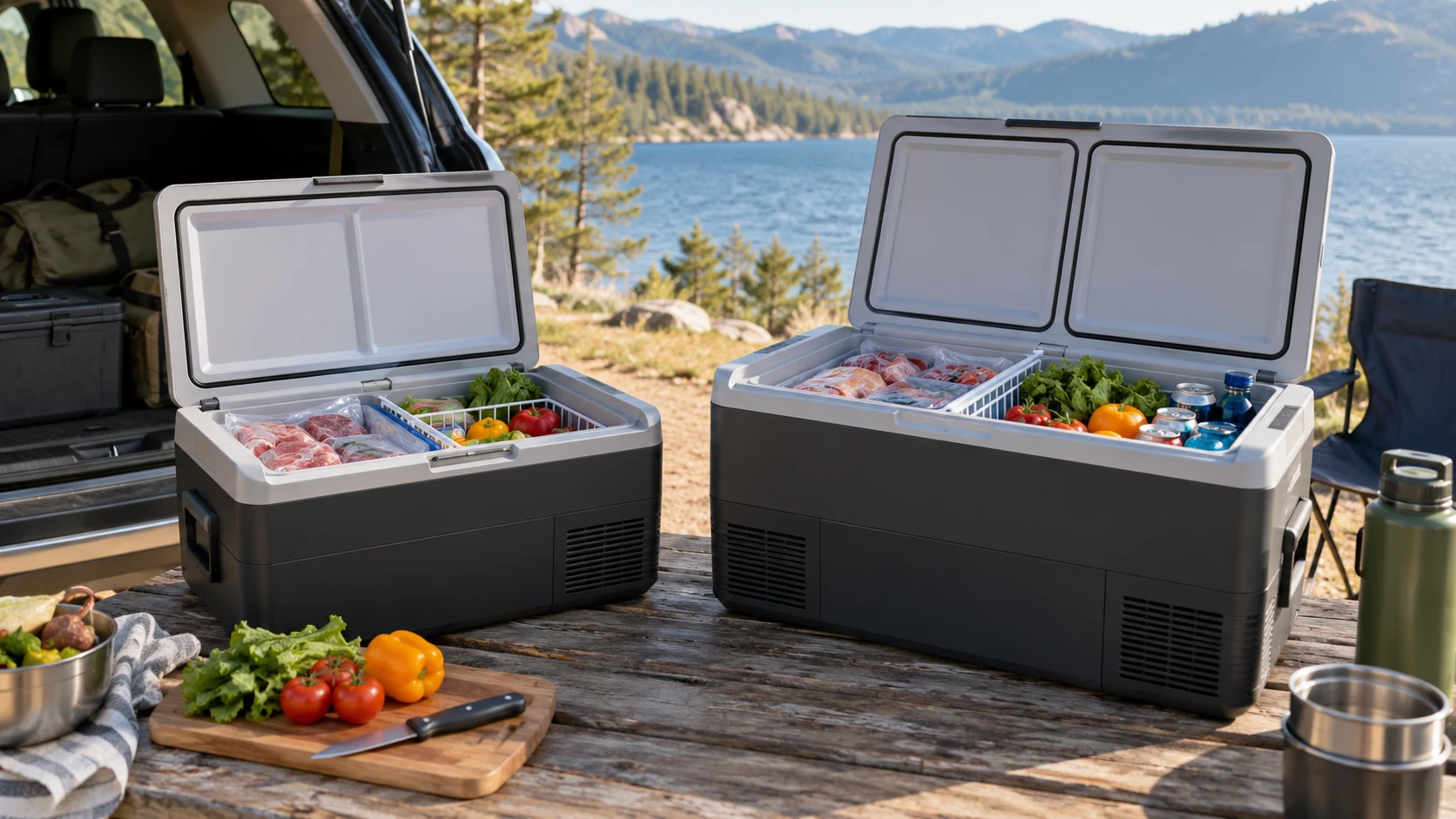
The Jinsanity SLA-35A portable fridge has a stated 35-liter capacity and independently adjustable dual-zone compartments. NEILA's model Refrigerators-8765 lists 50 liters, dual-zone storage, and removable baskets. The extra 15 liters may be useful for a longer trip, but neither saved listing shows how much of its total volume belongs to the cold or frozen side. Start with the food and drinks you plan to carry. A single large package may be harder to fit than several cans with the same combined volume.
The published guide on portable fridge vehicle and home power addresses a setup question shared by these models: where the appliance gets electricity during loading, driving, and an overnight stop. Both listings include AC and DC adapters for home and vehicle use. Check the outlet and plug in the actual car before packing perishables, then work out where the cord will run without crossing passengers or cargo that may shift. A fridge that fits the trunk but cannot safely reach power will not serve the planned route.
The NEILA 50L portable refrigerator names an inverter compressor, ECO and MAX modes, LCD controls, and an insulated protective cover. Jinsanity advertises app and manual controls, wheels, and a USB charging port. Those are different conveniences: NEILA gives more storage and a cover in its saved description; Jinsanity gives more detail on moving and adjusting the unit. Neither source provides a measured loaded weight, exterior dimensions, or operating consumption for a common trip. Obtain those details before deciding which one belongs in a small vehicle.
Divide the 35 or 50 liters before packing — NEILA 50L portable refrigerator
Jinsanity says its 35-liter, or 37-quart, cabinet holds up to 48 cans of Coke, 20 water bottles, or 12 wine bottles. Those are Republeq's catalog packing examples rather than a promise that all three loads fit at once. Bottle shape and the arrangement of the two zones can change the outcome. Ask for interior measurements and a photograph with the divider in place. If frozen food is part of the load, mark which section will run below freezing and how many chilled bottles remain on the other side.
NEILA states a 50-liter, or 52-quart, capacity with two odor-reducing compartments and removable baskets. The baskets can help organize food, but their handles and walls also occupy space. The saved excerpt does not provide separate compartment volumes or basket dimensions. Ask whether both baskets can be removed and whether the unit still operates as intended without them. A useful packing trial puts the largest rigid container in first, then adds smaller items around it. Total liters alone cannot show whether a tall bottle or a wide meal tray clears the lid.
Jinsanity's listing specifically says the temperature in each compartment can be set independently. NEILA names dual-zone compartments but does not spell out whether each has its own setpoint. This distinction matters if the trip needs both chilled food and frozen items. Request a control-panel diagram and a manual example of mixed-temperature operation for NEILA. For either unit, measure the actual temperature in both sections during a normal load. A display setpoint is a target, while food temperature depends on packing, ambient conditions, and how often the lid opens.
The two listings also leave lid access unresolved. If a bottle is needed at every stop, can it be reached without disturbing the frozen side? Neither saved description supplies a detailed lid or divider diagram. Sketch the order of the food you will use and put frequently needed items where they can be retrieved first. Leave enough room to lift a basket or container. A full cabinet is efficient on paper but frustrating if every lunch requires unloading the top layer on the roadside.
Compare the temperature statements carefully — NEILA 50L portable refrigerator
Jinsanity states a selectable range from 68 degrees Fahrenheit down to minus 4 degrees. It says compressor cooling takes the interior from 68 to 32 degrees Fahrenheit in 15 minutes and can reach minus 4. The excerpt does not give ambient temperature, load, zone allocation, or the test method for that speed claim. Treat it as a statement in Republeq's catalog to verify, not a guaranteed cool-down schedule for a warm box of groceries. Pre-chill food when the food's storage instructions require it, and measure the interior with a separate thermometer before depending on the appliance for perishables.
NEILA gives a range of 0 to 50 degrees Fahrenheit and names ECO and MAX modes. The source does not give a time to reach a target or a zone-by-zone range, and its lower stated endpoint is warmer than Jinsanity's minus-4-degree claim. Do not infer that both freezers will maintain the same conditions from the word "freezer" in the product title. Ask how the controls allocate cooling between compartments and whether ECO changes the attainable temperature. Test the settings with the intended AC or DC power source and a typical load.
Both Republeq product records list a 45-decibel operating figure. No matched measurement distance, room, or compressor duty cycle appears in the pinned excerpts. A camper sleeping near the unit may notice cycling and vibration even when two products quote the same single number. Listen to an operating unit if possible, with the lid closed and the compressor running. Check that the place where it sits is stable and meets the manual's ventilation requirements. The listings do not specify clearances, so do not push either appliance tightly into a storage cubby based only on its capacity.
Jinsanity describes three power-saving settings labeled low, medium, and high. The source does not explain whether they govern compressor speed, battery protection, or something else. NEILA names ECO and MAX but gives no measured energy use per day in either mode. A trip plan needs the unit's actual input draw, duty cycle, and available vehicle or battery power. Request the electrical data plate and manual for both. If an auxiliary battery will be used, calculate its usable supply with the accessory supplier rather than treating a mode name as a runtime estimate.
Fit the power route and the vehicle — portable fridge vehicle and home power
Jinsanity includes 12/24-volt DC and 100/240-volt AC adapters according to its listing. NEILA states 12/24-volt DC and 110-to-240-volt AC input, with adapters included. Confirm the plug shape, fuse requirement, and supplied cable length for the exact package. A vehicle socket may be in the dashboard while the fridge is secured in the cargo area. Check whether the outlet remains energized after the engine stops. Neither product excerpt establishes how a particular car manages that outlet, so test it safely before an overnight stop.
Jinsanity lists wheels, cup slots, and a cutting board. These additions may help at a campsite, but the pinned source does not say how much they add to the exterior footprint or whether the cutting board is a loose accessory. NEILA lists removable baskets and an insulated protective cover meant to reduce cold-air loss and protect from dust and scratches. Find out whether the cover must be moved away from ventilation openings while the compressor runs. Do not assume an insulating cover is compatible with every packing position simply because it ships with the appliance.
The products' external sizes and loaded weights are missing from these excerpts. Measure the floor space, lid-opening height, and path through the car door or hatch. Then ask the Republeq's catalog entries for a diagram that includes handles, wheels, cable plugs, and cover. A 50-liter cabinet could carry more food but also be harder to lift into a vehicle; the listing does not quantify that tradeoff. Plan how the unit will be restrained so it cannot slide or tip during a turn. Use the vehicle's cargo guidance and the appliance manual for the securement method.
Jinsanity offers Android and iOS app control as well as manual temperature controls. Test the physical controls first, then check whether the app adds a function you need. The saved description does not state its wireless method, pairing steps, or whether the app works away from the appliance. A trip should not depend on a phone connection for basic cooling. NEILA lists an LCD smart control but no app in the pinned excerpt. Ask whether its controls show both zones' measured temperatures and how clearly an alarm or power loss would be signaled.
Choose for the food, then test the stop — NEILA 50L portable refrigerator
Jinsanity is worth investigating for a 35-liter load where independently set zones, wheels, and manual plus app adjustment matter. NEILA is worth investigating for a larger 50-liter load, removable baskets, ECO and MAX modes, and the included cover. The saved descriptions do not show a direct performance test, and neither documents every dimension needed to fit a specific vehicle. Confirm the model on the delivered label, the compartment split, cable route, and ventilation clearance before loading it for a full trip.
Make a short home-to-car rehearsal. Fill the fridge with the containers you would take, bring it to the target temperature on AC power, transfer it to the vehicle's DC outlet, and observe each compartment with a separate thermometer during a representative stop. Note how easily you reach lunch, whether the lid clears the cargo opening, and how the unit behaves when the vehicle power changes. Those observations answer the practical choice between 35 and 50 liters more directly than capacity and cool-down figures alone.