Crypto Commerce
JBL Charge 6 portable speaker vs Kakki: choose a speaker for the place it will play
Compare JBL Charge 6 portable speaker by water and dust ratings, battery claims, stereo pairing, local inputs, lighting, and bundle contents.
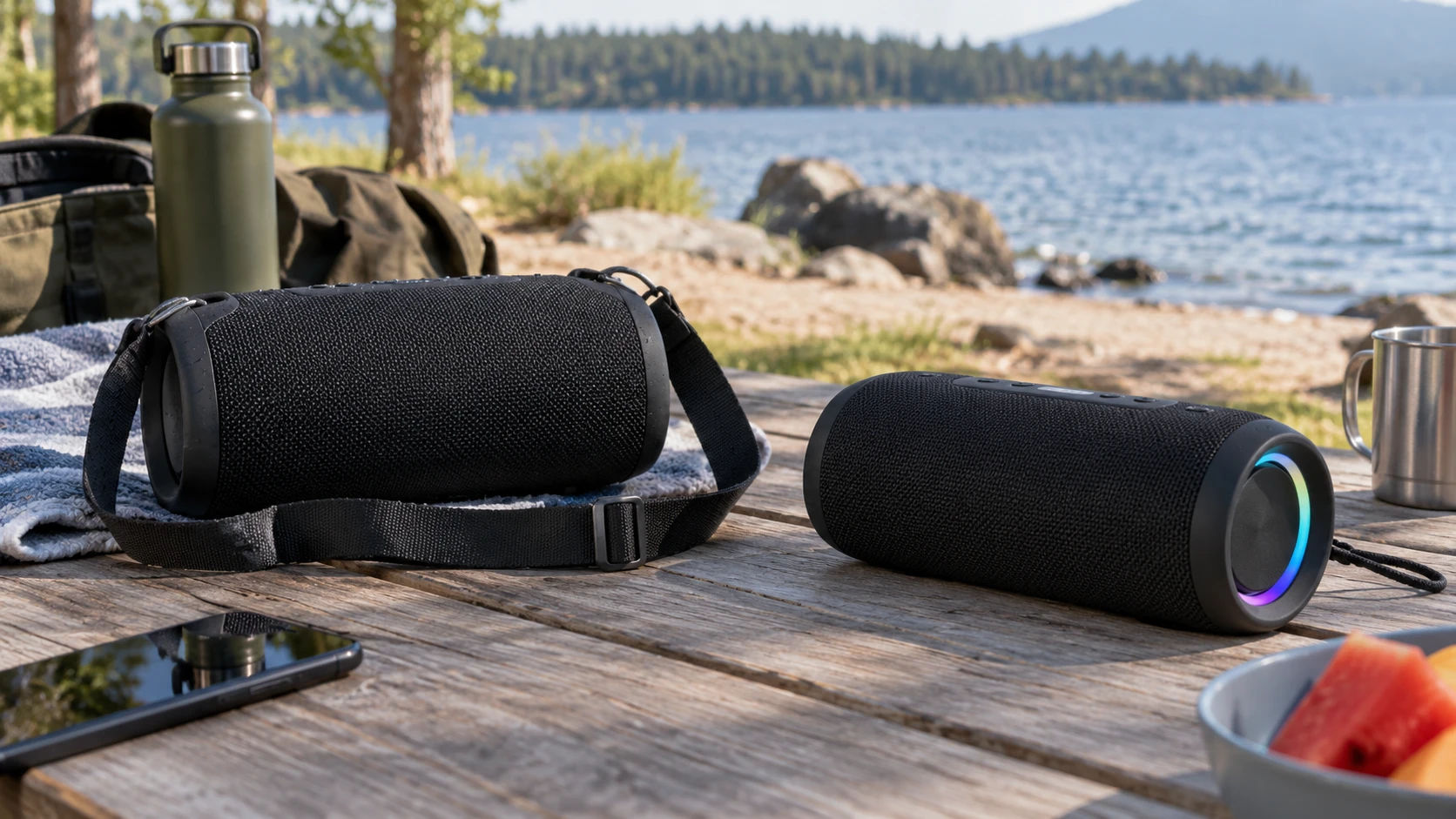
The JBL Charge 6 portable speaker listing describes an IP68-rated speaker bundled with a removable strap, USB-C cable, and travel case. This guide to outdoor speaker use discusses other products and gives a related way to think through placement and exposure. The Kakki 24W portable speaker lists an IPX7 water rating, RGB lighting, an AUX input, and TF-card playback. The guide's devices are separate; the product details here come from the two exact listings linked above.
Both are meant to move between rooms or go outside, but portability covers several different questions. A speaker may resist a splash yet lack a dust claim for a sandy beach. It may play for many hours at a moderate level but run down sooner with lights or extra bass. It may pair over Bluetooth while still needing a particular input for a friend's older device. Decide where music will be played and how it will reach the speaker before treating either product's headline battery or wireless version as the answer.
Read the protection codes literally — Kakki 24W portable speaker
JBL's saved entry states an IP68 rating for water and dust resistance. The first digit addresses solids, and the second addresses water under specified testing conditions. The listing does not supply the exact permitted immersion depth, duration, or care procedure for this bundle. Ask the current manual before taking it near a pool, seawater, or heavy spray. A rating for an intact unit is not a reason to charge it while wet or leave grit around a connector.
Kakki lists IPX7 and says the speaker can be submerged in one meter of water for 30 minutes. The X means the saved rating does not establish a tested dust-protection level. That matters at a sandy campsite or beach even if water is the more obvious hazard. Wipe and dry the unit according to its manual after outdoor use, especially before opening a port cover. The Republeq's catalog waterproof wording should not be stretched into a dust guarantee.
Both descriptions make impact claims. JBL calls the Charge 6 dropproof and describes rubberized protection and a fabric grille. Kakki says its construction can survive drops from three meters. Neither excerpt provides a common drop-test method, landing surface, or number of repeats. A speaker can survive one fall and still have a damaged connector or hidden seal. Use the strap or stable placement to prevent a fall rather than planning around a maximum claim in Republeq's catalog.
At home, these ratings may matter less than where the speaker sits. A shelf above a sink, a garden table, and a bicycle basket expose equipment to different risks. The included JBL strap can help carry it, and its travel case may protect it in a bag. Kakki's description names rugged canvas and rubber rings, but no case or strap in the saved excerpt. Ask for a box list and physical dimensions before deciding which is easier to pack or secure.
Compare battery figures at the same settings — Kakki 24W portable speaker
JBL says the Charge 6 can play for up to 24 hours, with a Playtime Boost setting that can extend the claim in Republeq's catalog to 28 hours. Its listing also says a ten-minute recharge provides about two and a half additional hours of listening. It does not state the volume or content used for these figures, nor the charger conditions for that quick top-up. Playtime Boost may change sound or other behavior; confirm its current manual description before assuming the extra hours come with no tradeoff.
Kakki claims up to 30 hours of continuous playback after a three-hour charge and says turning off its RGB lighting can conserve power. The excerpt does not say the volume, light setting, or listening mode used to obtain 30 hours. It gives a 2,500mAh battery capacity, which cannot be converted into comparable hours without the device's power draw and settings. The apparent 30-versus-24-hour advantage is a catalog comparison under unknown conditions, not a matched endurance test.
Make the battery test relevant to an actual outing. Set the volume to a level that can be heard over conversation or light outdoor noise, turn the desired lighting and sound mode on, and time a representative session. A picnic may need four hours without an outlet; a weekend camping setup may need a charging plan. Both listings name modern Bluetooth but give no evidence that one version uses less power in the configuration you will choose.
The JBL bundle includes a USB-C cable. Kakki's saved description does not list the charging cable or adapter contents. Check what arrives in the current offer and whether either speaker can be used while charging, if that is part of the plan. Portable speakers need a dry, suitable charging location after outdoor use. The saved IP claims do not specify safe charging conditions with a wet port.
Map the ways music can reach each speaker — guide to outdoor speaker use
The Charge 6 entry lists Bluetooth 5.4, PartyBoost-compatible multi-speaker pairing, and Auracast. Those are stated in Republeq catalog details connection features, but compatible products and software matter. Do not assume that any Bluetooth speaker can join a JBL group. If a household owns an older JBL speaker, check the exact pairing protocol on both devices before buying for stereo or multi-room use. The excerpt does not list an AUX input or local-card playback path for the Charge 6.
Kakki lists Bluetooth 5.3 and a TWS pairing mode for two units. It also names AUX-in and TF-card playback, which may be useful when a source lacks Bluetooth or when music is stored locally. Confirm the card format and supported files in the current manual. The TWS description is about pairing two compatible Kakki units; it does not promise stereo pairing with a JBL or another brand. If a second speaker is central to the plan, test the exact pair and check whether the selected mode works with the desired input.
Kakki's listing claims a wireless range of about 30 meters and uses language about faster transmission. Those numbers depend on obstacles, interference, and the source device, and the excerpt does not describe a matched test against Charge 6. JBL's description uses qualitative terms such as reliable streaming and stable connections. Try the connection across the actual distance between phone and speaker, with the walls, doors, or people that will be there. A Bluetooth version number is a compatibility detail, not a promise about range in every yard.
For video, timing can matter as much as connection success. The saved entries do not provide latency measurements for watching a film or playing a game. If a projector, laptop, or phone will supply video, check the audio path and whether dialogue remains in sync. A wired input on Kakki might offer another path, subject to the source's output and the speaker's current manual. Charge 6's listing does not give enough wired-input detail to make the same claim.
Listen before ranking watts and processing labels — Kakki 24W portable speaker
Kakki lists a 24-watt amplifier, two full-range drivers, and digital signal processing. It also gives three listening modes that emphasize bass or vocals. Those details describe its design, but JBL's saved entry does not provide a directly comparable output-power number. Comparing 24 watts to a missing figure cannot rank loudness or sound quality. Room size, placement, distortion at a chosen level, and the recording itself affect what listeners hear.
JBL describes AI Sound Boost as analyzing audio in real time and adjusting output. Its Republeq's catalog calls the result deep bass and clear highs. That is a feature claim and a listening description, not an independently measured advantage over Kakki's DSP modes. Try the same tracks at the same perceived volume. Listen for whether speech stays clear when the speaker is near a wall and whether bass overwhelms quieter material. A speaker that sounds strong outdoors may need a different setting on a small desk.
Kakki offers RGB lighting with 20 color variations and four mood modes, plus a light-off control. That may suit a casual party or make the speaker easier to see after dark. It may also be distracting in a bedroom. JBL's saved excerpt does not name a comparable lighting effect. If the speaker will play in a room used for sleep or work, confirm Kakki's lights stay off when restarted. A light feature matters only when it suits the setting.
Neither listing gives a common frequency-response curve, maximum clean sound level, or microphone specification for calls. Do not turn JBL's brand reputation or Kakki's amplifier number into a verdict on those missing measurements. If voice calls matter, ask whether either unit has a hands-free microphone and how calls are handled. The saved excerpts are about music playback and pairing, not conferencing performance.
Check the exact bundle and saved price — Kakki 24W portable speaker
This Charge 6 listing is a bundle. It says the black speaker comes with a removable strap, USB-C cable, and a Diginerds travel case. Those accessories can add value for someone who carries the speaker often, but confirm that the current checkout offer includes all of them. Kakki's saved entry names canvas and rubber exterior materials and lighting but gives no equivalent case inventory. A bare speaker and a bundle are not identical packages even if their speakers meet a similar need.
The saved minimum price is $224.94 for the JBL bundle and $210 for Kakki, a $14.94 difference in this snapshot. Prices and availability can change. JBL supplies the stated IP68 dust-and-water rating and the named travel accessories. Kakki supplies an IPX7 water claim, local playback inputs, two-unit TWS, and lighting. Verify current protocols, manuals, and accessories, then decide whether the speaker will spend more time on a sandy outing, beside a screen, or playing local files at a table. Those uses will make the small saved price difference easier to judge.