Laundry
An ironing board price premium needs verified working length
Verify the padded pressing span before paying for an apparent length advantage. Overall dimensions and unclear diagram endpoints cannot establish that benefit.
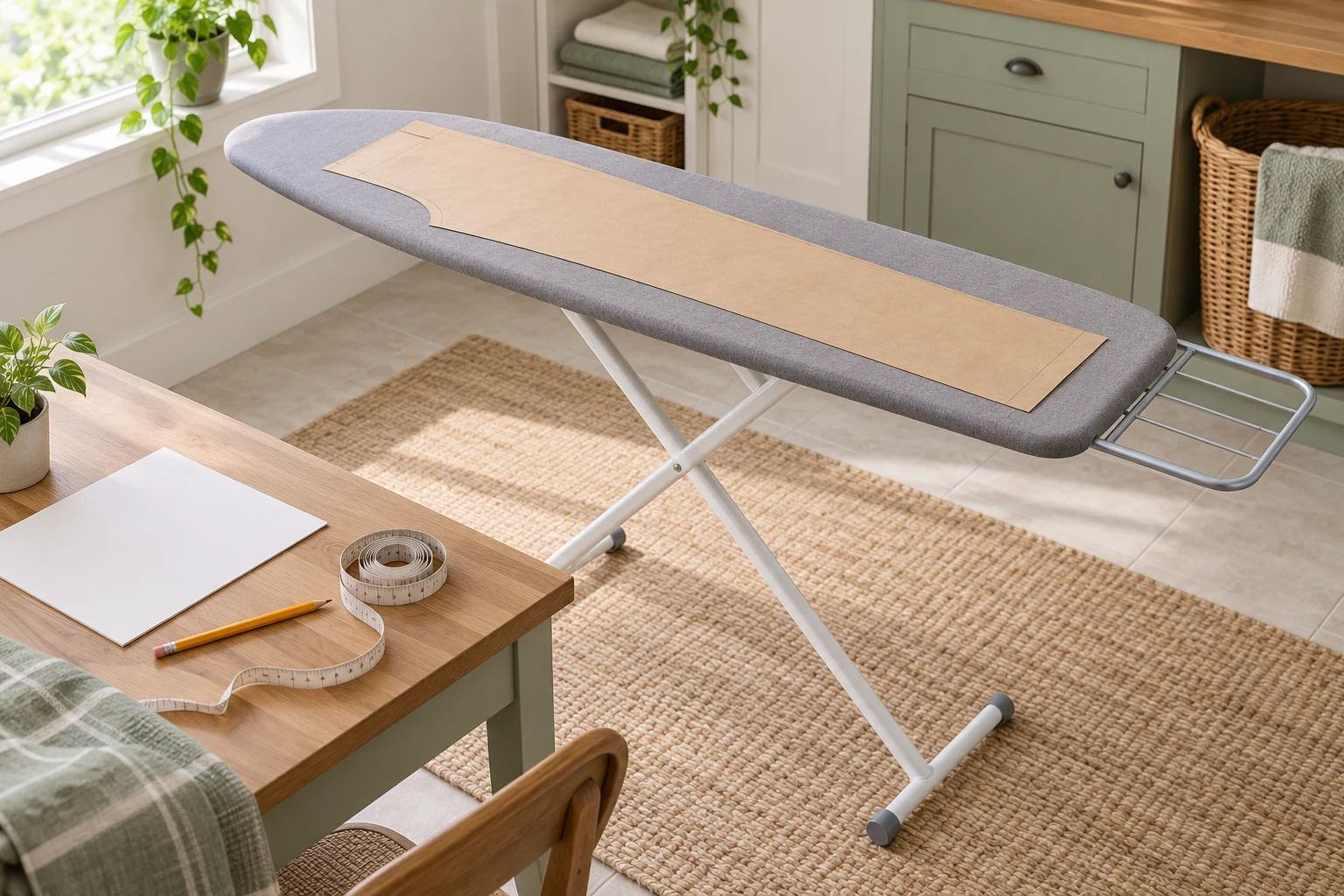
An ironing board price premium for extra length needs a measurement of the surface you will actually use. The space beyond the padded top may belong to a separate iron rest, and an overall dimension answers a different question from the length supporting a garment panel. Before paying for a larger number, identify the two endpoints that matter to your task.
Use this guide to set a buying threshold: name the additional support you want, check that both measurements describe it, and leave the proposed benefit unresolved when the boundaries remain unclear. Neither the listing comparison nor the paper exercise establishes a pressing-performance result.
Name the extra support you would pay for
Write a specific requirement before comparing headline dimensions. For example, you might want a particular section of a trouser leg to lie within the padded top without extending beyond its end. That is a different request from wanting a longer complete assembly or a larger place to park an iron. Keep the requirement in ordinary words so that a seller can answer the same question you are asking.
Use an item you already own to decide which span interests you, without applying heat or changing its care routine. You can represent the selected section on paper, then put the garment away. The paper is a planning shape, not a claim that a fabric should be pressed flat, that a seam can be treated safely, or that the finished result will improve. Actual garment treatment belongs to the garment's care information and the iron's instructions.
Give the requirement an endpoint at each side. A note saying that you need more room is hard to compare with a specification. A note identifying the start and end of the paper section gives you something definite to ask about. You may discover that the section of interest is shorter than the garment as a whole. Keep that chosen section visible in the purchase brief.
Read the separate measurement statements
The Xabitat full-size board listing describes 57 inches for the full board and 47 inches for the ironing area. Its gallery also separates those spans. The captured native offer lists USD 181.00. A 57-inch headline therefore should not be read as a claim of a 57-inch padded pressing surface.
The HE1150 over-door board description calls its ironing surface 14 by 41 inches, while a gallery diagram marks a 44-inch board length. The captured native offer lists USD 132.49. The boundaries behind those different lengths need confirmation before a working-length comparison.
These captured item amounts differ by USD 48.51. Obtain current delivered totals for the same address before making a final cash comparison. The difference alone establishes no usable-length advantage.
A useful clarification names the measurement directly: the length of the padded top from its narrow tip to its opposite padded edge, excluding any separate rest. If the supplier uses another convention, ask for that convention to be stated. A reply repeating the headline number without identifying its endpoints leaves the original question open.
A fictional pair can reverse the longer-board result
Imagine two invented drawings, unrelated to the linked products. Drawing A shows an assembly 60 inches long, consisting of a 48-inch padded top and a separate 12-inch end section. Drawing B shows an assembly 55 inches long, consisting of a 50-inch padded top and a separate 5-inch end section. In this deliberately simplified example, the longer overall assembly has the shorter padded top.
If your requirement concerns a 49-inch paper panel, the fictional 48-inch top is shorter than that panel, while the fictional 50-inch top is longer. Comparing 60 with 55 would answer which complete assembly is longer. Comparing 48 with 50 would answer which padded top is longer. Neither comparison can replace the other just because both use inches.
The example is one-dimensional on purpose. It does not establish that the paper panel fits either top, because width and outline have not been supplied. It also says nothing about an actual garment, a safe pressing method, or the time a task would take. Its only result is that a ranking based on total assembly length can differ from a ranking based on padded length.
Write the measurement name beside every number you keep. If one figure describes packaging, another describes the open assembly and another describes the fabric-covered top, they belong on different lines. Do the comparison only after the two relevant lines use the same boundary. There is no need to force a numerical winner from incomplete descriptions.
Define the route of the measurement as well as its endpoints. A straight line through the middle of a drawing and a line following a curved edge measure different paths. If your requirement concerns a straight paper section, ask whether the quoted padded length uses a corresponding straight span. You are defining a purchasing question, not announcing a universal measurement standard for every board.
When requesting a clarifying image, ask for the two endpoints to be identified. A picture with a ruler nearby can still leave you uncertain about where the measurement begins, or whether the ruler is aligned with the span being described. Use a clear response to understand the stated measurement; do not estimate missing inches from perspective or the apparent size of another object.
Keep conflicting figures in their original form until someone explains their relationship. Averaging two lengths would create a third number that neither description supplies. Choosing the larger figure because it better suits your panel would build the desired answer into the calculation. Retain the question and the alternative figures so that a later clarification can resolve the actual difference.
Make a cold paper map of the proposed span
Draw the paper section at the size relevant to your own requirement. Mark its intended direction and the two endpoints you selected. You can then compare its length with a confirmed padded-top measurement on paper. Keep this exercise away from a powered iron. It is a way to describe the space you seek, without starting a garment treatment or improvising a pressing surface.
Place the paper outline within a separate outline representing the confirmed top. Where an endpoint extends beyond that outline, mark the overhang. Where it remains inside, mark the remaining space. If you do not have a reliable top outline, record only the length comparison you can support. Do not draw a convenient rounded shape and later treat that invention as the manufacturer's specification.
Try the same paper orientation in both drawings. Rotating one panel diagonally while leaving the other straight changes the question. If you want to explore a diagonal position, label it as a separate layout and check the needed width and outline too. A diagonal drawn inside a simple rectangle does not prove that it stays inside a tapered padded top.
Keep the map modest. It can show what a stated length would mean for a paper section. It cannot show how fabric moves, whether a cover grips it, how a seam lies, or whether a user can comfortably reach the area. Those unanswered questions remain separate. A paper fit is a reason to investigate the intended benefit further, rather than a pressing-performance result.
Price a confirmed difference
State what the extra spending is intended to buy. If the answer is additional padded length, obtain that length before assigning value to it. You might still choose a board for a different reason, but write down the changed reason. Otherwise an attractive overall measurement can quietly become the justification for a benefit you never verified.
A price-per-inch calculation is only as useful as its denominator. Dividing one offer by overall assembly length and another by padded length creates unlike ratios. Even two correctly identified padded lengths leave width, outline and other requirements out of the calculation. Use such arithmetic only for the limited comparison it actually describes, without presenting it as a complete value ranking.
Keep an unresolved measurement out of the calculation. A blank entry is more honest than substituting the most favorable figure from a title or picture. If you are unwilling to buy until the additional support span is confirmed, leave the purchase pending. You can retain both offers for later consideration without treating either as the financial winner.
Keep other dimensions and operating questions separate
A longer padded top does not answer a width question. A wider middle does not describe the narrow tip. Working height and storage dimensions introduce further boundaries. Put each requirement on its own line and ask for the matching measurement. This prevents a correct answer about one dimension from becoming an assumed answer about another.
The compact-iron mode and contact guide addresses a different problem: a crease that remains during permitted ironing. Its model-specific setup discussion does not establish the working span of these boards. Keep a symptom investigation separate from a purchase justified by additional support length.
The integrated steam-board and generator comparison concerns appliance arrangements and garment-care workflow. It does not supply missing padded-top measurements for the two current board offers. An appliance choice and a verified support-span requirement need their own evidence.
Review a Republeq crypto checkout separately
When planning an ironing board purchase on republeq.com, keep any crypto payment decision separate from the working-length question. If the current checkout offers cryptocurrency and a USDT option, read the instructions for that exact order before choosing it. Check the displayed order amount, the stated asset and any network selection, then compare that information with the payment route you intend to use. A familiar token label does not replace the order instructions. Leave payment pending if the requested route is unclear. Record the order reference and save the checkout terms that matter to your decision, including any delivery, cancellation or return information the merchant actually presents. The measurements and budget established separately still govern whether the board meets your purchase requirement. If your wallet or payment service presents fees or other charges, include the amounts you can verify in your own purchase record instead of assuming the product-page figure is the full outlay. Review the final confirmation before authorizing payment, and use the merchant's stated support process if the instructions or order status need clarification. Keep a retained order receipt alongside the model and measurement confirmation so that you can identify what you intended to buy. This article does not establish that any particular asset or route is available for your order, and it does not promise a discount, conversion outcome or return entitlement. Choose the payment method from current checkout instructions after deciding that the documented board suits the intended job. A different payment route does not resolve an unanswered question about the padded surface or change which measurement supports the length benefit you sought.
Retain the answer that supports the purchase
Save a clear measurement response with the exact offer and variant it concerns. Include the endpoint definition and any qualification. If an answer provides only a general size category, keep the more precise question open. Should the offer change, check whether the same measurement still applies before relying on the earlier response.
Your final note can be brief: the paper section you wanted to support, the confirmed padded span, the other requirements still unresolved and the current delivered amount you are prepared to pay. If the intended length advantage remains undocumented, leave that premium unjustified. A separate reason for buying can be considered openly, with its own evidence.