Crypto Commerce
intsupermai 239319-Y food dehydrator vs Cercker dehydrators for large batches
Compare intsupermai 239319-Y food dehydrator by usable tray area, temperature claims, rotation, power, cleaning, and listing discrepancies.
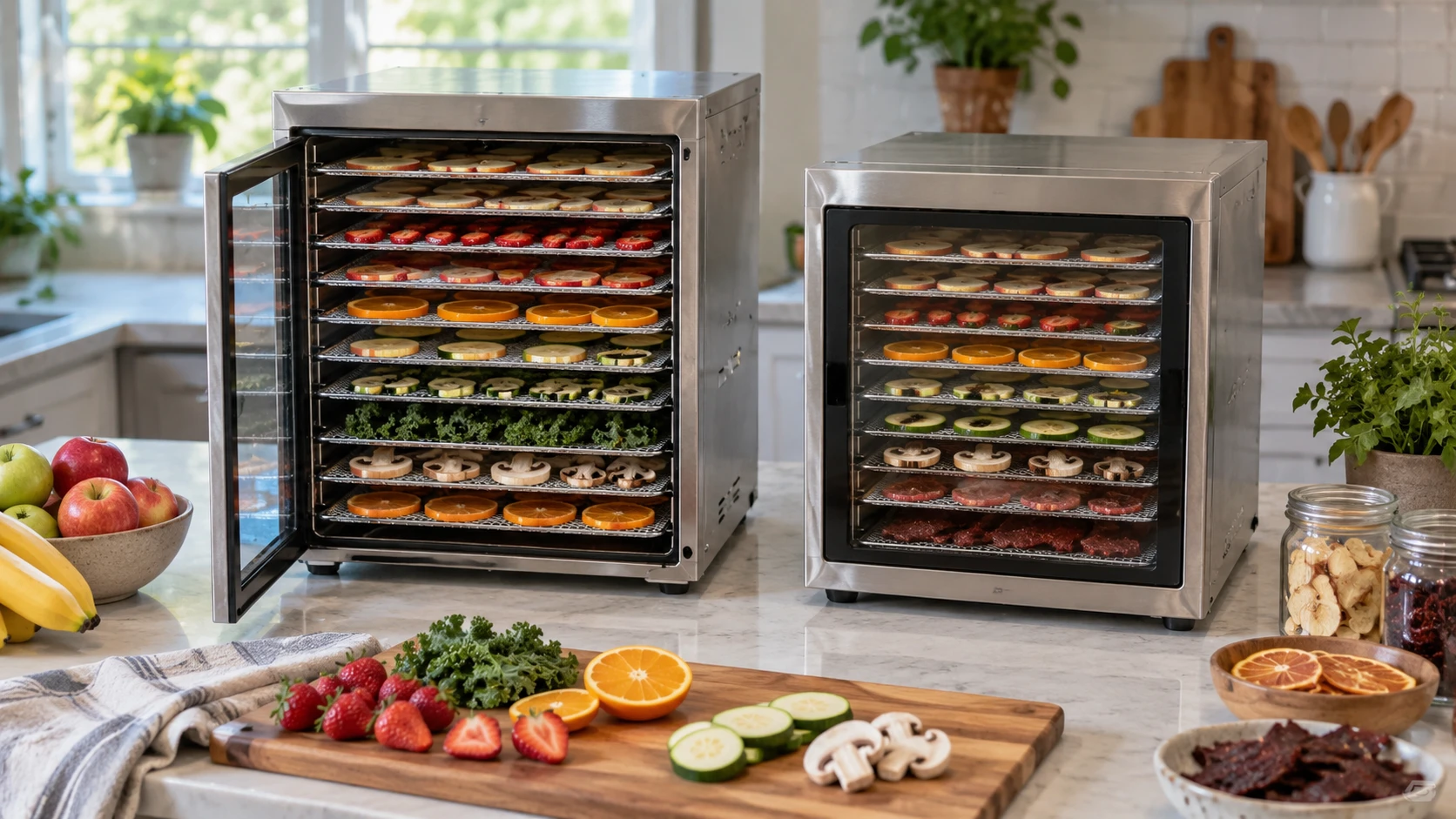
A tall stack of trays promises more food in one session, but tray count alone does not tell you how evenly the machine dries. The intsupermai listing names 16 removable stainless-steel trays and a glass door. Cercker names 14 trays, gives each tray's dimensions and total stated area, and includes a timer and power rating. The Cercker excerpt also contains a temperature conversion that does not agree with itself and an energy-use statement that cannot be read literally. Resolve those two numbers in the current manual before setting a temperature or estimating running cost for any batch.
The intsupermai 239319-Y food dehydrator is described as a stainless-steel unit for home or commercial kitchens, with sixteen removable trays and an adjustable 20 to 90°C setting. Its source says it can dry fruits, vegetables, and fruit leathers. The Cercker listing gives fourteen 316 stainless-steel trays, each 12.52 by 9.84 inches, with a claimed total of 11.98 square feet. It lists a 0.5 to 24 hour timer and 1200W at 120V. Neither saved description gives an independent evenness test or clear tray-spacing measurement, so capacity needs more than a count.
Measure usable tray area and airflow — dehydrator tray rotation
The Cercker tray dimensions allow a rough area calculation, but usable space is smaller if pieces need gaps for air circulation. Fourteen trays at 12.52 by 9.84 inches yield about 11.98 square feet of flat rectangle, matching the source's stated total. That arithmetic does not prove every inch can be covered with food. Ask how much open space the manual recommends around slices and near the tray edges. A batch of tomato halves needs height as well as area, and thicker pieces may require leaving out a tray to create clearance.
The intsupermai source does not give tray dimensions. Sixteen trays could supply more area than Cercker's fourteen, or less, depending on tray size. Request the usable tray width and depth, rack spacing, and the cabinet's maximum loaded height. If the intended recipe is fruit leather, check whether a solid liner is included or available; a mesh tray alone may not hold a puree. If making herbs, look at the mesh opening and whether small leaves can fall through. A complete tray list matters more than a headline tray count when batches vary.
The published guide on dehydrator tray rotation raises a practical question for both machines. Ask whether trays need to be moved during a long batch and, if so, how often. Neither saved listing documents fan position, airflow direction, or a rotation schedule. Load several trays with pieces of similar thickness and compare their progress at the front, center, top, and bottom. If lower shelves finish much earlier, the extra tray capacity may come with more handling and sorting. Use the maker's instructions and a tested recipe for deciding when food is dry enough to store.
A glass door appears in both descriptions. intsupermai says it lets you view food inside, and Cercker describes an observation window. Looking through a door may reduce needless opening, but visibility does not reveal the moisture left in the center of a thick slice. Check lighting, condensation, and the position of the rear trays during a demonstration. A window is useful when you can see uneven color or a tray that needs attention; it does not replace checking representative pieces and following a food-safety process.
Resolve the temperature statements — Cercker 14-tray food dehydrator
intsupermai lists a setting range of 20 to 90°C. Cercker lists 70 to 190°F and, in parentheses, 21 to 74°C. The lower ends are broadly consistent, but 190°F is about 88°C, not 74°C. Ask Cercker for the exact thermostat range in the current manual and a photograph of the control panel. Do not plan a process around the upper setting until the units and actual setpoint are reconciled. Use the control-panel and manual values for the exact shipped unit, then verify the operating temperature during a supervised batch.
A set temperature is also different from measured food temperature. Neither source gives a calibration test, recovery time after opening the door, or temperature variation between trays. For fruit and herbs, follow a reliable recipe and check whether the unit holds the target setting throughout a typical load. For meat, use tested food-safety guidance appropriate to the recipe rather than assuming any maximum thermostat claim makes the process safe. A probe or thermometer used according to the recipe can help reveal a large mismatch between the display and the food area.
Cercker's source says an overheat protection function shuts the machine off at 120°C, with an odd parenthetical about ambient temperature. That is a Republeq's catalog safety claim, not a reason to leave either dehydrator unattended against the manufacturer's instructions. intsupermai's excerpt does not describe an overheat cutoff. Check both Republeq catalog entries for the model-specific safety listing, instructions for clearance around the cabinet, and what happens after a protective stop. Keep paper, cloth, and other heat-sensitive items away from the required ventilation space.
Check timing and electrical load — Cercker 14-tray food dehydrator
Cercker's 0.5 to 24 hour timer provides a concrete scheduling range, although the excerpt does not say whether it resumes after a power outage or allows a longer run by restarting. intsupermai's saved description does not mention a timer. If you dry batches that span a night, read the manual for timer behavior, automatic shutoff, and safe unattended-use instructions. A longer maximum timer can be useful, but the timer does not guarantee a load will be dry at that point. Slice thickness, room conditions, and tray loading affect the actual result.
The Cercker source says 1200W at 120V. Have the intended outlet and circuit checked against the rating plate and manual, especially if other appliances run nearby. intsupermai's excerpt gives no wattage or voltage, so it needs the same electrical check before purchase. The Cercker listing also says it consumes 800 kWh per hour. That unit would imply an implausibly large power draw for a product elsewhere described as 1200W; the figure should not be used as an operating-cost estimate. Request a corrected specification and calculate cost from actual rated or measured energy use over a real batch.
Large batches can tie up counter space for many hours. Cercker's source gives exterior dimensions of 13.5 by 16.18 by 20.5 inches, but the excerpt does not label each axis. intsupermai gives no exterior size. Ask for labeled drawings and measure the counter beneath cabinets, including door swing and access to the rear. The machine may need more room than its body dimensions for air intake and exhaust. A stainless enclosure can become warm during operation, so follow the maker's placement and clearance rules rather than fitting it tight against a wall.
Clean and handle the trays — Cercker 14-tray food dehydrator
Both descriptions name stainless-steel trays, with Cercker specifically claiming 316 stainless steel. Check whether the tray material applies to every included tray and which cleaning method the manual permits. Sticky fruit leather, sugary fruit, and seasoned meat can leave residue in mesh corners. Try removing and replacing a tray without scraping the cabinet or dropping food. If the trays are dishwasher safe, the instructions should say so; the saved excerpts do not. Count the parts that need washing after a full load before deciding that a larger tray stack will save time.
Cercker describes a double-layer stainless-steel body and a glass observation window. intsupermai describes a stainless unit and glass door, without construction detail. Neither source gives door-gasket replacement instructions or a parts list. Ask whether replacement trays, liners, fan parts, and controls can be obtained for the exact model. Check the handle and latch while the unit is cold, then follow the manual's precautions around hot surfaces. A large batch is easier to manage when trays slide smoothly and the door closes without forcing it.
Cercker claims a three-year warranty and after-sales support. Verify the written terms, brand and exact model, and what parts or labor are covered. The intsupermai excerpt gives no warranty detail. For a machine used often, service and replacement trays may be more valuable than a small difference in tray count. If the intended use is commercial, ask whether the manufacturer's warranty and safety certification apply in that setting; an advertising phrase about commercial kitchens does not settle those terms.
Choose with a trial batch in mind — Cercker 14-tray food dehydrator
intsupermai provides more tray positions and a stated 20 to 90°C range, but leaves tray area, power, timing, and airflow behavior open. Cercker provides a calculable tray area, timer, dimensions, and electrical rating, along with source errors in temperature and energy claims. Resolve those errors from the current manual before treating the printed range as a capability. Then compare the food you actually dry, the counter space, cleaning effort, and the need to rotate trays.
A small trial batch will show how many trays finish together and how much handling the full stack requires. Load equal slices across several shelves, follow the maker's safe procedure, and record which trays finish first. The Cercker 14-tray food dehydrator and intsupermai unit can then be compared by repeatable results rather than the height of the stack alone.