Educational & Explainer Articles
Insulated tumbler temperature claims: cold time and food safety
Read Stanley and Thermos cold, iced and hot claims with their actual scope, then distinguish retention time from FDA food-storage temperatures and conditions.
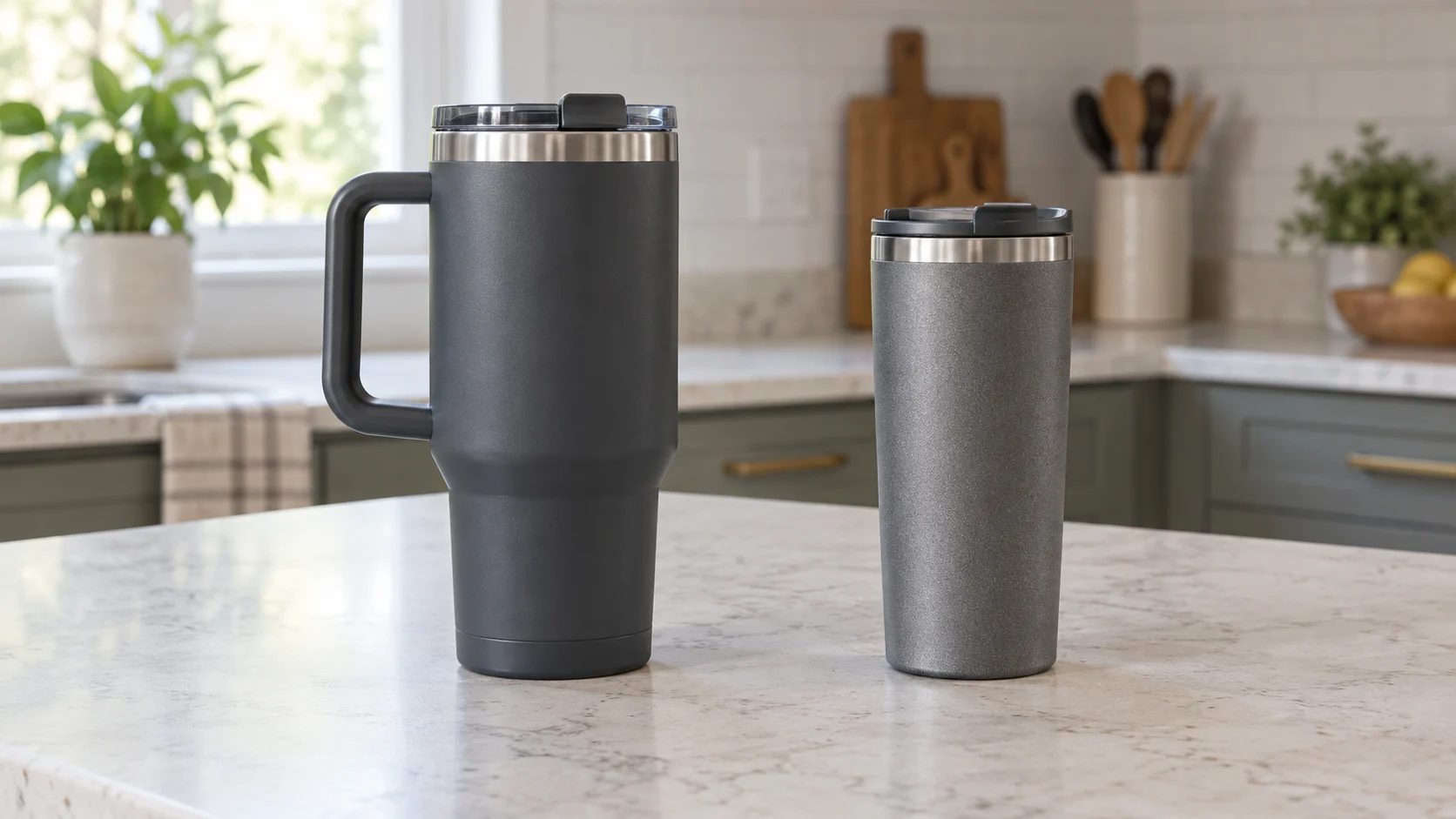
Insulated tumbler temperature claims describe a product's advertised retention performance. They do not automatically describe the conditions needed to store every drink safely. Read what the claimed time applies to, then keep the actual beverage's storage requirements beside it. The word cold needs more context before it can answer a food-safety question.
The selected Stanley Quencher and Thermos Icon offers name different capacities, closures and retention figures. Neither short description gives this article a complete, independently verified test record. FDA's consumer guidance about safe food storage supplies the separate refrigeration information considered below.
Read cold and iced retention times with their labels
For cold and iced retention times, keep the words beside the number. The Stanley offer states eleven hours cold and two days iced. Those are two differently labelled claims from the same offer. This article has no supplied protocol defining the exact starting conditions or end point for either one.
A cold claim is not interchangeable with an iced claim merely because both concern a cool drink. The description uses different labels, and the missing protocol remains missing. Do not choose a single figure from the two and apply it to every beverage, fill arrangement or place the tumbler might be used.
The Thermos offer gives up to twenty-two hours cold and up to six hours hot. Preserve the up-to wording and the named condition. Its hot figure does not redefine Stanley's cold claim, and its cold figure does not establish an independently matched comparison with the Quencher.
Hours give an elapsed interval, without naming a final temperature. Check the actual test's stated endpoint before treating a retention figure as a particular temperature.
Keep the selected Stanley package and seller claims distinct
The Stanley x Wicked Ozian Reprise Quencher offer identifies a forty-ounce stainless-steel H2.0 FlowState tumbler. Its actual catalog brand is STANLEY. The native description names 18/8 recycled stainless steel, double-wall vacuum insulation, a FlowState three-position lid and a reusable straw.
The same account says dishwasher safe and BPA-free. Read the applicable care instructions for the actual components. A care claim is also separate from the advertised eleven-hours-cold and two-days-iced wording. Neither makes the other a measured result for a particular filled tumbler.
The description contains a seller's claims about authenticity, sealed condition and expedited shipping, with variations sold separately. This article has no independent authenticity receipt or delivery guarantee for that seller. Keep the selected variation and actual transaction details with a contemplated order instead of treating promotional language as verified provenance.
Forty ounces is the offered capacity wording. It is not a forty-hour retention statement, an approved serving quantity or a complete external-dimension account. Keep the quantity and unit attached to capacity when comparing this product with the smaller named Thermos offer. Their different capacities are another reason the listings alone do not establish a controlled comparison.
Read the actual Thermos Icon closure account
The Thermos Icon twenty-four-ounce Granite tumbler offer has actual catalog brand Thermos. Its description gives 18/8 stainless-steel construction, a Slide Lock lid and a non-slip soft-touch base. It attributes up to twenty-two hours cold and six hours hot to its vacuum-insulation technology.
The description says the item can be used for hot or cold beverages. Its straw-compatibility statement is narrower: the slide lock is open and the beverage is cold. It expressly says the straw is not included. Retain that condition and absence rather than transferring the selected Stanley offer's included reusable straw into the Thermos package.
These statements provide no permission to use an unspecified straw with a hot drink. They also provide no substitute for the actual item's applicable instructions about the lid, filling or care. This explanation identifies what the source says without giving a closure-setting sequence or a hot-liquid handling demonstration.
The native Thermos description repeats some material and retention wording. A repeated claim is still one source claim. It does not count as a second independent test, a separate warranty or stronger proof of the time stated. Read the repeated text once with the selected model and its actual package.
Understand the limited role of the general insulation explanation
Thermos's separate science article describes two walls with air removed from the space between them. It distinguishes heat moving through contact, through the movement of gas or liquid, and through radiation. That general explanation does not provide a measured heat-transfer value for either selected tumbler in this article.
The same manufacturer reference describes controlled testing using a starting temperature, a sealed container, timed measurements and an ambient environment. It says actual performance depends on starting temperature, lid opening and the surroundings. Those are attributed general statements, without a selected-model test sheet or a matched Stanley test here.
Use that reference for its general explanation; the selected products still need their own test records. The retail figures remain attached to the specific products that advertise them.
Separate drink storage and refrigeration from a retention label
For drink storage and refrigeration, first establish whether the actual contents require refrigeration. FDA tells consumers to check food labels for storage directions and notes that dairy products are among the foods needing cold storage. A generic statement that a vessel keeps drinks cold does not identify the requirements of the drink put inside it.
A plain container name cannot classify a mixed beverage's ingredients. Keep the actual food information with the prepared drink. This article does not declare every beverage perishable or provide a formula for changing storage requirements by adding another ingredient. A question about milk-containing contents remains a food-storage question, even when the outer vessel is insulated.
FDA's storage guidance gives a refrigerator temperature of forty degrees Fahrenheit or below, with four degrees Celsius alongside it. It recommends checking appliance temperatures and identifies appliance thermometers as a way of knowing them. This is refrigerator guidance; the selected tumbler offers do not show that their contents remain within that stated condition.
The fact that a drink feels cool supplies no actual temperature record in this article. An advertised cold-retention duration likewise supplies no reading for a particular beverage at a particular moment. Preserve the difference between a source's defined food-storage condition and an offer's temperature word without a supplied numerical end point.
Read FDA's room-temperature time limits in their actual scope
FDA sets a two-hour maximum at room temperature for foods requiring refrigeration. When the surrounding air exceeds ninety degrees Fahrenheit, its limit is one hour. These are food-exposure limits, separate from a retail tumbler's advertised retention duration.
Do not replace those limits with eleven or twenty-two hours simply because either retail offer uses cold wording. Conversely, this explanation does not claim that every contents history can be decided from the clock alone. The actual storage conditions matter, and no verified temperature history for a filled Stanley or Thermos is supplied here.
The source recommends prompt refrigeration for perishables and says that when something has not been properly refrigerated, it is usually best to discard it. Follow the relevant food's storage directions and applicable food-safety guidance. A new lid position or a later addition of ice is not established here as a method for repairing an unsafe earlier storage history.
FDA also explains that food can cause illness while appearing, smelling or tasting unspoiled. It distinguishes disease-causing microorganisms from those responsible for obvious spoilage. That means an ordinary appearance cannot supply the safety evidence missing from an uncertain storage history. This article gives no instruction to taste a questionable drink to decide whether it is safe.
Use actual food temperatures when hot or cold holding matters
FDA's separate Serving Up Safe Buffets guidance defines its hot-food holding condition as an internal temperature of at least 140 degrees Fahrenheit. It gives forty degrees Fahrenheit or colder for cold food. These are actual temperature conditions, whereas the Thermos offer's six-hours-hot wording supplies no numeric final temperature in its short account.
The buffet page advises using a food thermometer to check hot foods and warns that some warming equipment holds food below its stated hot-holding requirement. Its example concerns food warmers, not these tumblers. The useful distinction is the source's actual required temperature and the observed food condition, rather than a product name containing warm or hot.
That source's two-hour discard instruction for room-temperature perishables expressly distinguishes food being kept hot or cold. Read the exception together with its stated holding temperatures. Merely placing contents in an insulated vessel does not establish which condition applies; an advertised duration without its numerical end point does not supply that evidence.
Keep safe preparation in view as well as later storage. FDA's buffet guidance names eggnog among recipes that may use raw or lightly cooked eggs and explains that such eggs can contain harmful bacteria. Cold-retention wording cannot establish that an ingredient or preparation was safe in the first place. Consult the applicable food guidance for the actual recipe.
Keep material, condition and contents as separate questions
Both descriptions name 18/8 stainless steel. Their constructions, closures and retention results still need to be read separately. The Stanley account also specifies recycled stainless steel. Preserve each statement with its own item rather than completing an unspecified part of the other description from the shared numbers.
A non-slip base is a physical feature claim. It supplies no numeric temperature limit or period of refrigerated storage. A reusable straw is a package detail, while the Thermos account's straw limitation concerns a particular use condition. Keeping these meanings distinct prevents one appealing feature from silently answering an unrelated food question.
If a storage decision depends on a condition that the source does not establish, identify that condition directly. Asking whether the actual food's required temperature is maintained is more precise than asking whether a tumbler is good. Ask for the evidence that establishes the relevant condition.
Use related guides for the measurement and preparation questions
The actual weather station readings guide distinguishes a quantity, its location and its time reference. Its indoor or outdoor readings concern the station's measurement arrangement. They provide no reading of a drink inside either selected tumbler and no substitute for the beverage's actual storage requirements.
The actual glass salad spinner guide keeps food handling and refrigeration separate from the equipment's mechanical task. Its OXO and Dynamic items concern produce preparation. Their instructions do not provide a tumbler-care method or extend a drink's storage life after an uncertain temperature history.
Ask for the missing evidence that affects the decision
For a product comparison, ask about the applicable retention test and exact model if its figures affect the choice. Keep the requested starting and end conditions with the advertised duration. A general technology explanation does not independently establish which product performs better under a household's particular conditions.
For an order, retain the actual variation, included contents, care information and current terms. For a food-storage question, retain the drink's requirements and actual storage history. Insulated tumbler temperature claims can inform a purchase while leaving a different question unresolved when the necessary evidence is absent.
Conceptual insulated tumbler temperature claims cover with generic inactive closed drinkware; no exact retail model, retention test or safe food-storage condition is demonstrated.