Crypto Commerce
Hupicker 4.3-cu-ft single-door fridge vs Twister.CK 4.3-cu-ft mini fridges
Compare Hupicker 4.3-cu-ft single-door fridge by fresh and freezer space, thermostat evidence, shelves, door fit, noise, and energy claims.
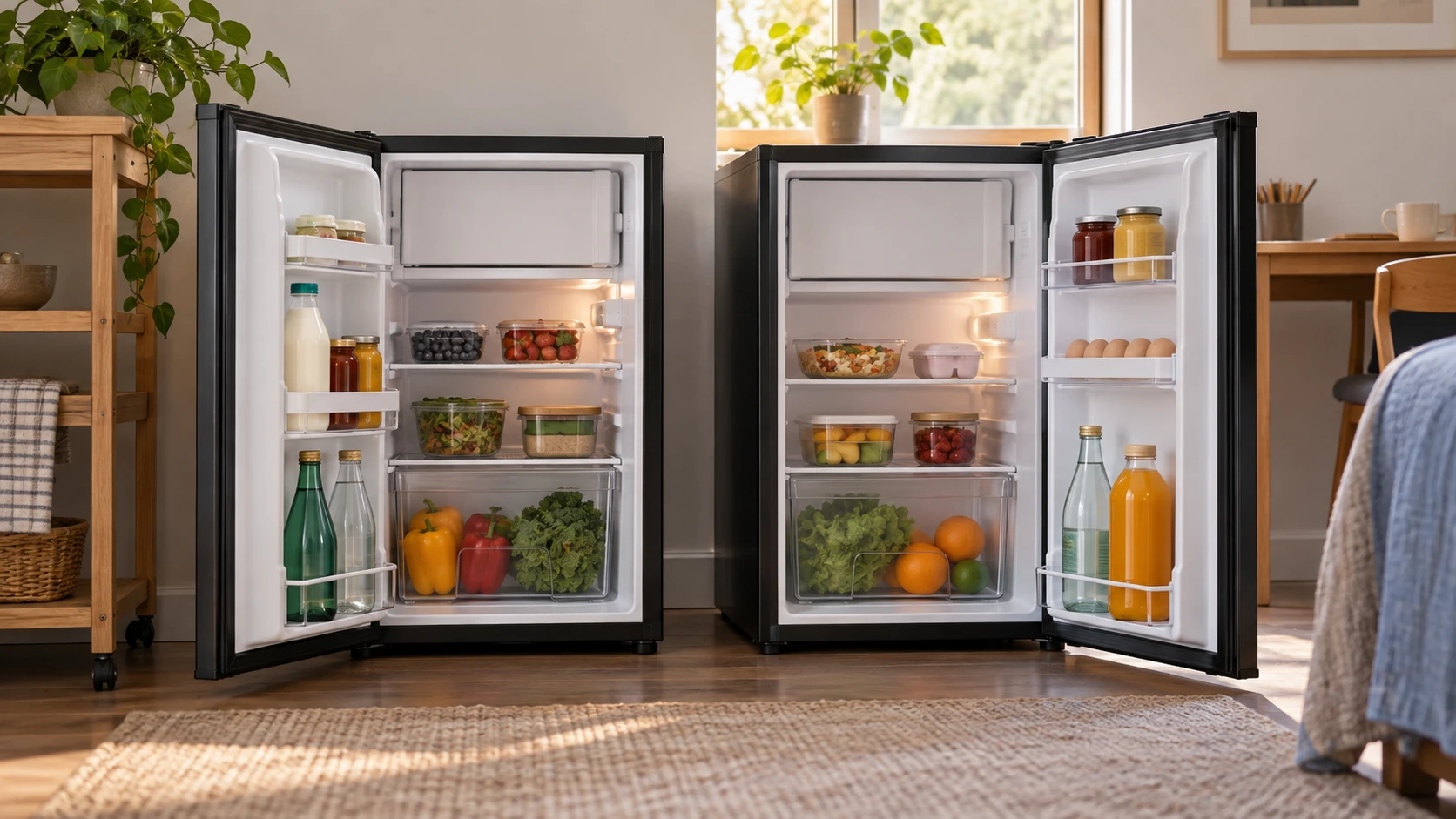
The Hupicker 4.3-cu-ft single-door fridge and Twister.CK's 4.3-cu-ft mini fridge look similar in a short catalog: both describe one door, an integrated freezer, seven thermostat settings, a crisper, and shelves that can be moved. Those shared labels do not tell you how much fresh food or frozen food fits in each compartment. They also leave the freezer's actual temperature unclear. Check the internal layout and exact model documentation before treating the equal headline capacity as equal usable storage.
The saved September 30 catalog gives more temperature, sound, and energy numbers for Twister.CK. Hupicker instead names a reversible door and adjustable feet. Neither excerpt supplies complete exterior dimensions or a measured side-by-side performance test. A buyer deciding where to place a fridge should verify those missing details and identify the food that must fit every week.
Divide the stated volume into real spaces — mini fridge compartment capacity
Both listings use 4.3 cu ft as the overall capacity. That number combines useful spaces but does not tell you the height of a tall bottle shelf, the shape of the freezer box, or how much room a crisper occupies. Ask for current interior drawings that label fresh-food and freezer volumes separately. A large total can still leave a freezer section too small for your usual packages. Open the door of a similar-size model in person if possible and compare it with a week's groceries.
Hupicker describes a crisper drawer and removable glass shelves for fruits, vegetables, and drinks. Twister.CK also names a crisper and adjustable, removable shelves. A shelf that moves can clear space for a tall container, though that may reduce room for shorter items elsewhere. List the containers you use often and measure their height. Check whether the door bins take large bottles and whether removing a shelf blocks access to the crisper or freezer area.
The published guide on mini fridge compartment capacity explains why a total-volume figure can be a poor substitute for a loading plan. Put fresh items, frozen items, and drinks on separate lists. Then ask which items need a door bin, crisper, shelf, or freezer compartment. A compact fridge bought mainly for beverages is being judged by different storage needs from one expected to hold dinner ingredients and frozen meals.
A single exterior door can also change daily use. Opening it for a drink may expose the integrated freezer area, depending on the internal design. The saved descriptions do not show the exact inner flap or compartment door arrangement for these SKUs. Verify that layout in the current manual or photos rather than assuming both interiors work alike. If frozen storage is a major reason to buy, an independent freezer may be a more suitable category.
Verify what the thermostat actually controls — Twister.CK 4.3-cu-ft mini fridge
Hupicker lists seven adjustable settings without giving a temperature range or explaining how the freezer responds at each setting. Twister.CK lists seven settings and describes a 32 to 46.4 degrees Fahrenheit range, with 37 to 41 degrees Fahrenheit recommended for perishables. The Twister.CK excerpt does not establish that its integrated freezer reaches or holds a separate safe freezing temperature. A refrigerator range is not a freezer performance specification. Ask for the current temperature chart for both compartments and use thermometers after installation.
A dial position is only an instruction to the appliance, not a direct reading of the food. Room temperature, a fresh load of groceries, door openings, and how tightly items are packed can change what a thermometer shows. Start with the manual's setup guidance, allow the appliance to stabilize, and check both the fresh-food and freezer areas before relying on them for perishable food. Recheck after moving the unit or changing the thermostat.
Twister.CK's saved text says the recommended range for perishables is 37 to 41 degrees Fahrenheit. That is useful as a target for the refrigerator section, but it does not replace the model's own instructions or food-safety guidance. Hupicker's short description does not supply an equivalent target. If the mini fridge will store medicine or another temperature-sensitive material, use equipment specified for that material rather than treating an ordinary household dial as certified monitoring.
The words freezer and integrated freezer appear in both listings. They do not reveal freezer volume, defrost method, or how the frozen section behaves in a warm room. Ask whether frost must be removed manually and how food should be handled during defrost. Verify the door seals and drainage instructions too. A small freezer space can quickly lose convenience if ice buildup reduces its capacity or if your most common frozen package does not fit.
Measure the room and door swing — Twister.CK 4.3-cu-ft mini fridge
Neither saved excerpt gives a complete exterior dimension drawing. Before shopping by a product photo, measure the floor or counter location, nearby cabinet doors, available outlet, and the path to bring the fridge inside. Include the space a door needs when fully opened and the ventilation clearances required by the exact manual. A compact body that fits a corner when closed may be difficult to stock or clean if the door strikes a wall.
Hupicker says its door can be reversed for left- or right-handed use. That may help in a narrow layout, but confirm the hinge parts and procedure for the exact SKU. It also names adjustable feet, which can help level the cabinet on an uneven surface. The Twister.CK excerpt does not state that its door reverses or describe leveling hardware. Absence from a short listing is not proof those features are missing; ask for the current manual if either affects your placement plan.
Hupicker's source title and category describe a white refrigerator, while its description also refers to a grey finish. Resolve the exact color and model variant before ordering if the appearance matters. Twister.CK is described as white but appears under a Restored Home catalog classification. Confirm the actual item's condition, Republeq's catalog, warranty, and return terms rather than inferring them from that category label alone. Product classification text can be inconsistent with a particular offer.
A fridge in a bedroom, office, garage, or dorm has different constraints. Both listings suggest use in several of those locations, but the saved descriptions do not establish allowed ambient-temperature ranges or every building's appliance rules. A garage can get hot or cold; a dorm may restrict appliances; a bedroom makes compressor sounds more noticeable. Check the model's placement limits and the room's rules before choosing a location.
Put energy and noise claims on comparable footing — Twister.CK 4.3-cu-ft mini fridge
Twister.CK estimates energy use as low as 0.5 kWh per day and describes operating noise at about 40 dB. Hupicker says it is intended to use less energy and operate quietly but gives no comparable numerical figures in the saved excerpt. These are unequal kinds of evidence. Look for current energy-label data under common conditions and a stated noise test method before ranking the two. Real consumption will also depend on room temperature, thermostat setting, load, and door use.
For a fridge beside a desk or bed, sound character may matter as much as one stated decibel figure. Listen for compressor starts, vibration against furniture, and airflow in a similar setting if you can. Keep the appliance level and leave the clearance its manual requires. A claim of quiet operation does not guarantee a particular person will sleep comfortably nearby. Do not place either fridge in a sealed cabinet simply to hide its sound unless the manufacturer permits that installation.
Twister.CK names R600a refrigerant. That detail does not by itself establish that the model will cost less to run than Hupicker. Compare the complete appliance's energy label and expected use over time. Hupicker's saved source does not identify its refrigerant. Avoid filling that gap from a similar-looking product or a different model year; check the nameplate or exact specification sheet if refrigerant is relevant to service or disposal.
Check current offers and daily handling — Twister.CK 4.3-cu-ft mini fridge
The saved catalog listed Hupicker at $535.71 and Twister.CK at $385, both marked available. Those September 30 prices can change. Confirm the exact model, condition, Republeq's catalog, shipping, warranty, return period, and any delivery restrictions. Keep the exact product and variant IDs with your inquiry, since similar 4.3-cu-ft listings may differ in shelving, finish, or the terms of the offer. A lower sticker price can be offset by a return policy or condition you would not accept. The saved product descriptions do not provide enough evidence to compare long-term reliability or repair availability.
Think about cleaning before the first spill. Can the shelves and crisper be removed through the available door opening? Is there room to wipe a compartment without shifting the entire unit? Ask how the freezer area is defrosted and how any water is collected. Both listings say shelves can move, but neither gives a complete care procedure in the excerpt. A layout that is easy to stock should also be easy to empty and clean.
Hupicker is worth considering if its reversible door and adjustable feet solve a real fit problem after you verify the compartment sizes. The Twister.CK 4.3-cu-ft mini fridge gives more saved numbers for the refrigerator range, noise, and energy, but its freezer performance still needs separate confirmation. Compare current manuals, measure your regular food packages, and check both compartments with thermometers.