Crypto Commerce
Huloretions 165-foot self-leveling sewer camera ft vs VEVOR 98 ft: plan the inspection route
Compare Huloretions 165-foot self-leveling sewer camera by cable reach, pipe fit, distance tracking, recording, battery claims, and locating gear.
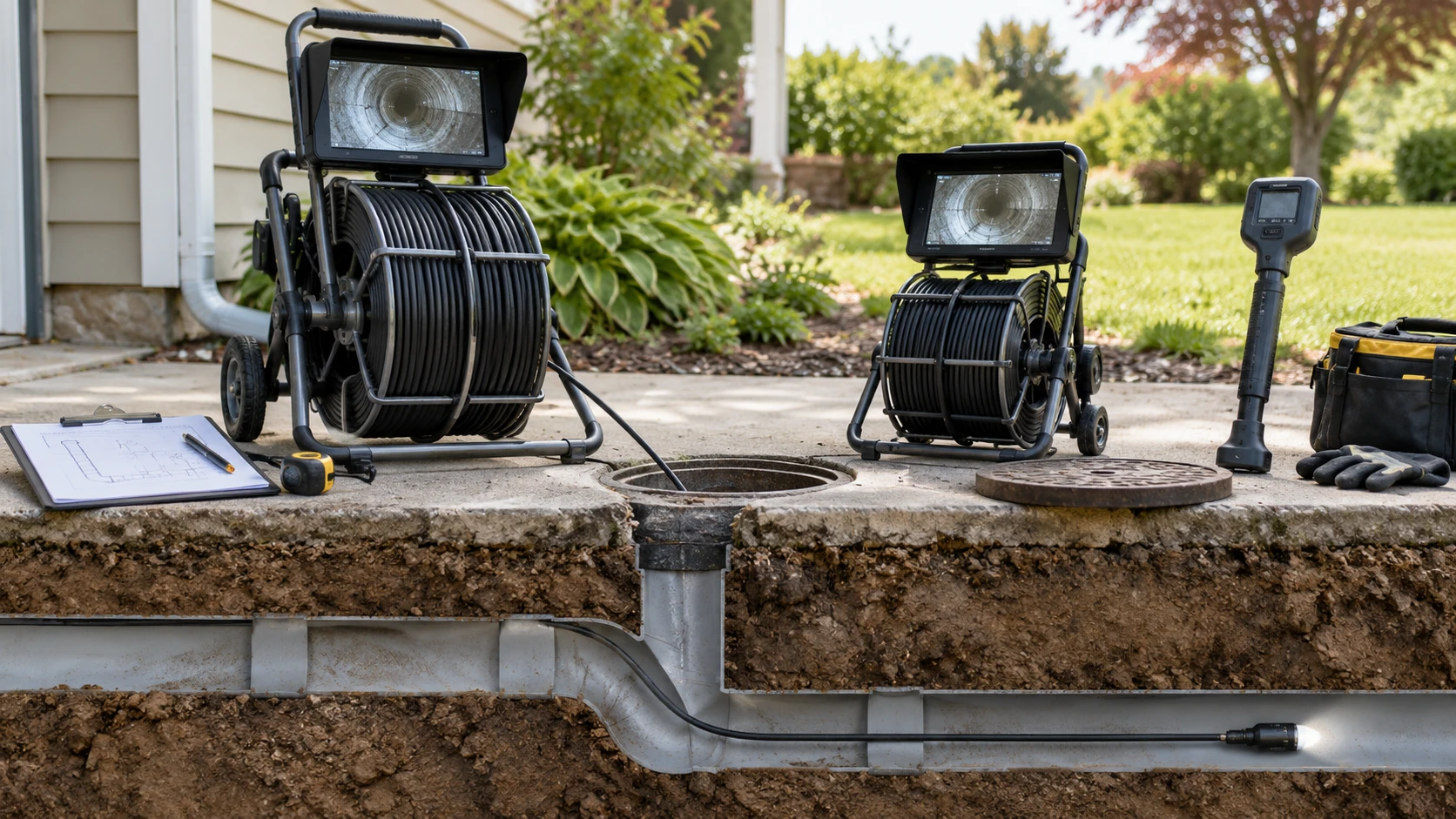
The useful length of a pipe-inspection camera depends on where it enters, which bends it must pass, and how you will locate anything it finds. The Huloretions 165-foot self-leveling sewer camera advertises the longer cable and meter markings along it. A published comparison of pipe-inspection cameras gives a related way to separate camera reach from practical inspection needs. The VEVOR 98-foot self-leveling sewer camera lists an on-screen distance counter and a 512 Hz transmitter for use with a separate locator. Those differences matter more than the fact that both listings promise a nine-inch 1080p viewing screen.
Start by drawing the actual route from a safe access point to the area you need to inspect. Include known changes of direction, pipe diameter, and an estimate of distance along the pipe, rather than a straight-line distance across the property. The catalog gives cable lengths but cannot confirm that either cable will negotiate your particular bends or reach an obstruction. If the line's layout is uncertain, make that uncertainty part of the purchase decision instead of assuming a longer cable will solve every access problem.
Reach and pipe fit are separate checks — VEVOR 98-foot self-leveling sewer camera
Huloretions states a 165-foot cable, with markings every meter to help gauge deployment depth. Its saved description says the camera is for pipes over one inch. It does not specify a minimum size for a right-angle turn or give a bend-radius limit for the cable. A longer advertised reach may be valuable on a long, accessible line, but the listing does not prove that the camera head and cable can pass every junction between the opening and the target.
VEVOR states a 98-foot, or 30-meter, semi-rigid cable. The saved entry gives the cable a 0.28-inch, or 7 mm, diameter and describes it as fiberglass. It also lists pipe ranges: 0.99 to 5.90 inches for straight pipes and 1.97 to 5.90 inches for right-angle pipes. Those conditions are important. A pipe near one inch may be within the stated straight-pipe range but below the stated right-angle minimum. Check the whole route, not just the diameter at the access opening.
VEVOR's description gives a 0.9-inch self-leveling camera head. Huloretions says its camera works in pipes over one inch, but the saved excerpt does not provide a head diameter. These figures are not enough to predict travel through a line with deposits, fittings, or a partially blocked section. Verify the exact head and cable dimensions, the manufacturer's routing guidance, and the actual pipe condition before assigning either system a job. Never force a camera past resistance on the strength of a catalog maximum.
The longer Huloretions cable may be attractive when the route is known to be long and sufficiently open. VEVOR's shorter run may still cover a nearer problem while supplying more described locating features. If the suspected problem lies beyond 98 feet along the only access route, VEVOR's stated length is a clear constraint. If the problem is close but the line includes a tight turn, the right-angle fit guidance may be the more useful specification to verify.
Markings, counter, and a separate locator — VEVOR 98-foot self-leveling sewer camera
Huloretions puts markings every meter on the cable. Those can help an operator estimate how much cable has been deployed, provided the marks can be read and the cable's path is understood. The saved listing does not say that the camera has an on-screen counter or a transmitter. It also does not describe a way to locate the camera head from above ground. Ask about those capabilities if pinpointing a repair location is part of the job.
VEVOR describes an on-screen distance counter that shows deployed cable length. It also lists a built-in 512 Hz sonde transmitter. The listing explicitly says the locator needed to track that transmitter is not included. This distinction matters when comparing complete job costs: a transmitting camera alone is not a surface-locating system. Confirm which compatible locator you have or would need to obtain, how the transmitter is used, and how its position is checked under the actual site conditions.
A deployed-length reading and a surface location answer related but different questions. Cable markings or a counter can tell you how far the camera has traveled along the route. A compatible locator may help identify where the transmitting head is relative to the ground above it. Neither number alone proves the exact depth or the cause of a blockage. Record the access point, route, displayed distance, and observations together so the inspection can be interpreted later.
The linked pipe-camera guide is useful here as a companion comparison, though it covers different exact products. Use it to frame the access and inspection questions, then return to the Huloretions and VEVOR manuals for the features of these two units. Do not transfer a dimension, locator feature, or operating procedure from the guide's products to the cameras on this page.
Screens and saved inspection evidence — comparison of pipe-inspection cameras
Huloretions lists a nine-inch 1080p HD LCD with DVR recording and a 16 GB built-in memory card for photos and video. Its description says files can be exported to a computer for review. VEVOR lists a nine-inch non-touch 1080p HD monitor with video and photo recording and an included 32 GB SD card. It also describes a keyboard input for logging inspection data and a sunshade for viewing the monitor in bright outdoor conditions.
These are useful workflow distinctions, but screen resolution and storage capacity do not tell you how much footage fits on a card. Video format, compression, recording settings, and available free space all affect that answer; the saved excerpts do not provide a comparable recording-time specification. If you need to document an entire line, check the current manuals for file formats, storage limits, transfer methods, and how a recording is labeled with location or distance.
VEVOR's entry says audio playback is supported through a computer or headphone output. That does not establish that the camera records audio during every inspection. Ask how the feature works before relying on spoken notes as part of an evidence record. Huloretions' excerpt does not describe audio handling. Keep a separate written log if the product documentation leaves that question open.
For an inspection that may be shared with a repair team, make a test recording before the actual run. Confirm that the camera image, any counter display, and the saved file can be reviewed on the intended computer. Then note the pipe access point and the time of the recording. A screen that looks clear on site does little good if the file cannot be transferred or matched to the section of pipe later.
Image orientation and visibility — VEVOR 98-foot self-leveling sewer camera
Both listings call their cameras self-leveling, a feature meant to keep the viewed image upright as the head rotates. Huloretions gives a 140-degree viewing angle and adjustable high-brightness LED lights. VEVOR gives a 145-degree viewing angle, 12 adjustable LEDs with three brightness settings, and 3x digital zoom. The five-degree difference in stated viewing angle is too small a basis for a quality ranking without comparable imaging tests. Lighting, pipe condition, and distance from the wall will affect what is visible.
Huloretions describes its camera head as IP68 waterproof. VEVOR describes an IP68-rated sapphire lens on its head. Those statements concern the specified camera components; they do not say the monitor, keyboard, connections, or battery can be submerged. Check the exact model's immersion and cleaning instructions before putting any part in water or washing it after an inspection. An IP code in a short catalog entry is not a blanket care instruction for the entire system.
VEVOR's digital zoom may help enlarge a detail on the screen, but the saved description does not show whether zoom adds any image detail beyond the underlying recording. Huloretions' excerpt does not name a zoom function. If small cracks or joins are the reason for the inspection, ask for representative footage from the exact model or test a unit in a known section of pipe. A 1080p label by itself cannot prove that a specific defect will be visible.
Battery claims and moving the equipment — VEVOR 98-foot self-leveling sewer camera
Both saved listings name a 4,500 mAh rechargeable battery. Huloretions claims up to eight to ten hours of continuous operation; VEVOR claims approximately six to eight hours. Those are figures in Republeq's catalog under unstated conditions, not independently measured runtimes with lights, recording, and other functions set for your job. Plan a charging interval or backup procedure for a long inspection, and check the current instructions for charging time and battery care.
Huloretions describes lightweight, removable attachments that simplify carrying, assembly, and cleaning. VEVOR describes a stainless-steel frame and auxiliary wheels for support and transport. Neither short excerpt gives a complete packed weight or dimensions for a direct mobility comparison. Think about how far the unit must be carried from a vehicle, whether stairs are involved, and where the monitor will stand near the access point. Ask for the full kit size and contents if that handling matters.
The larger battery-runtime claim and the longer cable appear together on Huloretions, but a long cable run may also take longer to inspect and retrieve. VEVOR's wheels and sunshade may matter more at an outdoor site than an hour figure on the box. Use your expected setup, recording, and retrieval time to judge the battery margin. The manufacturer should provide exact instructions for operating the unit during a lengthy session.
Decide around the line you need to inspect — VEVOR 98-foot self-leveling sewer camera
Huloretions merits closer inspection if a known long route needs more than VEVOR's stated 98 feet and the pipe is large enough for its head and cable. Verify the head diameter, bend guidance, cable-handling procedure, and the usability of its meter markings. Its 165-foot claim is a reach specification, not a promise that the entire route is navigable or that the head can be located from the surface.
VEVOR merits closer inspection if its stated straight- and right-angle pipe ranges match the route and if the on-screen counter and 512 Hz transmitter serve a locating workflow you can actually equip. Remember that a separate compatible locator is not included in the saved description. Verify the locator requirements and whether the 98-foot cable reaches the suspected issue from the chosen access point. Its shorter length may be enough for a nearby inspection with more detailed distance information on the monitor.
The exact saved identities are Huloretions product ID prod_b95281a6ea85924c38b0c6cb and VEVOR product ID prod_bb60040c2f0e374bca0a6002. Check the current pages and manuals for those products, including pipe-size limits, accessories, storage, warranty, and price. The better choice is the camera whose verified route, inspection record, and locating method match the job you have mapped, with enough access to bring the camera back out safely.