Home & Living
Understand how faucet aerators mix air through separate paths
Learn how faucet aerators mix air through inlet passages, a mixing chamber and outlet structures, with named design examples and clear catalog limits.
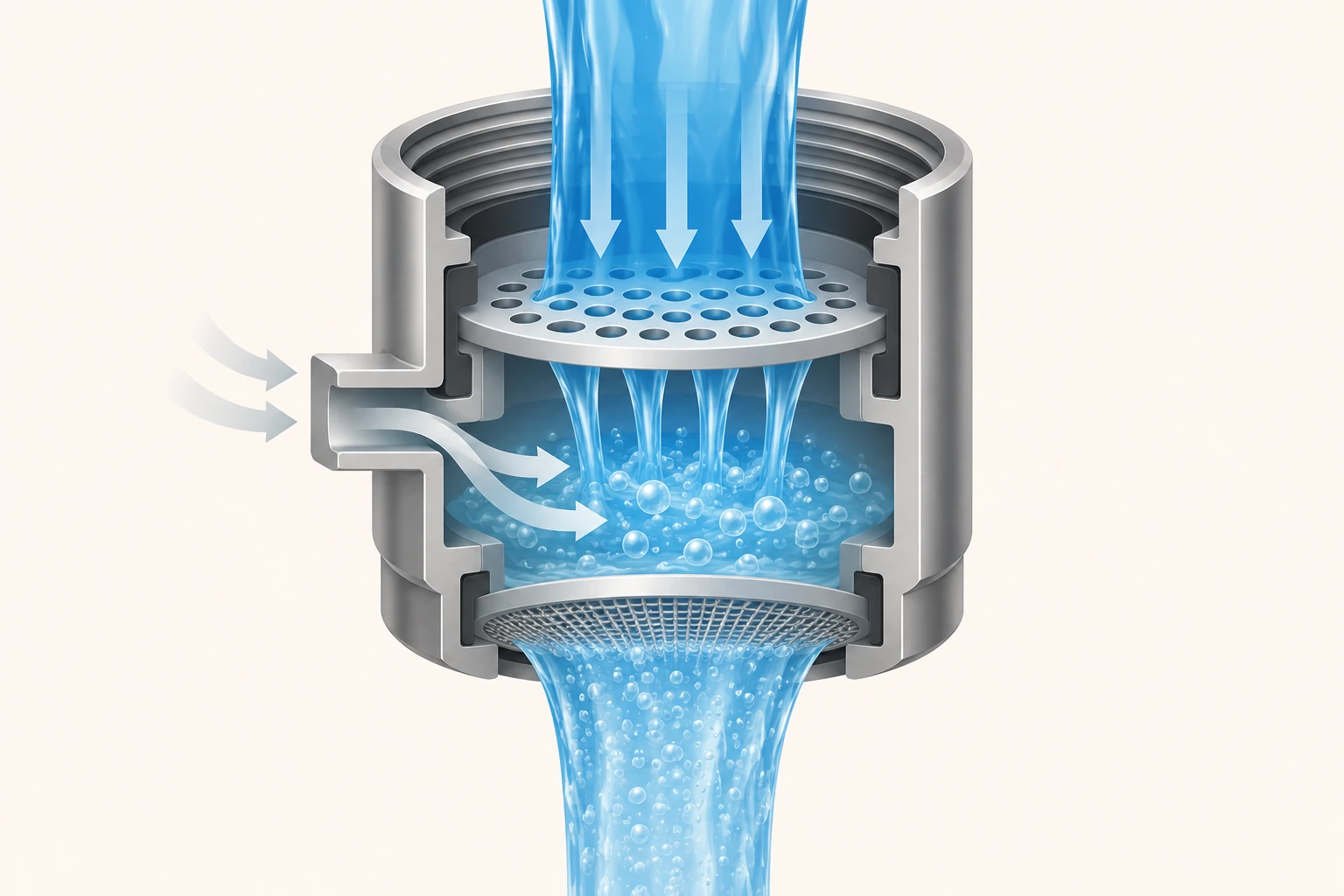
Understanding how faucet aerators mix air begins with a question about the route through the outlet. Where does the water enter, where can outside air enter, and where do those paths meet? NEOPERL describes an aerator as a faucet-end component that regulates the stream, including by mixing in air. Its explanation also distinguishes this role from pressure-responsive flow regulation. An O-ring that changes the openings available to water belongs to a different part of that explanation. Keep the two functions separate when reading a product description. The word aerator alone leaves the particular internal arrangement to establish. NEOPERL also explains that PERLATOR is its registered trademark, rather than the name of every faucet aerator. This article uses aerator as the general term and follows several named design documents for specific structural examples. The examples describe their own arrangements. They supply vocabulary for reading a diagram without identifying the hidden construction of a faucet offered in a catalog. The maker also lists mixing nozzle and stream straightener among the names used for these faucet-end components. Retain the function described beside any name.
Read each example on its own terms
Start with one drawing or description and keep its labels together. Write down the document name beside any component you identify. If a later example uses a different label, leave both labels with their respective examples until the relationship is clear. A short note can say which passage you followed and which point you still cannot locate. That makes the next reading question specific. It also gives you a way to explain an uncertainty without turning an unfamiliar diagram into a guessed account of your own fixture. You can finish a useful reading session with a clear question still open.
Keep the complete fixtures in the shopping context
The Elegant Lighting FAK-304 faucet is catalogued as a complete black kitchen fixture. The description names a retractable hose, a switching spray head and an aerated rinse. Its image shows the fixture, attached head and lever. A small body emblem is unreadable. The FAK-304 model retains MBK locator wording. Metadata carries a Proposition 65 warning for lead and lead compounds. This exterior view leaves the internal air route unidentified.
The Blossom F01 206 02 faucet is another complete fixture. Its account names a handle, pull-down sprayer, cartridge, hardware and Swiss Neoperl aerator. Its image shows a silver fixture, attached head and lever. No maker or model label is readable. The description’s material, leak-free-operation and warranty statements remain catalog claims. No outlet section is shown. Neither catalog account identifies its internals with the named examples below.
An example that admits air from the outlet
US3067951A describes an arrangement in which air enters at the water outlet. Its first claim places a water-breaking unit upstream of another unit that mixes the divided water with air. An air passage receives air at the outlet and feeds it into the tube beside the downstream mixing structure. In the illustrated example, grooves identified as 67 pass through the faucet’s internal-thread region. Holes 64 connect those grooves with the aerating space. A perforated disc and an inverted perforated cup sit above the screens. Follow those named features in their stated order when reading this example. Water arriving from above and air arriving through the outlet route have different entrances into the arrangement. The document also describes versions with a substantially imperforate surrounding wall. An air inlet therefore need not appear as an exposed slot on the outside of a projecting attachment. That is a feature of this documented outlet-entry design. It leaves the inlet location of another fixture to its own drawing or description. Its fifth claim describes the screen breaking up the water and then joining it into a coherent stream containing small bubbles.
A molded structure with a return path for air
US3684191A describes molded internal parts within a barrel. Its cup-shaped member has grooves that form outward-directed water jets. Those jets meet a curved impingement surface. The resulting water passes through a constricted annular opening into the mixing chamber below. Air follows a different route from the discharge end, travelling through passages around a supporting ring before entering that chamber. Screens form its downstream boundary. In the document’s description, the support struts, ring and barrel wall cooperate to leave the air passages available. These named relationships let you distinguish the part that forms the water jets from the space in which air joins the water. They also show why a component can have a supporting role alongside its role in defining a passage. Keep the barrel, ring and struts together in this example when tracing that route. A loose list of component names would omit the spatial relationship that explains how the described air path reaches the chamber. The described ring’s upper edge sits upstream of the cup’s furthest downstream portion, an arrangement intended to keep water from leaving through the air passages.
Two curved screens with a space between them
US4789103A provides a different named screen arrangement. Its cylindrical housing has air slots, with a perforated member upstream of them. Below those slots are two screens curved in opposite directions. Their peripheral edges touch, while their central portions remain separated. That separation forms a lens-shaped water-and-air space between the screens. The document calls the arrangement lenticular. In one described form, the upstream screen is finer and the downstream screen coarser. Another form joins screens of the same mesh by a crosspiece. These are alternatives in the document, so keep the selected form clear in your notes. The presence of a screen alone would leave its shape, its neighbour and the intervening space unspecified. Here the curved surfaces and their contacting edges explain the named arrangement. The description also includes upstream flow-control features. Those features should retain their own labels when you trace the air slots and the downstream screen pair through this particular example. A spacer extending from the perforated member bears on the upstream screen and holds the pair against the housing’s supporting portion.
A labyrinth before the meeting space
US5803368A describes a labyrinth disc upstream of a water-and-air meeting space. Its passages run largely across the disc before turning through it toward the outlet face. The document describes that route as reducing pressure at the outlet side. An external air passage leads into the mixing chamber there. In one illustrated arrangement, the air route lies between the housing and a water-guide assembly. Openings at the upper part of that assembly connect the route to the chamber. The downstream guides also have several described forms, including concentric tubes, circular passage arrays and a honeycomb-like body with parallel passages. These alternatives belong to the document’s account of possible arrangements. Keep the labyrinth disc, the air route and the outlet guide as separate named features while reading. The example explains an arrangement that does not depend on the paired curved screens in the preceding document. It provides another way to describe the route without making the earlier screen layout a universal requirement. The document also describes inward-slanted surfaces near the passage outlets that direct water toward the centre of the meeting space.
Side entry within a surrounding spout
US20210270021A1 describes a cap with air ports in its side. A communication port in the surrounding flow-channel structure guides air toward those ports from a space inside the spout’s outer wall. The document explicitly explains communication as a connection through which air can pass between spaces. Water enters the cap upstream, and the mixed discharge leaves downstream. In the described embodiment, columns divide the side openings around the cap. The account also describes an offset between the communication port and the cap’s air ports. Reading this example requires following both the cap and the structure around it. A view of the cap alone would leave part of the described outside-air route out of the account. Keep the communication port distinct from the air inlet it feeds. They occupy different positions in this example, even though both belong to the connected route. This is another named structural description, without establishing that a catalog faucet uses that arrangement. The described cap places its air ports upstream of the threaded engagement, leaving internal space at that engagement available for mixing.
Leave neighbouring purchase decisions with their own guides
The faucet aerator replacement cost guide concerns permission for assessment or removal work and the spending attached to that permission. Understanding a named internal passage does not settle the proposed service commitment.
The 4 inch centerset bathroom faucet fit guide concerns the sink deck, connections and associated replacement parts. Those fit questions require their own evidence before selecting a complete replacement fixture.
Keep a conditional purchase tied to its actual order
If the reading later leads to a product enquiry at republeq.com, retain the exact catalog reference and the question you want answered. Confirm the selected fixture and supplied contents before treating a basket as the order you intend to place. If checkout offers cryptocurrency, including USDT, use the current instructions displayed for that particular order. Read the asset, network, destination and required amount, then compare them with the transaction your wallet is preparing. An earlier message about a different product or option can remain in your records, but obtain the instructions that apply to the order now in front of you. If another household member will handle payment, give that person the confirmed order reference and its associated instructions. Ask them to check the same purchase before proceeding. Keep a merchant’s reply with the question it answers so a later conversation can identify the relevant item and order. When an instruction remains unclear, seek clarification through the merchant’s current support route before authorizing the transfer. Retain the order acknowledgement actually provided, together with the transaction reference from the wallet. If the transaction outcome becomes uncertain, ask the merchant to reconcile its status before considering another transfer. A question about payment can then be addressed using the actual order record. Keep any unresolved product question beside that record as well. Paying for an item leaves its own technical documentation and intended-use questions to establish. After delivery, compare the received fixture and contents with the confirmed order and retain the relevant correspondence for any enquiry about a difference. An explanation of a generic aerator design remains reading material alongside those purchase records.
Finish with the relationship you can identify
Return to the document you selected and describe the route in your own notes using its labels. Name the point you can follow and any point that remains unclear. Keep a later answer with that same example. When you explain how faucet aerators mix air to someone else, make clear which document supplies the arrangement you are describing. A precise question about an identified passage is a useful result of the reading, even when the retail fixture’s own internal drawing is still unavailable.
A generic cutaway illustrates how faucet aerators mix air through an air inlet and a mixing chamber.