Crypto Commerce
Hopestar 300W portable Bluetooth speaker vs Pyle PPHP1264A for portable music and outdoor announcements
Compare Hopestar 300W portable Bluetooth speaker by battery claims, microphones, weather exposure, music inputs, transport, and event setup.
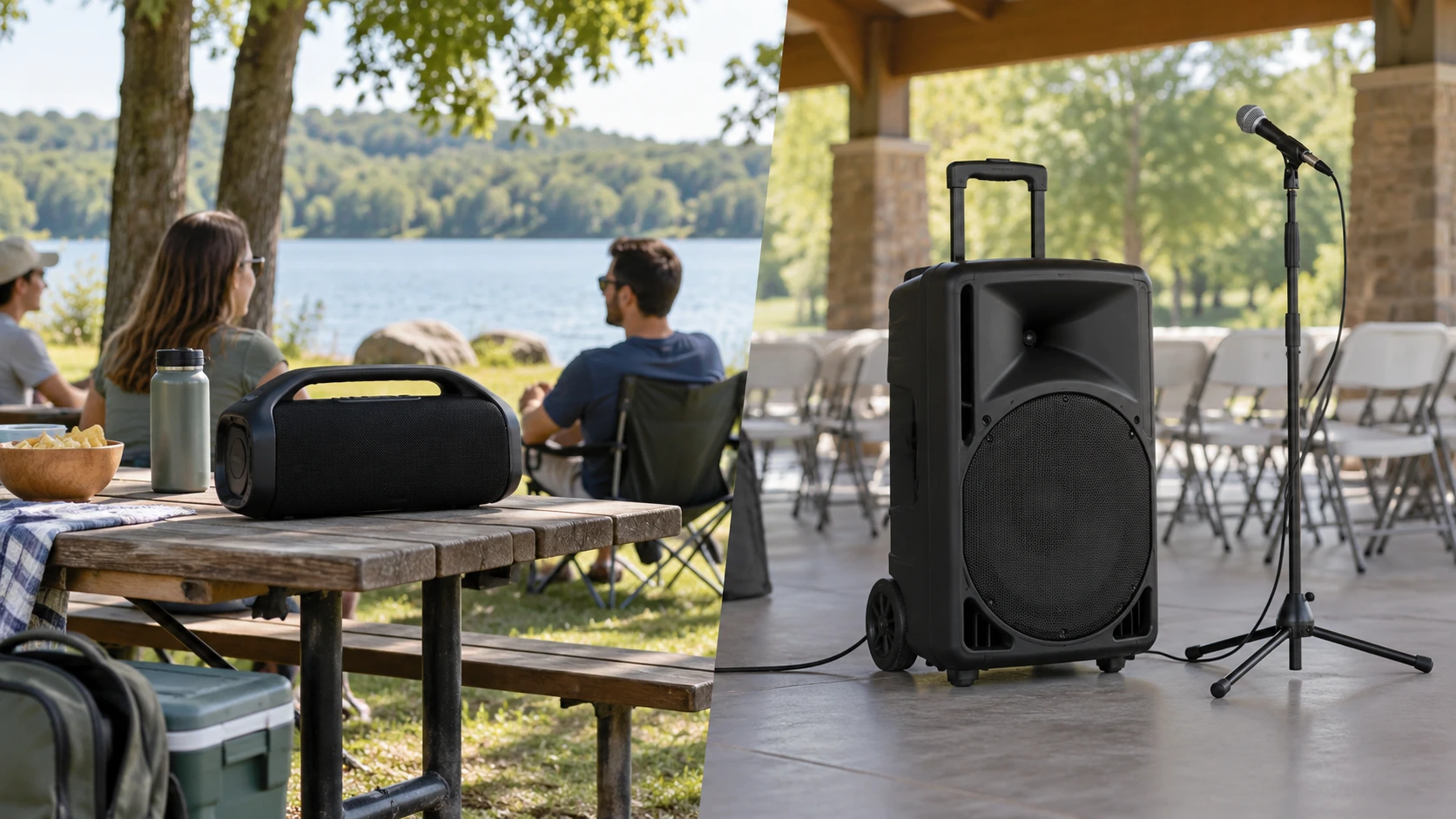
The Hopestar 300W portable Bluetooth speaker is described as a handle-equipped unit with an internal battery, Bluetooth 5.3, a built-in microphone, and IPX6 splash protection. The published Bluetooth speaker setup guide discusses a different pair, but its questions about where audio comes from and where a speaker will sit apply here. The Pyle PPHP1264A portable PA speaker is a 29-pound wheeled unit with a supplied wired microphone, a 12-inch woofer, and an advertised recording mode. Both can play music away from a fixed stereo. Their saved listings point to different ways of moving equipment, using a microphone, and getting through an event.
Decide what the audience needs to hear — Pyle PPHP1264A portable PA speaker
Start by writing down the event rather than the speaker's wattage. A few friends listening near a picnic table need a different setup from a presenter speaking across a hall. If announcements matter, plan the distance from the speaker to the audience, where the person with the microphone will stand, and how much room noise will compete with speech. If music is the main use, note whether listeners will stay near one spot or spread out. Neither pinned product description includes a controlled coverage or speech-intelligibility test at a stated distance.
Hopestar's listing emphasizes music for parties and outdoor gatherings. It names three driver sizes, an equalizer mode, and a true wireless stereo pairing feature that requires a second compatible Hopestar speaker. Its title calls the product 300W, but the saved description does not supply an RMS rating, a measurement method, or a loudness test. Do not use that title number alone to decide how far the sound will carry. A second speaker could give a wider stereo arrangement, but it also requires another purchase, charging plan, and place to stand.
Pyle describes a 12-inch woofer and a 1-inch tweeter, with figures in Republeq's catalog of 1,000 watts peak and 500 watts RMS at 4 ohms. Those specifications are not directly comparable to a model name with “300W” in it. The Pyle page does not say how speech clarity or usable output was measured in an outdoor crowd. Test a microphone and familiar recording at the expected audience distance if possible. Keep volume at a level that lets people understand the words without driving the system into audible distortion.
Plan the microphone path — Pyle PPHP1264A portable PA speaker
The Pyle package is said to include a wired microphone with a 9.8-foot cable. That supports a basic announcement or karaoke setup without separately finding a compatible mic, provided the current box actually contains the listed part. Measure the distance from the speaker's position to where the presenter will stand. A cable that is long enough on paper can still cross a walkway or force the speaker closer to a microphone than planned. Check the connector, gain control, and feedback behavior with the exact unit before relying on it for a public event.
Hopestar's saved description says it has a built-in microphone for karaoke and hands-free calls. It does not explain whether a person can hold a separate microphone, how far a speaker can stand from the unit, or how voice volume is controlled against music. A built-in mic on the speaker could be convenient for a nearby call and less suitable for a host walking around. Ask for an actual demonstration of the intended speaking setup. The product title also mentions a microphone, but the pinned row does not provide a full box inventory or independent voice test.
Pyle additionally claims a microphone recording mode that can create MP3 files. That feature may be useful for a rehearsal or a simple performance record, but the catalog does not specify the storage medium, file settings, or whether music and voice are saved together. Test a short recording, copy the file, and listen before planning to keep important audio from an event. If a reliable recording is essential, make a separate recording plan rather than relying on an untested PA feature.
Count hours from setup to pack-up — Bluetooth speaker setup guide
Hopestar claims 8 to 10 hours of battery use from a stated 27,000mAh total capacity. Pyle claims up to 2 hours from its rechargeable internal battery. These are estimates in Republeq's catalog under conditions the pinned rows do not align. The audience may hear a lower volume during setup and a much higher one during the main event. Bluetooth, lights, equalizer settings, microphone use, and temperature could change real endurance. Test the chosen volume and input over the complete time window, including setup and clean-up.
Pyle's specifications list 120/240V power and a power adapter in the package. If a safe outlet is available, the short battery claim may be less limiting; verify from the current manual how it operates while plugged in. Keep cables clear of foot traffic and use weather-appropriate power equipment outdoors. The saved row does not document a weather-resistance rating for the Pyle unit or its power connection. Do not treat an “outdoor” use description as permission to leave electrical equipment in rain.
Hopestar lists an IPX6 rating, described in the source as splashproof and suited to splashes or light rain. That is more specific weather information than Pyle's listing gives, but it is not a promise that the unit can be submerged or charged while wet. Check the current care instructions for ports, drying, and warranty limits. A covered table is still a sensible place for a speaker during unpredictable weather. If the event is truly exposed, plan for protecting phones, microphones, and power gear as well as the speaker.
Match the inputs and the route between them — Pyle PPHP1264A portable PA speaker
Hopestar names Bluetooth 5.3, a stated 10-meter wireless range, TWS pairing, EQ modes, and a 3.5mm wired connection in its saved description. The wording calls that socket a headphone jack, so confirm whether it accepts an incoming audio signal before planning to feed it from a mixer or laptop. A jack shape does not settle its direction or level. Test the phone that will play music, then walk the intended route to find out whether the link remains stable through people and walls.
Pyle names Bluetooth 4.2 with an up-to-32-foot range, plus the supplied microphone, remote, and LED lighting. Its saved excerpt does not give a complete list of wired music inputs. Obtain a current port diagram if the event uses a computer, mixer, or instrument. A microphone input is not automatically suitable for every line-level source, and a wireless connection can be interrupted when the phone leaves the operator's pocket or runs out of power. Keep the playback device charged and available to the person controlling the program.
For either unit, run the transitions that matter. Pair the phone, play a track, speak into the intended mic, change volume, and resume music. If two people need to take turns controlling audio, check how handoff works rather than assuming the Bluetooth connection will switch cleanly. The related guide is useful as a setup checklist; it is not a laboratory verdict about this Hopestar or Pyle pair. A simple, repeatable sequence reduces surprises when an audience is waiting.
Check the path to the venue — Pyle PPHP1264A portable PA speaker
Hopestar's integrated handle suggests one-person carry, but the saved row does not give its weight or dimensions. Ask for both before choosing it for a hike, crowded train, or small car trunk. A 27,000mAh battery figure tells you little about how comfortable the unit will be to carry for ten minutes. It also does not tell you how long the speaker takes to recharge. Plan where it will sit securely and how it will be protected between uses.
Pyle gives more physical detail: 29 pounds, about 19.3 by 16 by 27.2 inches, an integrated handle, and wheels. Wheels help on a smooth path and less on stairs, gravel, or a muddy field. Check the route from vehicle to venue, whether a helper is needed, and where the speaker can stand without blocking exits. Its lights may suit a party and may need to be disabled or covered for a presentation; the saved text does not describe their control in detail. A large box that is easy to roll in a shop may still be difficult to lift into storage.
Neither listing provides a confirmed stand-mount specification or a matched sound-dispersion test. If the audience sits behind other people or furniture, placement height may matter. Avoid balancing a heavy speaker on an improvised support. Check approved mounting options and the floor space the system needs. Test from the back of the intended room, not only beside the speaker. What sounds powerful at arm's length may be uneven across an open venue.
Compare the complete package and run a trial — Pyle PPHP1264A portable PA speaker
The September 30 catalog snapshot marked both available and listed minimum prices of $222.01 for Hopestar and $202.49 for Pyle. Those are historical saved offers, not confirmed checkout totals or current stock. The small price difference can be outweighed by a second Hopestar unit, an extension cable, weather protection, transport help, or a replacement microphone. Confirm the exact Republeq's catalog, package contents, return terms, and warranty. The Pyle row explicitly names a wired microphone, remote, and power adapter; the Hopestar row needs a current contents check before an event plan is built around any separate accessory.
Take the chosen unit through one complete rehearsal. Start from the vehicle or storage room, position it, connect the actual music source, test speech at the farthest listener, and run it long enough to reveal a battery or heat problem. Listen at an ordinary level as well as the level expected during the busiest part. If recording matters, verify the original file after the test. Note every cable and person the setup required; those are part of the product's real cost.
Hopestar merits inspection for a smaller gathering where a carry-handle speaker, longer claimed battery life, and stated splash protection fit the route. Pyle merits inspection when a supplied wired microphone, wheeled PA format, and larger speaker cabinet fit the audience and a short battery window or outlet is acceptable. Choose with a rehearsal at the actual venue conditions. The pinned descriptions identify features and claims in Republeq's catalog, but they do not replace a speech, music, power, and transport trial.