Audio Production
Home soundwalk: follow one continuous indoor route
Choose a private doorway-to-kitchen route, preserve its order in one continuous recording and note the transitions you can actually hear.
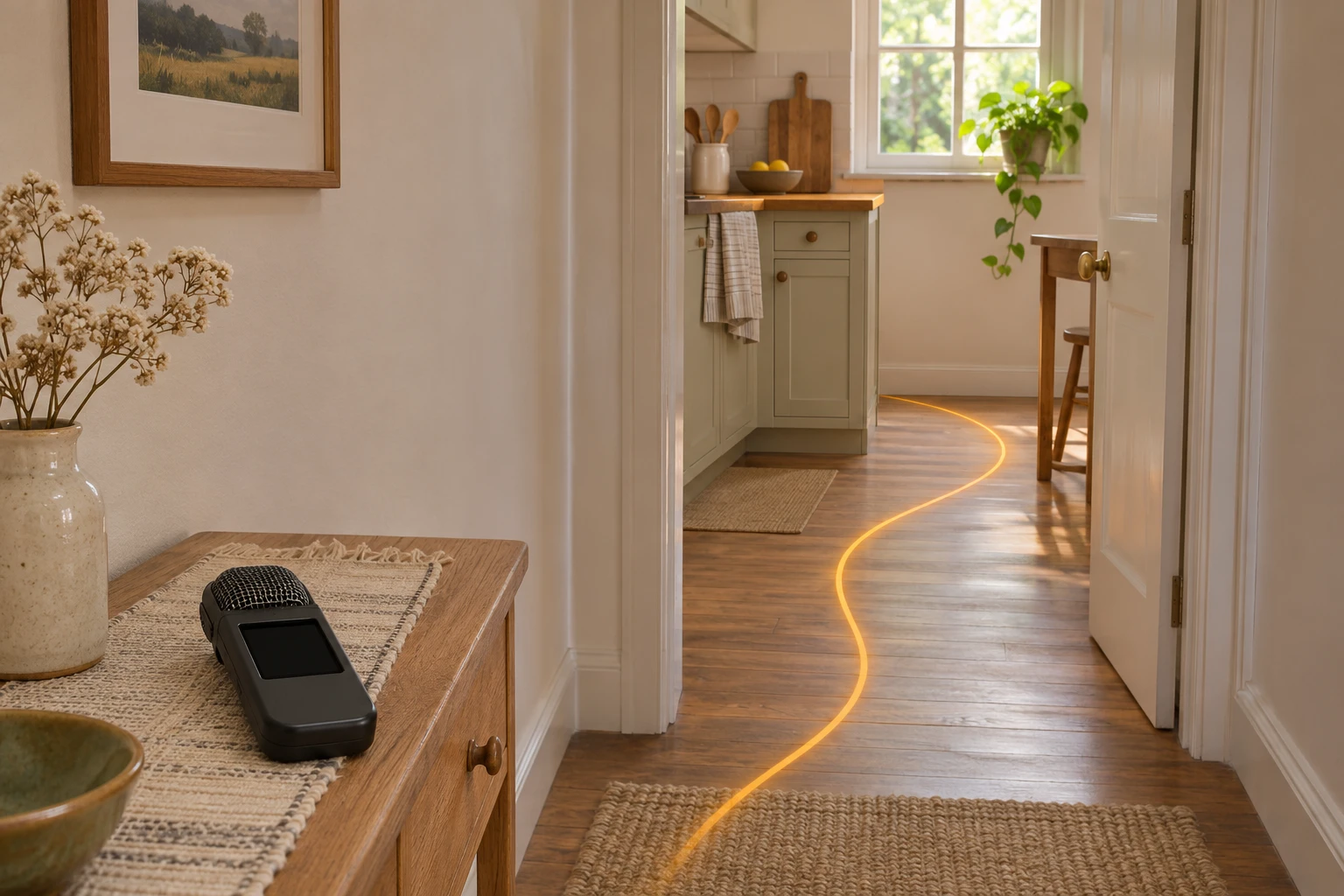
Home soundwalk planning can begin at an ordinary doorway and end in the kitchen. Choose to keep that short passage intact, then listen for the transitions you actually notice. You are making an observational record of one route on one occasion. There is no need to turn it into a tune, add a remembered conversation or make every room sound different.
The Zoom M4 MicTrak microphone and recorder has a handheld body with a display and protective grille. The Zoom M3 MicTrak microphone and recorder has a long shotgun tube with a separate crosswise control body. These are distinct device formats.
Zoom’s M4 documentation confirms a USB audio-interface role; the M3 listing also names interface use. Those functions establish no tested recording chain for this project.
Give the route a beginning and an end
Choose a room-sound route you can describe without drawing a complicated map. A hallway through an open doorway to a kitchen is enough. Name the place where you intend to begin and the place where you intend to finish. Keep the plan attached to the actual home available to you, rather than a room arrangement imagined from a product photograph.
For continuous sound recording, the continuity is the project’s chosen form. You intend to retain the passage between those two places instead of collecting attractive fragments and rearranging them afterward. That choice gives the first attempt a boundary. It does not prescribe a recording mode, promise an uninterrupted device result or establish what a particular microphone will capture.
Walk the proposed passage normally before involving equipment. Choose a route where you can pay attention to moving through the home without climbing over objects or interfering with another person’s task. If the passage is awkward, shorten it or choose another one. This is a small private listening project, so the route does not need to include every room or prove anything about the building.
Keep the occasion private to the people involved. Use a time and space where recording is welcome, and leave other people’s conversations, calls and private activities out of the plan. A short route can be changed or postponed. The interest here comes from attending to the passage you chose, rather than finding something personal that someone else did not intend to share.
Leave the equipment under its own instructions
Use a recording arrangement you have already established as appropriate for the task, following its applicable instructions. An unanswered setup question can stay in your preparation note without taking over the project. This article does not choose the connections, power source, storage media, support or settings for your actual equipment. Keep any unresolved equipment question separate from the route you want to explore.
If the arrangement is unfamiliar, leave the recording idea on paper while you obtain the relevant instruction. You can still identify the beginning, doorway and ending without operating anything. Do not make the project depend on changing an unexplained setting or borrowing a control sequence from another model. The route should be ready to revisit when the equipment question has been answered.
Decide how you will keep the resulting file recognizable if a recording is made. A plain personal title can identify the route and the occasion. Retain the original result separately from any later edited version you might choose to make. The project described here concerns that original passage; a rearranged version would be another creative work with its own choices.
Follow one passage without staging its sounds
Once the actual recording setup is ready under its own instructions, follow the route you chose. Let ordinary events remain ordinary. You do not have to tap a surface, shut a door dramatically or repeat an action to make the passage interesting. If you decide to stage a sound, identify that choice afterward rather than presenting it as an unnoticed event the recording happened to reveal.
Keep your attention on the route instead of trying to narrate every moment while it happens. You may choose a short spoken place cue as part of the project, but keep it recognizable as your own contribution. The cue does not prove that everything else in the passage can be identified from sound alone. A listener may still be unsure where one part of the route ends.
The first result might contain fewer distinct events than you expected. That can remain the result of this occasion. You are not obliged to manufacture an interruption or repeat the route until it resembles a story with a dramatic ending. Keep any actual interruption in the account. If the intended continuity was not captured, describe what you obtained rather than declaring the planned passage complete.
Listen before explaining every event
When a recording is available to review through your established setup, begin by listening to the passage as a whole. Notice where your attention changes. You might hear an event you recognize, a quieter interval or something you cannot identify. Describe what you actually notice in ordinary words. This is your response to this recording, rather than a universal description of how the rooms sound.
Then compare the heard order with the route you remember walking. Keep the two accounts distinguishable. Knowing that you passed a doorway does not establish that a particular sound marks that crossing. If the relation is unclear, write that it is unclear. An honest uncertain transition is more useful to this project than a confidently labelled event that the recording does not support.
Avoid adding a cause merely because it would make the passage easier to describe. An unidentified click can stay unidentified. A sound you associate with the kitchen might have another explanation that this recording cannot settle. You can retain your association as an association without turning it into a finding about an appliance, a room boundary or an event outside your view.
A note beside the file can say which part you recognized and which part remains open. Keep it specific to this occasion. There is no requirement to measure a duration, assign an acoustic rating or judge the home. The note helps you return to the same passage without asking your memory to supply details that were never established.
A fictional doorway-to-kitchen passage
Imagine Mina choosing a route from her hallway console through an open doorway to the kitchen window. Mina and this entire example are fictional. No recording was performed for this article, and no linked device was tested. The example illustrates how a route and a listening note could differ without either being silently rewritten to match the other.
Mina’s route note names the console, doorway and window. In the imagined listening account, she recognizes a brief sound near the beginning and notices another event later, but she cannot confidently place the doorway crossing. She leaves that transition unassigned. The route she intended to walk remains clear even though the hypothetical recording has not supplied an audible marker for each place.
She first considers labelling the later event as a cupboard closing, then remembers that she did not observe a cupboard being closed. She changes her note to unidentified short sound. This fictional revision preserves the limit of the account. It does not demonstrate a microphone’s accuracy, a recorder’s noise handling or a way to identify hidden activity elsewhere in a home.
Mina can keep that first passage without making it the definitive sound of her kitchen. If she later wants another attempt, she gives it its own title and occasion. She might choose the reverse route as a different project. The second passage would not retrospectively repair the uncertain doorway transition in the first, and neither would establish how every visitor hears the same rooms.
Keep neighboring creative projects distinct
The glockenspiel sound-journal guide connects a remembered scene with an imagined musical gesture. Its creative association belongs to that project. Here, the subject is an actual passage you intend to observe and record; there is no composed tune standing in for a memory.
The photo album sequence guide orders selected images through visible links such as shape or colour. This soundwalk keeps the walked passage in its original order. Selecting fragments and rearranging them into a new sequence would change the form of the project described here.
Neither related activity has to become a later stage of this one. You can enjoy the short passage as it stands, with a modest note about what you heard. There is no need to build an album, compose a soundtrack or publish a series. The stopping point can be the end of the route and a listening account that stays within the actual result.
Keep a purchase separate from the passage
If you decide to investigate an order on republeq.com, confirm the selected offer, variation, quantity, delivery information and applicable terms with the responsible seller or checkout service. This article does not establish that cryptocurrency payments are available for either product. If you want to ask about USDT, use the service’s confirmed contact or checkout channel and identify the particular order. A payment enquiry does not establish that a proposed recording setup is suitable. If a crypto option is offered, obtain the specified asset, network, receiving destination, amount, fees and order reference from current transaction instructions before authorizing any transfer. Check any conversion terms against that actual transaction. Keep the instructions with the selected goods so the payment question remains connected to the order you intended. Obtain the applicable cancellation, return and refund terms, including how a refund would be handled for the proposed payment method. Retain the seller’s relevant answer, the date and the confirmed order references. This guide supplies no wallet address, settlement guarantee, recovery procedure or assessment of a counterparty. If an instruction changes, ask the responsible service to confirm the change against the same order. If a transfer or order status is uncertain, reconcile that status before considering another transfer. An unresolved result is not evidence that nothing happened. Payment acknowledgement does not prove delivery, authenticity, package contents or recording suitability. Preserve those questions and their answers separately. Proceed only when the conditions of the particular transaction are clear to you and the remaining product questions have been addressed to the extent your purchase requires.
Home soundwalk planning does not require the particular devices linked here or a new order. Begin with the route you want to hear and the recording arrangement you can appropriately use. Keep the actual passage, the route note and any uncertainty together. That is enough to return to one ordinary movement through your home with a more attentive ear.