Seasonal & Holiday Content
Holiday tablecloth drop planning: centre and offset
Compare centred drops, offsets and asymmetric requests using original rectangle calculations and two nominal cloth sizes.
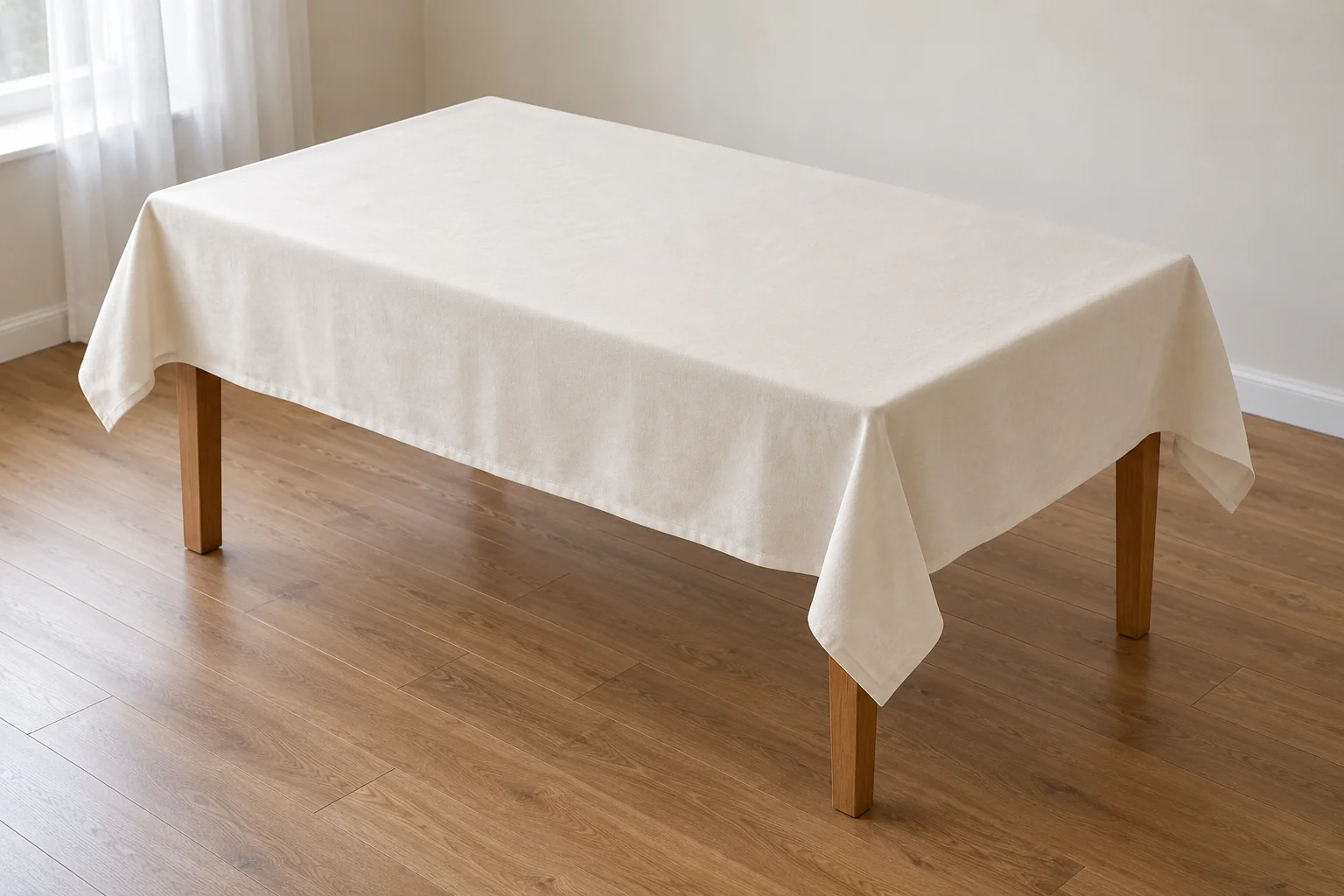
Holiday tablecloth drop planning can begin with a rectangle on paper. If you want fabric to extend beyond a table by a chosen amount, the cloth's overall dimensions and the table's dimensions need to describe the same problem. An attractive size label alone does not tell you the extension at each edge.
The examples here use ideal flat rectangles, aligned edges and inches throughout. They assume no stretch, folds, rounded corners or change in dimensions. Every table measurement below is invented for the calculation. The offered cloth sizes are nominal source inputs, rather than measurements made for this article. Use the arithmetic to understand a proposed arrangement before resolving the shape, dimensions and other requirements of an actual item.
Keep the selected offer separate from its address
The Violet Linen Treasure tablecloth offer describes its selected White option as 72 by 162 inches. Its address names 70 by 144. Keep that discrepancy open when confirming the intended variant. The calculation below uses the description's stated dimensions without establishing what a delivered item would measure.
The Violet Linen MAJESTIC BE-5 offer names Beige 60 by 102 inches in its actual title and description, while its address names 60 by 84. Its gallery also uses differing size labels. Confirm the selected variant separately. Neither catalogue photograph provides a measured table or an independently checked drop.
Give the rectangular tablecloth drop two directions
For the first imaginary holiday table, call the shorter direction the width and give it 36 inches. Call the longer direction the length and give it 84 inches. For these examples, place the shorter side of each ideal cloth rectangle across that width and its longer side along that length. Those labels define the model; they do not verify the outlines or measurement conventions of a retail product.
A rectangular tablecloth drop has an answer in each direction. Subtract the model table's width from the model cloth's width to find the total width available beyond the two sides. Do the corresponding subtraction along the length for the two ends. Keep the two totals on separate lines. A single answer would conceal whether it belonged to a side or an end.
Using the nominal 72-by-162 input on the imaginary 36-by-84 table leaves 36 inches across the two sides and 78 across the two ends. These are totals for opposite edges together. They are not the amount hanging at each edge, and the larger total does not need to equal the smaller one. The two directions describe different differences between rectangles.
Centred placement in this ideal model divides each total equally. Half of 36 gives 18 at each side; half of 78 gives 39 at each end. Write both pairs with their direction: sides 18 and 18, ends 39 and 39. The calculation supplies no table height or floor measurement, so it cannot answer whether those extensions belong in a real arrangement.
The nominal 60-by-102 input gives another result on the same imaginary table. Across the width, 60 minus 36 leaves 24, divided into two side drops of 12. Along the length, 102 minus 84 leaves 18, divided into two end drops of 9. The resulting pairs are sides 12 and 12, ends 9 and 9. Calling the whole arrangement a twelve-inch drop would lose the end result.
Work backwards from the extension you actually want
Suppose the fictional plan calls for twelve inches at all four edges of that first table. Across the width, add twelve twice to 36. The required ideal width is 60. Along the length, add twelve twice to 84. The required ideal length is 108. This produces a target rectangle of 60 by 108, with no claim that an actual offer has that shape or size.
The 60-by-102 input matches the target width but has six fewer inches along the other direction. In a centred calculation, that difference is shared between the ends: each end has three fewer inches than the preferred twelve. The earlier nine-inch answer follows from the same numbers. A correct result along one axis does not establish the requested result along the other.
You can check the inverse calculation without relying on its name. Reassemble the proposed length from the fictional table and the two desired extensions: 84 plus 12 plus 12 equals 108. Then compare that total with the chosen model cloth length. This check asks whether the quantities describe the same rectangle. It supplies no instruction for cutting, stretching or changing a real textile.
Uneven tablecloth overhang redistributes a fixed amount
For uneven tablecloth overhang, keep the first table and the 60-by-102 model input. Its total length beyond the table remains eighteen inches. Instead of dividing that total equally, imagine transferring three inches of extension from one end to the other. The nine-and-nine pair becomes twelve and six. Add the new pair: twelve plus six still gives eighteen.
The transfer is a numerical offset in this model, not a handling procedure. One quantity increases by the amount the opposite quantity loses. If the preferred end is identified on a drawing, mark which end has twelve and which has six. Reversing those labels changes the proposed arrangement even though the same two numbers appear on the page.
A different request might call for eleven at one end and seven at the other. Those figures also add to eighteen. Compared with the centred nine-and-nine pair, they represent a two-inch redistribution. The model allows you to compare the requested pair with the available total before deciding whether it describes an arrangement you actually want to investigate.
Check an asymmetric request before choosing an offset
Now suppose the fictional preference is twelve at one end and eight at the other. The requested pair adds to twenty. The available total in this length calculation is eighteen. There is a difference of two inches. Choosing a different offset cannot make both requested numbers true at once, because an offset changes how the fixed total is divided.
Work backwards again. The hypothetical table length of 84 plus the desired twelve and eight gives a required ideal length of 104. That is a different target from the 108 required for twelve at both ends. State the actual preference before deciding which target to calculate. Two arrangements can share one twelve-inch end while requiring different total lengths.
If the fictional host changes the preference to twelve and six, the requested total becomes eighteen and agrees with the earlier model. That is a changed request, not a discovery that the original request had already been met. Keep the earlier target visible if it still matters to the decision. Arithmetic can show a disagreement without choosing which preference the person should abandon.
A changed table needs a new calculation
Consider a second imaginary holiday table, 42 inches wide and 96 long. Keep the same nominal cloth inputs and the same ideal assumptions. For the 60-by-102 input, the width difference is eighteen and the length difference is six. Centring divides those totals into nine at each side and three at each end. The old twelve-and-nine pair belonged to a different table.
The change from the first table adds six inches of width and twelve of length. That uses six more inches of the width budget and twelve more of the length budget. When the remaining amount is divided equally, each side loses three and each end loses six. Keeping the total change separate from the per-edge change explains why those two answers differ.
The 72-by-162 input on this second table leaves thirty inches across the sides and sixty-six across the ends. Centring gives fifteen at each side and thirty-three at each end. Those figures can be checked by adding the opposite drops back to the relevant table dimension. They remain model results, with the actual variant and physical arrangement still to establish.
Keep the seasonal calculation within its own task
The Thanksgiving napkin-ring guide uses an actual place setting and serving pieces before repeating its decoration. That is a separate household trial. A calculated cloth extension does not confirm ring fit, serving space or a guest's comfort. Keep those questions with the real pieces and meal you intend to use.
The Thanksgiving menu-display project keeps the page's wording attached to the actual meal. A holiday cloth calculation also needs its own clearly named occasion and table. A decorative plan for one dinner need not become a requirement for every later gathering. Frame specifications there provide no cloth measurement here.
If crypto is part of the proposed order
If cryptocurrency is how you intend to pay for a proposed tablecloth order through republeq.com, confirm that method in the actual checkout. If USDT is the method you would prefer, investigate the choices presented for the exact order while the decision remains yours to make. The item needs to be identifiable independently of that preference. Someone helping with the purchase should understand which variant you intend, what remains unresolved and whether you are ready to place an order at all. A convenient payment route cannot turn an unanswered product question into a confirmed specification. You may keep the holiday plan on paper while leaving the purchase undecided. If a checkout option needs clarification, use the current information for that transaction rather than instructions remembered from a different order. No transfer destination, token network or asset movement is supplied here. Before proceeding, read the delivery information and return conditions that apply to the proposed goods. Treat any intended gathering date as your own planning requirement, rather than a delivery commitment created by this article. Where an actual checkout produces a confirmation, retain it with the goods and order reference it concerns. Those records identify a transaction; they do not measure the received cloth or demonstrate an arrangement on a table. A person who later asks about the purchase should be able to distinguish the order details from the hypothetical dimensions used in an exercise. You can decide to use something already available, change the intended purchase or make no purchase after considering the arithmetic. Mention of crypto or USDT promises no acceptance for every order, financial advantage, transfer result or particular refund outcome.
Return from the model to the actual holiday table
Keep a short calculation record with the two axes named, the assumed table dimensions, the selected nominal cloth input and the requested opposite drops. A centred pair and an offset pair should remain distinguishable. The total available beyond an axis stays tied to the difference between its two rectangle dimensions, while your preferred split is a separate choice.
Then return to the real item and the actual table. Confirm which variant is being offered and obtain the relevant shape, measurement and product information for the arrangement you intend. These hypothetical rectangles have answered a numerical question. The actual tablecloth and the place where you want to use it still require their own information.