Holiday Decorations
Holiday doorway hanger shifting: check frame contact before rehanging
Diagnose a shifting holiday doorway rod by checking each frame contact, door movement and the decoration arrangement.
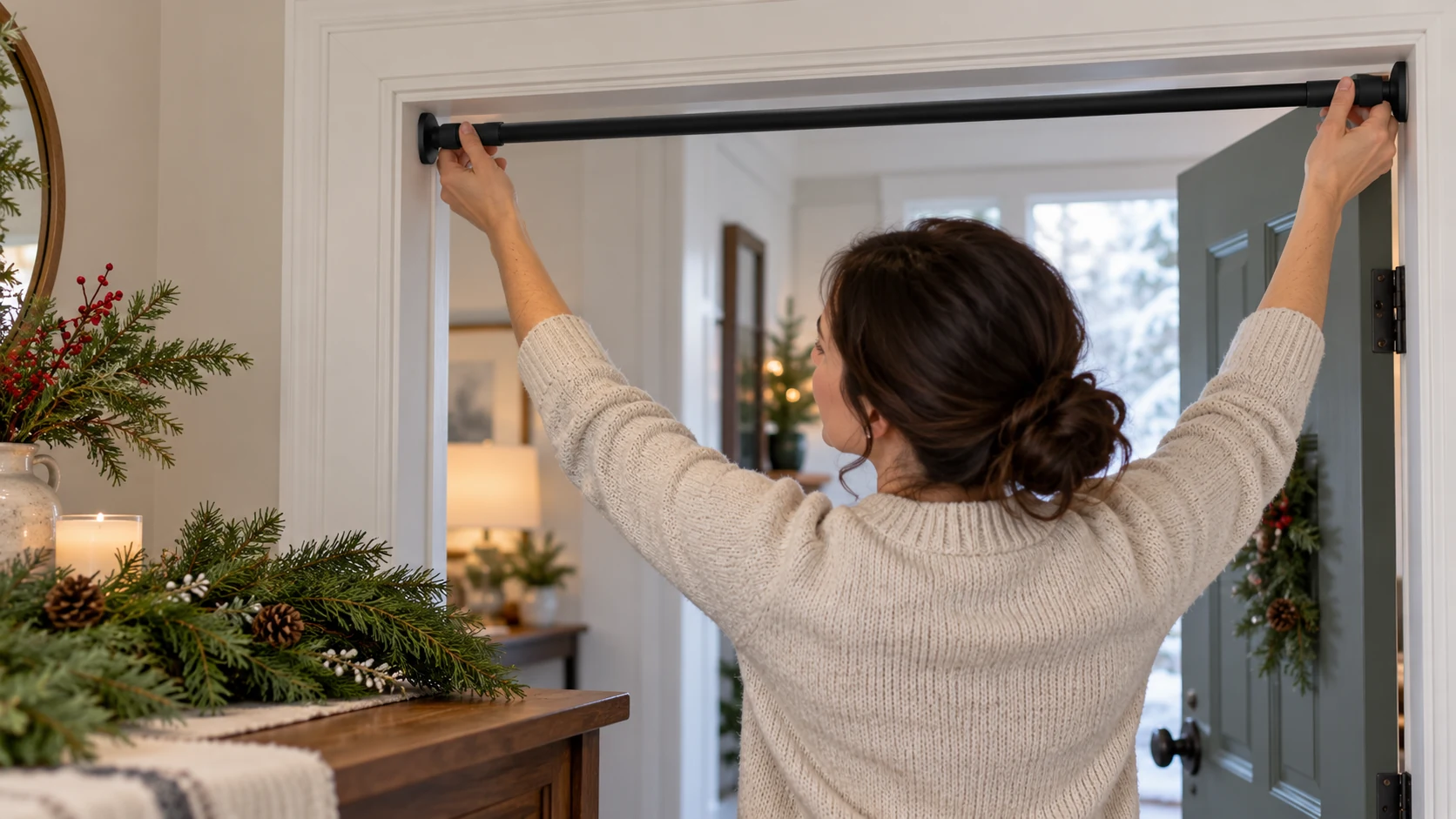
Holiday doorway hanger shifting can begin even when the rod looked level during setup. Remove the decoration before trying to reseat the rod; the changing load makes it harder to see which contact point moved. The Fuliko door-frame garland hanger and the AOOOWER door-frame hanger are frame-spanning rod designs. Their product names do not prove that either will grip your doorway. Diagnose the frame contact, door movement and decoration arrangement before considering a replacement.
Start with the decoration off the hanger
Move the garland or other decoration to a stable surface. Do not hold a shifting rod overhead while another person pulls on the decoration. If a piece is damaged or an attached light string is tangled around the rod, release it carefully before examining the support. Make the doorway usable again while you work. A hanger that has already moved should not be treated as secure just because it remains temporarily in place without weight.
Record what happened. Did one end slide down, did the whole rod rotate, or did a hanging clip move along the rod while the rod stayed fixed? These observations point to different joints. A pad slipping on painted trim calls for a contact check; a garland bunching in the middle calls for a look at how its weight is distributed. Mark the previous rod position with a removable reference if that can be done without damaging the finish. The movement itself is more informative than guessing from the hanger’s advertised rating.
Check door movement and frame contact before adjusting the rod
Look at the two places where the ends are meant to press or sit. Are they on firm, flat areas of the frame, or has one landed partly on a molding edge? A small change in height or angle can make two ends behave differently. Compare left and right by sight before tightening anything. If the doorway has decorative trim, a sloped surface, a loose piece or a surface you are not allowed to mark, stop and consider another approved display location rather than forcing this style of hanger to work there.
Open and close the door slowly with the decoration removed, watching the route of the door and any seal. The doorway fit guide for a Halloween wreath covers the pre-hanging size decision. Here the question is whether a hanger that has shifted occupies the door’s moving path. A door edge, closer or weatherstrip can brush a rod or hanging piece as it travels, even if the doorway looked clear while the door stood open. Restore full ordinary operation before putting the decoration back.
Check the frame opening at the height where the rod is installed, not only near the floor. Measure across at the actual contact points and compare with the current product’s stated adjustment range. A nominal doorway width does not capture trim thickness or the exact surfaces the pads contact. If the frame is wider at one height than another, moving the hanger up or down can change the needed extension. Do not improvise a wedge to make up for an unverified range; seek an appropriate hanger or another location.
Inspect the two contact ends and the adjustable body
The Fuliko product photo shows a black adjustable rod with broad end pads and multiple small hanging arms. Its physical role is to span a door frame and carry decoration from the rod. If the rod has shifted, inspect each pad for correct orientation and full contact with the frame. Check whether the adjustable sections are seated according to the product instructions. The photo establishes the design, not the amount of pressure suitable for your trim or an exact fit at your doorway.
The AOOOWER product photo shows another frame-spanning rod with separate pieces and hanging arms. That arrangement makes assembly and seating worth checking against its current instructions. A piece that was never fully engaged can look aligned until the decoration is added. Do not assume the parts from these two products interchange or that one maker’s adjustment method applies to the other. Keep hardware identified with its own hanger and use the instructions for the exact model in hand.
Wipe visible dust from the contact surfaces with a method suitable for the frame finish and let them dry before reseating. Do not put adhesive, oil or an abrasive pad on the frame simply to increase grip. Those changes can mark the surface and hide a geometry problem. If a contact pad is missing, worn or cracked, do not tighten against the bare rod end. Check whether the manufacturer offers the matching replacement part or choose another supported solution.
Reseat without treating force as a repair
Follow the exact hanger’s assembly and adjustment instructions with the decoration still off. Keep the rod level and bring both end pads to their intended surfaces. Ask a second person to observe the opposite end if the doorway is wide enough that one person cannot see both contacts at once. Stop if one end rides onto trim as the other seats. The goal is balanced contact in the allowed range, not maximum force. Excessive pressure can damage a frame and does not prove that the hanger will remain stable under a changing load.
After reseating, look at the rod from the room side and the doorway side. Check that it does not twist, lean or interfere with a hinge or closer. Open and close the door gently again. A frame-spanning decoration bar should not make the door rub or fail to latch. If normal door use moves the rod, remove it and choose a different placement. The fix is not to stop using the door or to keep resetting the rod after each passage.
Try a light hand check only as the maker permits, with no decoration attached. Do not hang from the rod or use your body weight as a test. Watch for a pad lifting, a section rotating or a clamp sliding. If the same joint moves twice, record that exact point and stop treating the issue as a simple leveling error. A repeated movement can reflect an unsuitable frame surface, incorrect assembly, a damaged part or a size range mismatch. The visible symptom does not identify which cause without examining the joint.
Put the decoration back in a controlled way
Before rehanging, look at the garland itself. A heavy cluster at one end can make one side of the support work harder. Spread attachments according to the hanger’s intended use and the decoration’s own structure, without stretching wires or branches to make the load appear even. If lights are present, keep cords out of the moving door path and follow the light maker’s instructions. Do not use a powered light cord to hold up or stabilize a decoration.
Add the decoration in stages while another person watches the end pads if practical. Pause before adding the last cluster. Has the rod stayed at the reference position? Did an arm slide, or has a tied section begun pulling sideways? A static check with the full decoration is more useful than a quick glance at an empty rod. If it starts to move, take the decoration down. Do not continue adding weight in the hope that it will settle into place.
If a wreath is part of the doorway display, keep its shape and attachment separate from the frame-spanning garland bar unless the exact hanger supports that arrangement. When the display comes down, the wreath storage guide addresses its off-season shape and container. Storage is not the repair for an in-use shifting rod, but removing a wreath safely gives you the clear doorway needed to diagnose contact and movement. Do not leave a decorative ring suspended from an uncertain support during the check.
Know when to replace the hanger or move the display
A different hanger may be appropriate if the current rod is outside its stated opening range, its pads or locking parts are damaged, or the frame lacks suitable contact surfaces. Compare the next candidate with the actual measured opening and the type of frame, not just a broad “fits most doors” phrase. The two catalog examples are similar in role, but their components and adjustment details must be evaluated individually. Another version of the same physical idea may fail at the same awkward trim.
Sometimes the sensible answer is a different display location. A doorway with a closer, unusual molding, frequent traffic or a finish that must remain untouched may be a poor match for a pressure-contact holiday bar. A wall-mounted solution or another freestanding support may have its own installation requirements; use only a method suitable for the property and the decoration. Do not drill, glue or modify a door frame as an unplanned response to a seasonal hanger slipping.
Keep the failed observations for the next attempt: opening width at installation height, contact-surface shape, which end moved, whether the door brushed the hanger, and how the decoration was hung. A short note prevents repeating an identical setup next season. If the hanger is damaged, set it aside so someone else does not reuse it without noticing. If it is sound but simply wrong for this doorway, store it with a label naming the limitation rather than treating it as a universal spare.
Finish with a normal-use check
For a normal-use check, with the display in place only after a stable check, use the doorway normally for a short period and look again at the end positions. A support that shifts after a few door cycles is not repaired. Take it down and revisit the contact surfaces, the moving door path and the load arrangement. A holiday decoration should not make a household practice a special door motion merely to keep a hanger standing. The repair is complete when the hanger remains in its intended position during ordinary use within its actual instructions.
If the doorway cannot meet those conditions, move on without forcing the installation. The decoration can still be used somewhere else, and the hanger can be judged against a different frame only after its condition is checked. The key troubleshooting sequence is simple: remove the load, find which joint moved, verify the two frame contacts and door path, reseat exactly as directed, then reintroduce the decoration gradually. Each step answers a real question. Repeated tightening without understanding the movement answers none of them.
Before storing the display at the end of the season, take a photograph of the stable position and note the measured opening and assembly arrangement. Keep the hanger’s pieces together so the next setup does not begin with a missing pad or clamp. A record is useful only if it describes what actually worked, including any reason the doorway was rejected. It should never become permission to skip a fresh contact and door-movement check next time.