Home & Living
holiday candle warmer corner: plan the lamp, controls and clearing date
Plan a temporary candle-warmer display around one exact lamp, reachable controls and an end date without assuming safety from a product photo.
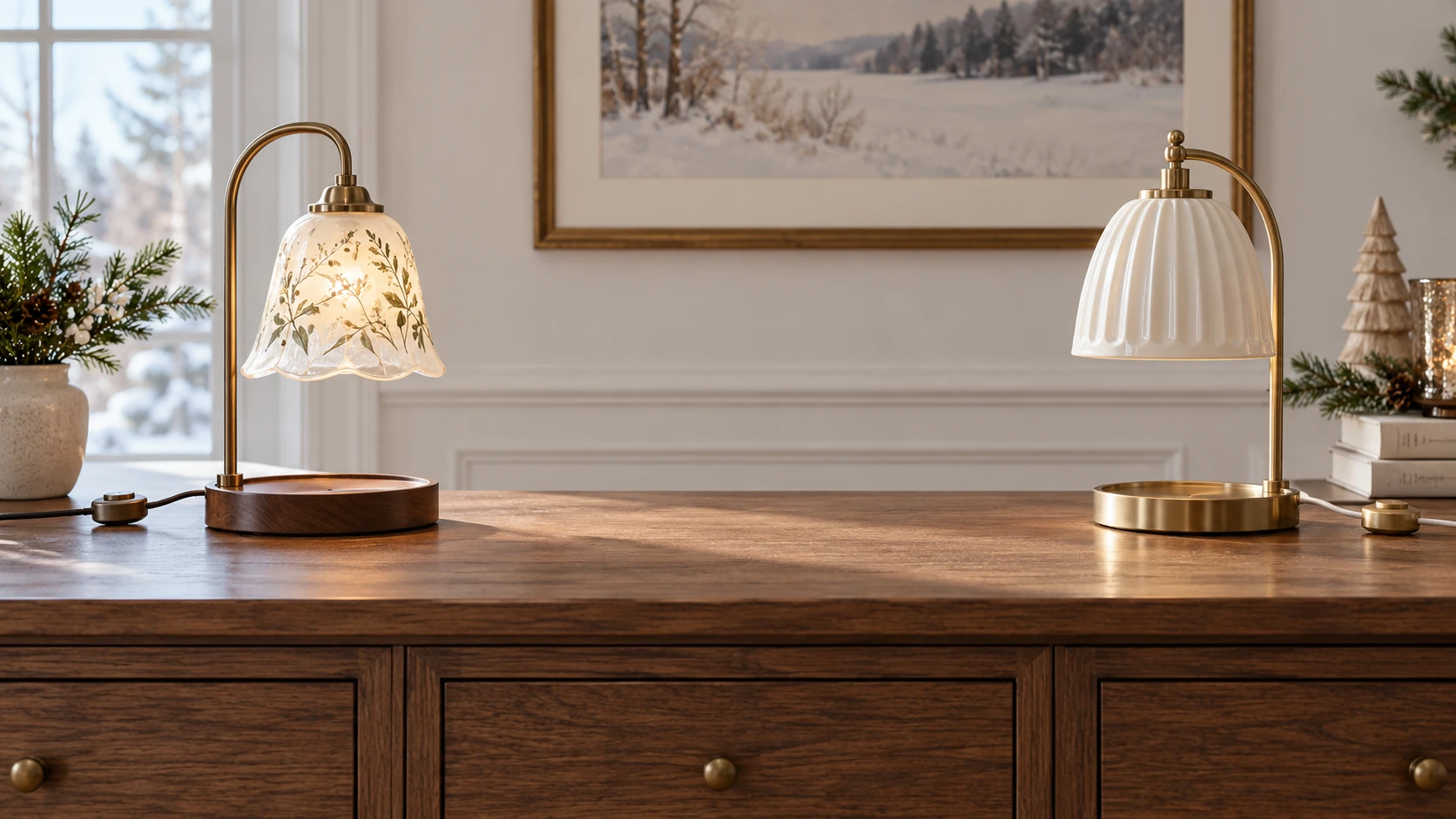
A holiday candle warmer corner works best as a temporary arrangement with an exact lamp, a reachable control, and a clear takedown date. Choose the surface before choosing decorations around it. The warmer needs to be used according to its maker's instructions; a festive photograph cannot establish safe clearance, jar fit, cord routing or permission to leave it running. This guide helps you compare two actual candle-warmer listings and plan where the lamp and its parts will go before guests arrive and after the holiday is over.
Choose the corner before the lamp style
Start with the surface you already have. Measure the usable depth and width, note what doors or drawers open nearby, and decide whether anyone needs to set down a bag, key or serving dish there. A lamp looks different on a console used only for display than on a busy kitchen counter. Put a paper outline of the proposed lamp and candle jar on the surface before adding garlands or gift boxes. Leave access to the actual switch, dimmer or timer control and enough room to follow the specific maker's placement directions. A measured outline is a planning aid, not a safety clearance certification.
Look at the normal walking route through the room. An entryway may be crowded when several people arrive together. A holiday table may need its surface for plates later. If the proposed lamp occupies the only clear part of a passage-side console, choose another location or a smaller scene. Keep a photo of the undecorated surface so you can compare the plan with the room as it is used. The holiday small-scene planning guide discusses grouping decor in a limited space; this article applies that room-level thinking to the physical footprint and accessible controls of one candle warmer.
Compare the two lamp offers as separate products
The flower candle warmer lamp listing describes a height-adjustable lamp with an arched metal support and walnut base. It names a timer with two-, four- and eight-hour choices, four dimmer levels listed as 25, 50, 75 and 100 percent, and two supplied 50-watt bulbs. Those are seller-stated features for this offer, not a set of controls you should assume on every warmer. Read the current variant and its instructions before planning a timed use. The listing does not supply a measured clearance for your table, jar or nearby decoration.
The ceramic-shade candle warmer listing names an adjustable height, timer, dimmer and two bulbs. It does not establish that its timer uses the flower lamp's two-, four- and eight-hour choices or that its dimmer has the same four percentage settings. The ceramic shade and gold base will also read differently in a room from the flower lamp's clear white and wood elements. Compare the actual current listing, instructions and dimensions for the exact selected offer. Similar product names or supplied bulb counts do not prove matching controls or jar clearance.
Draw one simple layout for each candidate rather than mixing their features. For the flower lamp, mark the base and the control location shown in its current instructions. For the ceramic model, mark its own base and control location. Place the intended candle jar in the plan only after confirming the maker's fit directions for that lamp. A jar photograph is not a measurement. Adjustable height may help with an eligible candle, but it does not authorize any jar or any decorative object under the shade. If the seller does not provide a needed dimension, leave that compatibility question open instead of drawing a precise fit you cannot support.
Keep holiday decor out of the operating decision
Garland, cards and wrapped gifts can make a candle warmer look like part of the display, yet they remain separate objects with their own materials and positions. Plan the lamp's normal operation from its manual first. Then decide whether other decorations can be placed in the scene under those instructions. The product listings' broad statements about ambiance, children, pets, smoke or stability are marketing claims; they do not establish that a particular crowded console is safe. Do not place paper or fabric by a lamp because a staged product photo did so.
Some households use the holiday corner only while people are in the room. Others imagine setting a timer and leaving the area. A timer setting does not replace supervision or the maker's operating rules. The flower lamp's listing gives the three timer choices, while the ceramic lamp's captured description merely names a timer. If you are unsure whether the selected lamp may operate in a given location or under a proposed schedule, consult its exact instructions or the seller before using it. Record the question with the model rather than borrowing a timer rule from the other lamp.
Keep the power path visible in the layout. Identify where the selected lamp's cord and normal control will sit without crossing a walkway or becoming hidden under wrapping paper. Do not infer cord length or outlet suitability from the photos. If a cable would need to stretch behind furniture or through a busy route, the corner may be wrong for that lamp. Look for another surface that keeps normal use and the maker's instructions compatible. A display plan should not require improvised wiring, a different plug or a buried switch.
Choose light and scent as separate questions
A dimmer can change the look of the lamp in an evening scene, but the percent labels in the flower listing are not measured room brightness. The ceramic listing names a dimmer without the same captured level values. If you want a soft visual accent, ask how the selected model's control works and check it in the intended room under its normal instructions. The ceiling light, window, shade color and other decorations will influence what you see. Do not promise a specific glow from a product photo, or assume a lower light setting has a particular effect on wax.
Scent is a separate household preference and can affect guests differently. Select an appropriate candle only after checking the warmer maker's stated fit and use guidance. The listings' gift and fragrance language does not show how strongly a particular wax will smell in your room. If guests have preferences or sensitivities you know about, plan around those instead of treating fragrance as a universal holiday welcome. A decorative lamp can be part of a visual scene even when you decide not to warm a candle during a visit.
The two listed lamps may support different jar shapes once their exact instructions are consulted. Do not use the words “fits various sizes” in a title as a substitute for the actual opening, shade height or approved jar type. Keep the jar's label or product identity with your notes. If you cannot confirm fit, make the display without operating the warmer until that question is resolved. The scene remains a holiday arrangement, and a lamp does not need to be switched on to occupy its planned place.
Plan guest use without handing over vague controls
If another adult may operate the corner, leave the exact lamp instructions available and show where its ordinary switch or control is. State which setting you intended, when you expect it to be turned off, and any unresolved fit or location question. Do not say only “it has a timer”: for the flower lamp the captured listing names two-, four- and eight-hour options, but the selected model's instructions still govern use. For the ceramic lamp, obtain its own timer behavior. A guest should not have to guess which parts are decorative and which are an operating control.
When children or pets will be present, treat their actual movement through the room as part of choosing a location. The flower listing claims a stable, non-slip base and makes broad family suitability claims; it does not prove the lamp cannot be pulled, tipped or reached in your home. The ceramic listing's shade and base styling also says nothing about a particular guest route. Choose a location and operating plan supported by the maker's directions and your real room. If the layout cannot meet them, leave the warmer off and choose another holiday decoration.
During a gathering, table use changes. A sideboard that is clear before dinner may later hold serving dishes or opened gifts. Ask which objects are likely to arrive on the surface, and keep a place for them elsewhere. This makes the holiday candle warmer corner easier to keep intact. It also avoids a last-minute move while a lamp is operating. Any movement, cooling or storage step should follow the exact maker's instructions. The plan's value is deciding in advance where the lamp belongs and when the temporary display ends.
Make a second layout for the day after the gathering. Imagine the cards, serving pieces and flowers removed, with the warmer still on the surface. Does that location remain practical for ordinary use, or will the lamp need to be packed immediately? A temporary corner can have a clear start and end without becoming an extra permanent appliance. If another household member handles cleanup, put the lamp and its parts on the takedown list by exact name. This helps avoid a shade, bulb or control being separated from the base during hurried holiday sorting. Keep the original packaging if its instructions call for it, and record where the manual is stored. These steps address household organization; they do not supply operating or cooling instructions for either lamp.
Write the takedown date into the plan
Before setting the corner, choose when it will be cleared: after a particular gathering, at the end of a holiday week, or before the surface returns to daily use. Photograph the final arrangement and note which lamp, supplied bulbs, control and candle jar belong together. Let the lamp cool and pack it only as the maker directs. Keep fragile shade or bulb components protected according to its packaging guidance. Do not assume both lamp models disassemble or store in the same way because each listing includes two bulbs.
The holiday decoration box-label guide
A finished plan should name one lamp, one proposed location, the documented controls you will use, and the date you will clear the space. If any jar-fit, outlet or operating-limit question remains open, leave it as a question for the maker rather than presenting it as a solved detail. The holiday candle warmer corner can still be attractive as an unlit composition while you decide. That keeps the festive scene tied to the actual household and the exact product instead of to a generic seasonal photo.