Crypto Commerce
HOFI 2.1 Bluetooth speaker vs Laney F67 speakers for a small listening room
Compare HOFI 2.1 Bluetooth speaker by inputs, tone controls, power claims, placement, and room setup.
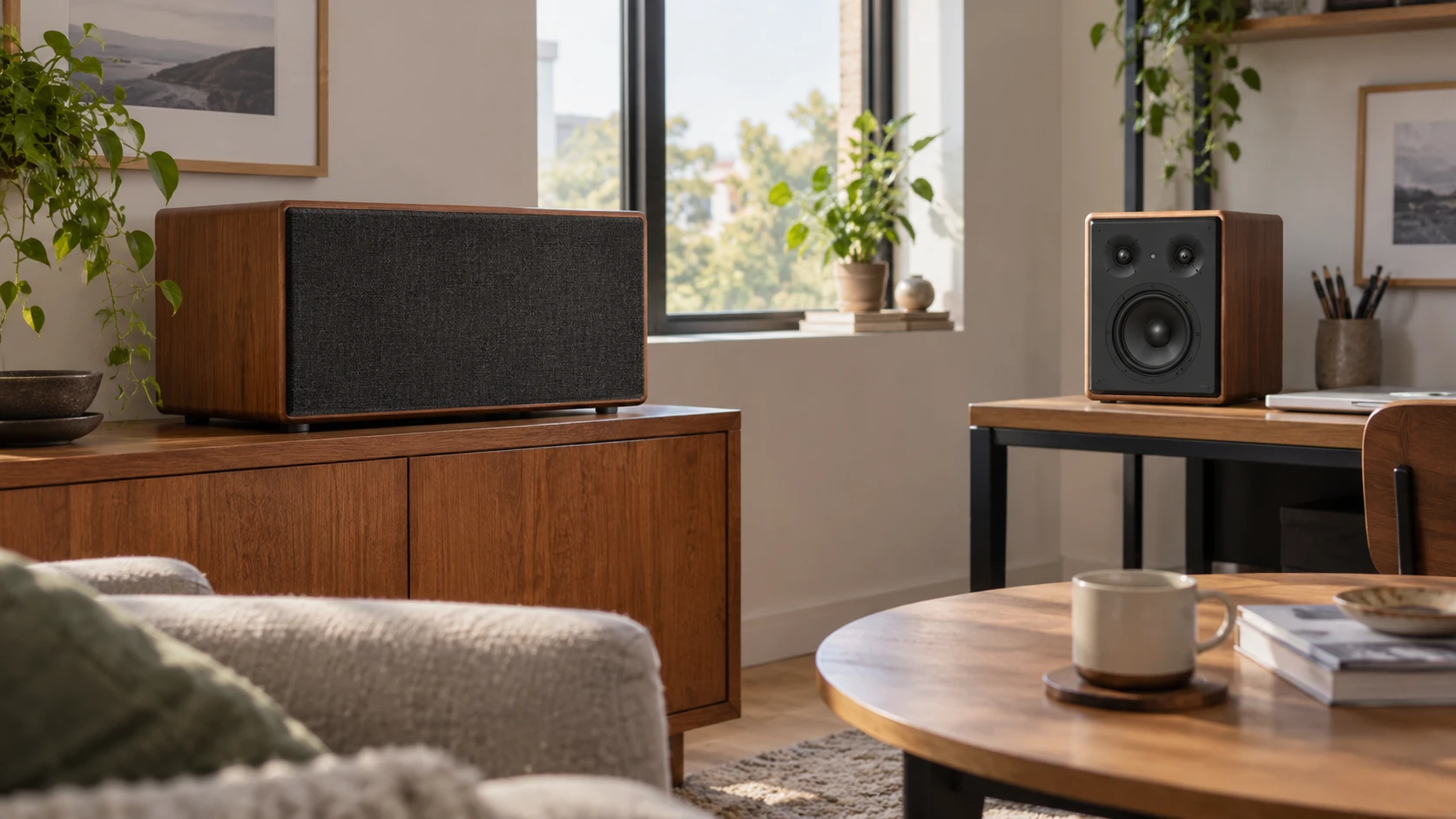
The HOFI 2.1 Bluetooth speaker is described as a single-piece system in a full-wood cabinet, with Bluetooth 5.0, USB, and aux playback options. Laney's F67 Supergroup listing emphasizes a four-inch woofer, two small tweeters, physical bass and treble controls, and a stereo aux input. Both are candidates for a room where people will listen from a couch or desk, but their short descriptions leave different gaps. HOFI gives little detail about power supply and speaker placement. Laney's title calls it portable, while the description says it uses a universal power supply and ships with a separate mains lead.
A published guide comparing other models discusses Bluetooth speaker room setup. Its examples are not listening tests of HOFI or Laney. The useful planning step is to identify the source device, outlet, shelf, and normal listening position before choosing a speaker. A unit that sounds promising in a product listing may be awkward if the cable cannot reach the outlet or the controls face a wall. Take a few measurements in the actual room. Those simple constraints may narrow the choice more reliably than a wattage figure on either product page.
Compare the cabinet and drivers carefully — Laney F67 Supergroup speaker
HOFI's source calls its design a single-piece 2.1 system with a subwoofer for low frequencies and satellite speakers for highs. It also describes a handcrafted full-wood cabinet. The excerpt does not show how the drivers are arranged within the cabinet or provide overall dimensions. Ask for front and rear photos and a specification drawing before deciding where it will sit. A single-piece enclosure may be convenient on a shelf, but it cannot be positioned like a system with physically separate speakers unless the exact product actually provides separate units. The saved description does not establish that it does.
Laney gives more driver detail: a four-inch dual-coil woofer and two three-quarter-inch dome tweeters. Its description claims a frequency range of 50 Hz to 20 kHz at minus 3 dB and a peak sound-pressure level of 105 dB measured at one meter. These are figures in Republeq's catalog for the exact listing, not a room response measurement. Shelves, walls, listening distance, and volume will affect what you hear. A speaker placed deep in a bookcase may sound different from one near the front edge, even before any tone control is adjusted. Leave space to try placement rather than committing to a tight recess.
The materials may influence the look and handling of each product, though the saved descriptions do not prove a sound-quality ranking. HOFI emphasizes its wood cabinet. Laney's excerpt names its drivers but does not describe enclosure material. If the speaker will share a shelf with books or other electronics, ask for the weight, width, and depth of each. Make sure the shelf can support the unit and that the controls and connections remain accessible. Neither short listing provides a complete clearance requirement. An attractive cabinet is useful only if it can be placed safely where you intend to listen.
Think about the listening area rather than the largest possible volume. For a desk, you may sit close enough that a modest setting is comfortable. A couch across a room calls for a different level, and several listeners may sit at different angles. Neither source provides measured coverage at those positions. If you can audition the speakers, use familiar music and spoken audio at an ordinary volume. Listen for clarity where you will sit, then check whether the sound remains pleasant when you move to the side. This says more about the room fit than a single advertised maximum level.
Read the power figures without guessing — Laney F67 Supergroup speaker
HOFI's listing says the system delivers 80 watts of audio, but it does not identify whether that is peak, continuous, or another rating. Laney's title states 160 watts peak and 80 watts continuous. Its description also includes “2 x 20 Watt RMS.” Those Laney figures do not form a clear one-to-one accounting in the short excerpt. Ask the manufacturer to explain which number refers to amplifier input, total output, or a particular driver channel. Without the same measurement basis, HOFI's 80 watts cannot be treated as equal to Laney's 80-watt continuous claim.
Wattage alone also does not tell you how loud the speaker will be at your seat. Efficiency, distortion at high levels, and room acoustics affect the result. Laney's claimed 105 dB peak at one meter gives a stated measurement point, yet it does not tell you what a comfortable listening level sounds like at home. HOFI's source does not provide a comparable maximum sound-pressure figure. If a Republeq's offer includes a demonstration, pay attention to whether speech remains understandable and bass stays controlled at the volume you expect to use. Resist turning a peak number into a quality score.
Laney explicitly states that it is powered by a universal supply and ships with a separate mains lead. Check the plug and voltage compatibility for your location and measure the distance to a suitable outlet. The title's “portable” wording should not be read as evidence of a battery. HOFI's excerpt does not state how it is powered or whether a power adapter is included. Ask for the current manual and box contents. If you need music in a place without mains power, settle that question before ordering either model. A speaker can be easy to carry between rooms while still requiring an outlet at each stop.
Choose the inputs you will actually use — Bluetooth speaker room setup
HOFI's description names Bluetooth 5.0, USB, and aux inputs. That gives several possible source paths, but the excerpt does not define what the USB port accepts. It might support file playback, device connection, or another function; only the current manual can settle that. Check the aux connector size and whether a cable comes in the box. If you intend to play from a laptop, phone, and USB drive, identify which inputs are actually supported and how you switch among them. A list of connectors is useful only when it matches your source devices.
Laney's source clearly names a stereo 3.5 mm aux input and physical bass, treble, and volume controls. The product title calls it a Bluetooth speaker, but the saved description gives no Bluetooth version, codec, pairing process, or USB input. Verify wireless details from the current manual if phone streaming is central to your plan. For a wired desk setup, the named aux input may be enough. Check whether the output from your computer or audio interface is compatible and whether the cable length permits clean placement without stretching across a walkway.
Neither short source explains multi-device pairing or what happens when a second person tries to take over playback. If the room is shared, test how quickly one phone can disconnect and another connect. If the speaker will stay attached to one television or computer, a reliable wired path may be simpler than changing Bluetooth users. These are setup choices, not claims that one model has a specific feature the listing omits. Ask for current connection diagrams. They can reveal whether an input is on the front, back, or side, which matters when the speaker is against a wall.
Laney's bass and treble controls offer a way to make small adjustments without reaching into an app. Start with neutral settings and change one control at a time in the actual room. The short HOFI description does not mention comparable tone knobs or software controls. It may have them, but that requires confirmation. If you listen to speech as often as music, easy tone adjustment may be valuable. A bass-heavy setting that suits one recording can make spoken words harder to follow, especially when a speaker sits close to a wall or inside a shelf.
Work through placement and daily use — Laney F67 Supergroup speaker
Set the speaker where you expect it to live, then consider what else uses that surface. A desk speaker competes with a monitor, lamp, and paperwork; a living-room shelf may have a television or router nearby. The short sources give no exact footprints, so request current dimensions before planning the arrangement. Leave room for the rear connections and for reaching the volume control. Try to avoid routing an audio cable across a door or a chair path. The right location is one where the speaker is usable every day, not merely where its cabinet fits when the room is empty.
Neither listing gives a water-resistance rating or outdoor operating instructions. Treat both as room-use candidates unless the manufacturer's documentation states otherwise. The Laney title's “portable” word does not change its need for mains power, and HOFI's wood cabinet should be protected according to its manual. If you want to move a speaker to a patio, check weather exposure and electrical safety for the exact setup. A covered area can still become damp or collect condensation. The saved descriptions do not provide enough evidence to recommend either product for wet conditions.
Check warranty, return terms, and included accessories before finalizing the choice. HOFI's excerpt does not specify a warranty or cable bundle. Laney says a mains lead ships separately, but confirm the plug supplied with the exact offer. Keep the model names on the order and the manuals aligned; power and input details can change across similar-looking variants. A clear return path matters if the cabinet arrives too large for the shelf or a promised input works differently from the way you expected.
The Laney F67 Supergroup speaker has more stated driver and control details, plus a named aux input and mains supply. Its power figures need clarification before comparison. HOFI offers a single-piece wood-cabinet design and more named connection types, though its power method and USB function are unspecified in the saved excerpt. Measure your space, verify the source path and outlet, and listen at the seat where the speaker will be used. Those checks will tell you which listing fits your room.