Crypto Commerce
HighSound 70-can cooler vs Whynter keg froster
The choice comes down to how often your bar would actually use keg storage. If individually packaged drinks will remain its everyday stock, the HighSound 70-can cooler deserves attention for its listed removable glass shelf, wire shelves and basket. If you expect to switch between cans and a sixth-barrel or Cornelius keg, Whynter explicitly describes those alternative loads. That gives Whynter a documented keg-storage option, although its description does not establish that dispensing equipment comes with it.
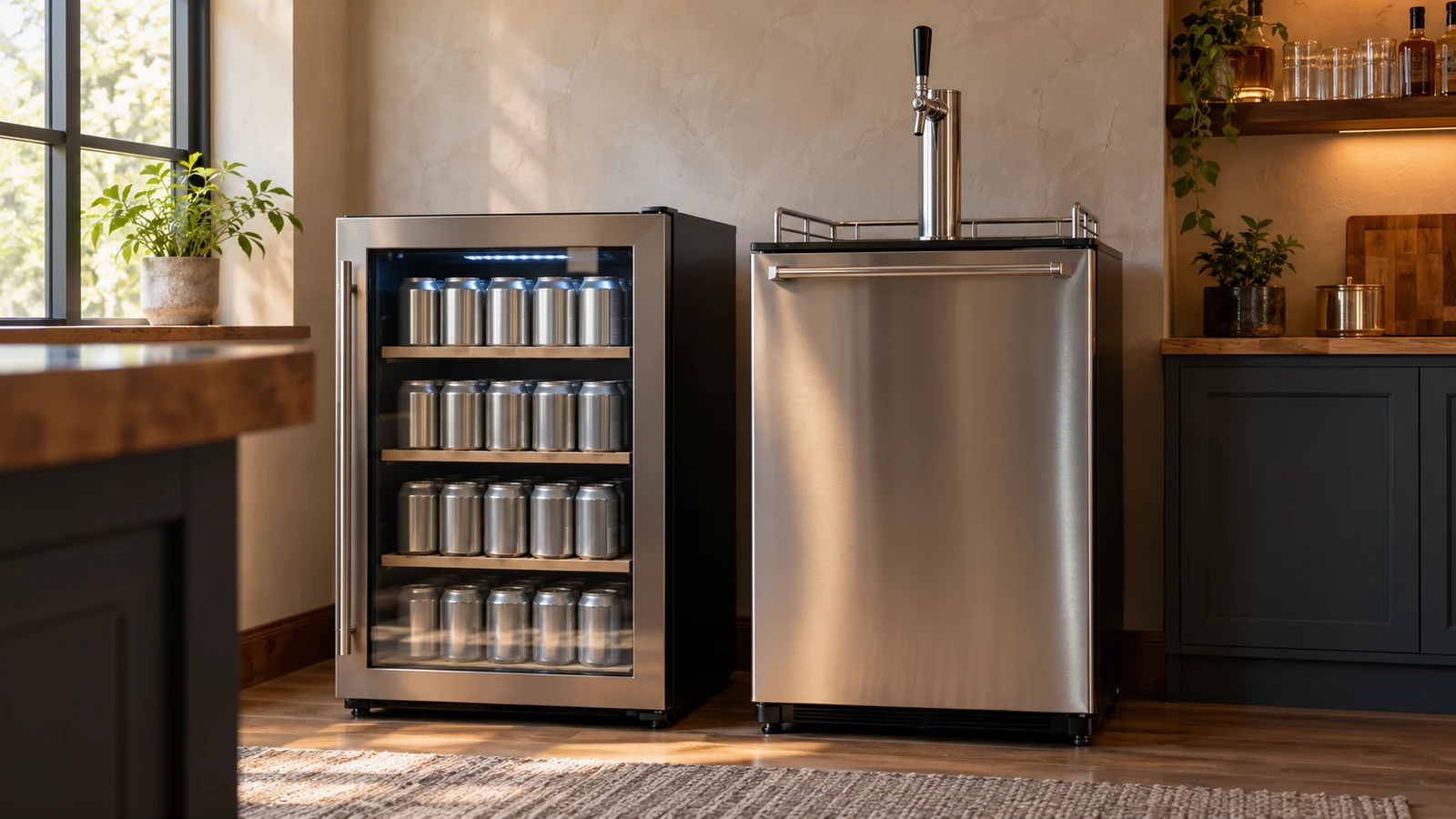
The choice comes down to how often your bar would actually use keg storage. If individually packaged drinks will remain its everyday stock, the HighSound 70-can cooler deserves attention for its listed removable glass shelf, wire shelves and basket. If you expect to switch between cans and a sixth-barrel or Cornelius keg, Whynter explicitly describes those alternative loads. That gives Whynter a documented keg-storage option, although its description does not establish that dispensing equipment comes with it.
Consider the changeover before choosing either appliance. Where would the cans go while a keg occupied the refrigerator? Would you need to keep several different drinks cold at the same time? A keg option is useful when it supports the way you serve drinks, but less useful if using it would displace the refreshments you reach for every day. Neither description establishes how many cans could remain alongside a keg.
The comparison below separates the described equipment from questions that still need an answer. HighSound provides details about removable storage pieces and front ventilation, but no numerical temperature range or exterior dimensions in its supplied description. Whynter provides dimensions and a thermostat range, along with named keg formats. Those differences help you decide what to investigate without treating either listing as an installation manual or a performance test.
Compare Refrigerator Compartment Capacity Beyond The Total: Plan The Changeover
Write down what you intend to refrigerate during an ordinary week, then describe what would change when you wanted a keg. For example, your usual stock might include several canned drinks and a few taller bottles. An occasional keg could require a different arrangement, or a separate place for that regular stock. This is a planning example, not a claim that either refrigerator accommodates that particular combination.
HighSound's description lists one glass shelf, two wire shelves and one wire basket, all removable. That is a concrete reason to examine it for a varied selection of packaged drinks. The description also refers to loading tall drinks, but gives no usable shelf heights or internal measurements. Ask for a loading illustration using containers comparable to yours before assuming that removing a shelf will create the arrangement you need.
The 70-can wording appears in HighSound's product name. Its supplied description does not explain the can size, stacking arrangement or shelf configuration behind that number. Treat it as a named capacity that needs clarification if your purchase depends on fitting a specific quantity. It does not establish how many taller cans or bottles will fit, and it should not be presented as a tested result for your own drinks selection.
Whynter's description is more specific about its stated can load: up to 115 standard 12 oz. beverage cans. It separately lists a sixth-barrel keg or one Cornelius keg and a total volume of 2.9 cubic feet. The wording presents alternative loads. It gives no combined can-and-keg arrangement, so avoid planning around spare space that the description has not identified.
For a broader explanation of storage measurements, read Compare refrigerator compartment capacity beyond the total. For this particular purchase, keep the question narrower: can the refrigerator accommodate your normal drinks selection, and what would you have to move when changing its use? An answer based on your intended load is more useful than choosing solely by the larger advertised count.
Whynter Refrigerator Alternative: What Happens To The Shelves?
Whynter lists three slide-out wire shelves. Its description does not explain the shelf positions or the reconfiguration needed for either named keg format. Request the model's instructions for preparing the interior for a keg, including which components must come out. If you expect to alternate regularly, find out how those components are removed and where you would store them between uses.
Picture the return to everyday use as well. After the keg is removed, you would want to restore a useful arrangement for packaged drinks. Ask whether the instructions identify a standard can-loading layout and whether all necessary shelf hardware is included. The purpose is to understand the actual changeover before buying, without assuming that a slide-out shelf description answers every question about removal and reassembly.
HighSound's removable basket may be relevant if you prefer a separate place for some drinks, but its dimensions and load limit are not stated. Likewise, the different shelf materials do not establish durability under a particular load. Match each proposed arrangement to the manufacturer's instructions. Do not assume HighSound supports a keg merely because its storage pieces are removable; its description makes no such claim.
Whynter Refrigerator Alternative: Separate Keg Storage From Serving
The Whynter refrigerator alternative is worth examining when a sixth-barrel or Cornelius keg is part of your plan. Its description expressly names those formats. It does not identify an included tap, regulator, gas cylinder, coupler or beverage line. A decision to buy it for keg storage therefore leaves a separate question about how you intend to serve the contents.
Give the seller the exact keg and proposed dispensing arrangement when asking about compatibility. Request confirmation of the space needed with the intended connections attached, together with any restrictions in the appliance instructions. Do not infer approval for drilling, adding a tower or routing lines through the cabinet. None of those modifications is established by the supplied product description.
This matters even if you already own dispensing hardware. A named keg format does not answer every question about the complete assembly you intend to place in or around the refrigerator. Ask which parts belong inside, which remain outside and whether the manufacturer permits that arrangement. If you only want chilled keg storage before serving elsewhere, explain that use instead so the answer addresses your actual setup.
For a bar that mostly serves individual cans, compare the work involved in those occasional keg occasions with how often they will happen. You may value Whynter's documented option enough to investigate it further. You may instead prefer to concentrate on HighSound's packaged-drink arrangement and handle the occasional keg separately. Neither choice requires assuming that one appliance wins every category.
Compare Refrigerator Compartment Capacity Beyond The Total: Match The Temperature
Whynter's supplied description gives a temperature range of 23°F to 65°F and identifies Fahrenheit and Celsius temperature indicators. HighSound's description mentions fan-forced internal circulation and makes a general cooling claim, but supplies no numerical range. You therefore cannot make a like-for-like thermostat comparison from these descriptions alone. Obtain HighSound's permitted settings before deciding whether it suits the drinks you intend to store.
The Whynter description also characterizes its purpose as storing beer just above freezing. That phrase does not tell you which setting is appropriate for every drink, and it should not replace the numerical range or the instructions for your beverages. Ask about an appropriate setting for your intended contents. Do not assume the lowest available setting is the most suitable one.
If a keg and packaged drinks need different storage conditions, resolve that before planning to keep them together. Neither supplied description establishes independently controlled compartments. Ask whether the exact model offers the control arrangement you need, without assuming separate temperature zones exist. If the answer is no, your proposed combination may require a different storage plan even if its containers physically fit.
Cooling descriptions also leave performance questions unanswered. Whynter lists a fan-circulated compressor system; HighSound lists fan-forced internal circulation. These statements do not provide comparable measurements of cooling time, noise or energy use. If any of those factors will determine your purchase, request model-specific documentation. There is no basis here for declaring one appliance faster, quieter or cheaper to operate.
Whynter Refrigerator Alternative: Check The Model And Bar Opening
Once the load and temperature requirements are settled, check whether the selected appliance can be installed where you want it. HighSound's description supports built-in or freestanding placement and identifies a front vent. It does not provide exterior dimensions or required clearances. Front ventilation is a relevant feature, but it does not supply the missing measurements or authorize enclosing the appliance in any available opening.
Whynter lists dimensions of 34 inches high, 15 inches wide and 23.7 inches deep, with an additional 2 inches when the handle is installed. Its description permits built-in or freestanding use and expressly says clearance is needed around the unit. Obtain the installation drawing to establish the required opening. The listed cabinet dimensions alone do not define that opening.
Include the way you would load the appliance in your measurements. Ask about the door opening needed to withdraw shelves and insert the intended keg, especially if a neighboring cabinet could restrict movement. Check the handle projection against the working space in front of the bar. These are practical fit questions, not evidence that either door is reversible or that either unit has a particular hinge clearance.
Confirm the exact model before relying on documentation supplied in response. HighSound's description uses wine-oriented language alongside its beverage-refrigerator identity. That does not establish a separate wine configuration or a different model. Ask the seller to connect the manual and dimensions to the exact item being ordered. For Whynter, similarly confirm that the drawing and package details belong to the described 2.9-cubic-foot unit.
Several smaller features are documented, but they should remain secondary to a workable load and installation. HighSound lists a carbon filter and an integrated lock. Whynter lists a security lock with two keys, interior lighting and a stainless steel handle. These details can help you compare daily use, but neither lock description establishes a safety certification, and neither product description supplies a complete maintenance schedule.
Compare Refrigerator Compartment Capacity Beyond The Total: Make The Purchase Specific
Before ordering, turn the remaining questions into a short request tied to your intended use. For the HighSound 70-can cooler, the most consequential gaps are its dimensions, allowed temperature settings and the loading arrangement behind the named capacity. For Whynter, clarify the keg changeover, connected-hardware fit and supplied package. Ask for answers about the exact model, not general assurances about beverage refrigerators.
You can start that conversation from the HighSound 70-can cooler product page if removable storage for individual drinks matches your everyday plan. Describe the containers you expect to use and the available installation space. If keg use remains an occasional idea, establish whether you genuinely need that option before allowing it to decide the purchase.
Review the current price and availability for the chosen item, along with delivery arrangements and applicable return terms. If you plan to pay with cryptocurrency, read the payment options and instructions actually presented before proceeding. This comparison does not establish a current payable total, accepted network or refund condition. Keep those transaction questions separate from the product-fit answers so neither substitutes for the other.
Choose HighSound for further consideration when its removable shelf-and-basket arrangement supports your packaged-drink plan, subject to resolving its missing specifications. Choose Whynter for further consideration when you expect to use one of its expressly named keg formats and can confirm the complete arrangement. Before committing, have the model documentation and the proposed load agree on what will occupy the refrigerator during an ordinary week and during a keg occasion.