Crypto Commerce
Headery 5L countertop dishwasher 5 L tank vs SAHUANIYE piped countertop dishwasher
Compare Headery 5L countertop dishwasher for water access, drainage, fit, cycles, and daily loading.
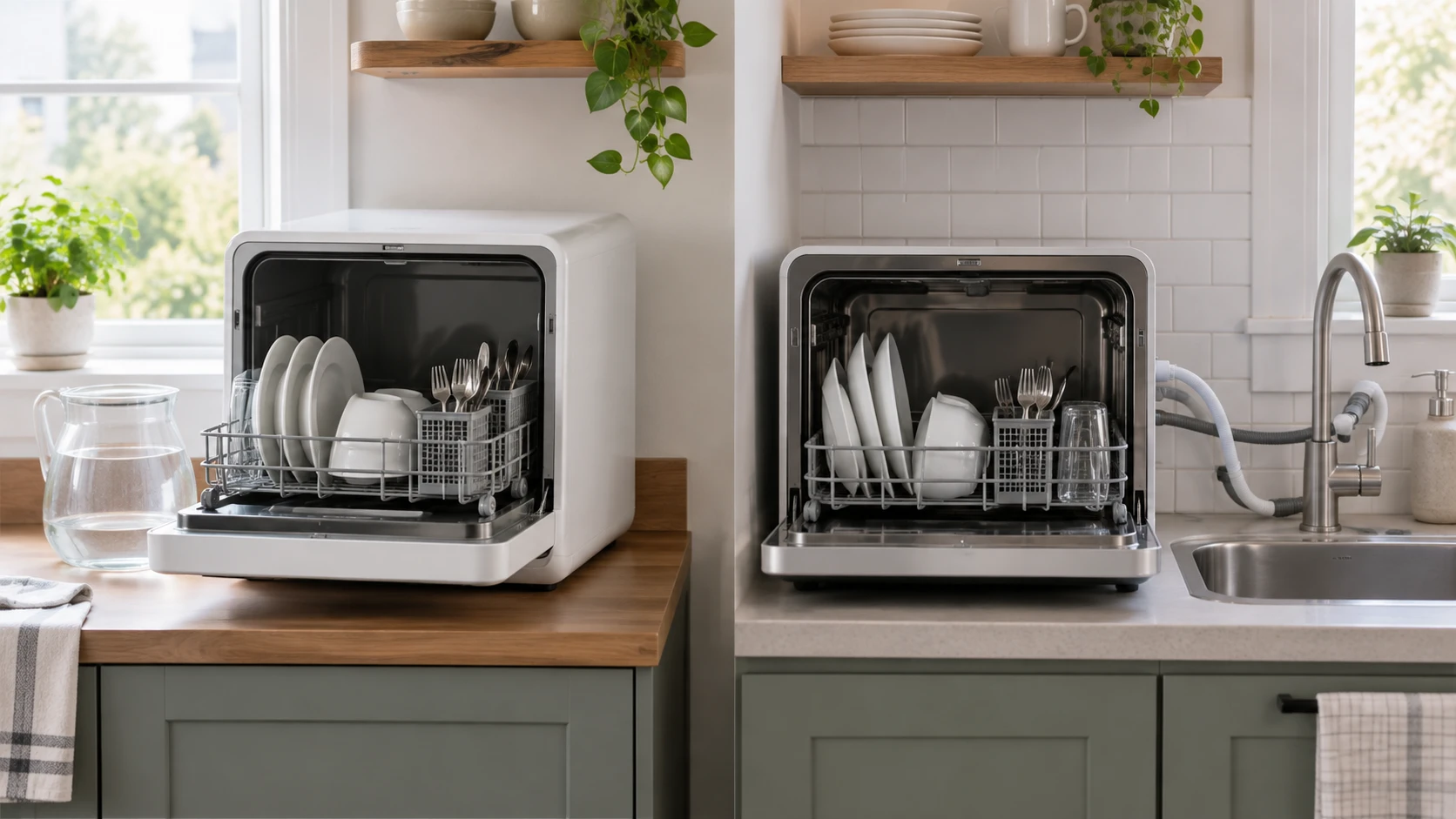
A countertop dishwasher has to fit more than the plates. It needs a stable surface, a practical water supply, a drain path, and space for the door to open. The Headery listing names a built-in 5 L water tank and a compact cabinet with several wash functions. The SAHUANIYE row describes inlet and outlet pipes connected without drilling or cabinet changes, with three named wash modes. Those descriptions suggest different daily routines. Before comparing wash claims, decide where water will come from and where it will go after every cycle.
The Headery 5L countertop dishwasher row lists a built-in tank, space for up to six sets of tableware, and a maximum water-use claim of 1.32 gallons per wash. The countertop dishwasher water hookup guide helps frame the plumbing questions that apply even when a machine is called portable. The SAHUANIYE portable dishwasher row specifies quick, standard, and power wash settings and says inlet and outlet pipes connect without altering the cabinet. Its saved description does not document a built-in tank.
Map the water path first — countertop dishwasher water hookup guide
Headery's built-in 5 L tank may suit a kitchen where a temporary faucet attachment is awkward. A tank still has to be filled before a wash, and the used water still needs a drain. The saved row does not show the fill opening, drain hose, or whether a direct-faucet option is available. Ask for the exact manual and an image of the rear connections. Put a container or sink where the outlet can discharge without the hose lifting, kinking, or slipping during operation.
SAHUANIYE says its inlet and outlet pipes connect without drilling or cabinet changes. That does not tell you which faucet adapter is included, whether it matches your tap, or how far the outlet hose can reach. Some faucets have removable aerators while others have integrated spray heads that complicate temporary attachments. Photograph your tap and check its thread or connection style against the current kit. The water source must be available for the entire cycle according to the machine's instructions. A setup that requires disconnecting the only kitchen faucet may be inconvenient during a meal.
The published hookup guide is a useful prompt to sketch both paths on paper: clean water into the machine and used water out. Include the sink, hose bends, power outlet, and where you will store any adapter. A drain hose that reaches a sink in a straight line may fall short after the dishwasher is moved back against the wall. Test with plain water before loading dishes, and stay nearby for the first full cycle so a loose connection can be corrected while it is easy to reach.
Measure the complete counter footprint — SAHUANIYE portable dishwasher
Headery gives dimensions of 15.6 by 15.4 by 16.9 inches in its saved row. That is a starting point, not the full working footprint. Check which dimension is height, how far the door swings, and how much clearance the manufacturer requires above and behind the unit. A cabinet shelf that leaves exactly 16.9 inches of vertical space may block the fill opening or vent. The listing notes four feet intended to reduce slipping and tabletop scratches, so place them on a level, sound surface.
SAHUANIYE's saved description does not give a full dimension set. Ask for the model's measured width, depth, and height before treating it as interchangeable with the Headery unit. Consider the position of the inlet and drain hoses as well as the door. A narrow counter may fit the appliance body while leaving no room to turn a hose or place dishes before loading. Measure the route from sink to outlet and the space needed to open nearby drawers.
Both rows describe portable countertop machines, but moving one after each meal is still work. A dishwasher with water in its tank or lines should be handled according to the manual before storage. Decide whether it will stay out permanently or be carried to a closet. If storage is part of the plan, ask for the unit weight, handle arrangement, and how residual water is drained. Neither saved description gives a complete answer. A shorter setup routine often determines whether a small appliance is used regularly.
Treat capacity as a loading test — SAHUANIYE portable dishwasher
Headery advertises room for up to six sets of tableware, including dishes, cutlery, chopsticks, and cups. The row does not provide a rack diagram or standard place-setting dimensions. A large dinner plate, tall mug, or wide pan can reduce the number that actually fits. Bring measurements of the dishes you wash most often to the current manual or Republeq's catalog diagram. Check whether the spray arm can turn freely with your tallest item loaded.
SAHUANIYE's saved text has an unclear tableware quantity, so do not build a capacity comparison from that number. Request an interior photograph and maximum plate-height specification for its exact model. Count the dishes from a normal meal, including cooking utensils that you would otherwise wash by hand. If the dishwasher holds only the plates while the pots still fill the sink, that may still be useful, but it should be an intentional choice.
Loading affects cleaning as much as a mode name. Place items so water can reach their soiled surfaces and so cups do not trap a pool of water when unloaded. Follow each manufacturer's limits for plastics, fragile glasses, and long utensils. A small cabinet gives fewer placement options than a full-size built-in machine. Run a representative load during the return period, then inspect the items that were hardest to place. An empty-rack photograph cannot show that result.
Compare the named wash and drying options — SAHUANIYE portable dishwasher
Headery's row says it has five wash functions but names quick wash, strong wash, fruit and vegetable wash, and self-cleaning. It does not name the fifth in the saved description. Confirm the full program list and what each does in the current manual. A self-cleaning function may help care for the cabinet, but it is not a substitute for checking the filter and drain area. Ask which settings use heated water, if that matters for your dishes and available time.
SAHUANIYE lists quick, standard, and power wash modes. It also describes hot-plate heating, high-temperature steam, residual-heat and air-cooled drying, and odor suppression. Those are claims in Republeq's catalog without a temperature profile or cycle-time table in the saved row. Its claimed 99.99% cleaning rate lacks an identified test method here, so it should not be treated as a verified sanitation result. Find the manual's program table and try the ordinary cycle on food soils you actually encounter.
Drying is easy to overestimate from marketing language. Plastics and inverted cups may retain water even when the plates look dry. Headery's saved description does not give a matched drying specification. SAHUANIYE's description names two drying approaches but no measured end-of-cycle result. If dry dishes are important because you unload just before bed or store them immediately, check a mixed load at the end of the selected program. Leave the door and filter care to the manufacturer's instructions to avoid stale water and odors.
Check water, power, and noise claims in context — countertop dishwasher water hookup guide
Headery's row gives a maximum of 1.32 gallons of water per wash, 800W motor claim, and a stated 55dB operating level. These figures lack detailed test conditions in the saved text. A short program may use a different amount from a heavy cycle, and sound measured near the unit can differ from what you hear across a small apartment. SAHUANIYE lists 800W but no matched water-use or noise figure. There is no basis here for declaring one cheaper to operate or quieter.
Check the power outlet and the manufacturer's electrical instructions before the first run. Keep the plug, cord, and hose routes clear of standing water and hot cooking surfaces. Do not assume a crowded outlet strip is suitable for another heating appliance. The saved rows do not state cord lengths or circuit requirements, so use the exact manuals. An extension cable can seem convenient on a temporary counter but may conflict with the manufacturer's guidance.
For routine use, note how much time filling or attaching water takes, then add the wash and unloading time. A quick cycle that saves minutes inside the cabinet can lose that benefit if the connection is difficult. Headery's tank may make setup simple for one user and burdensome for another who must carry water across a room. SAHUANIYE's pipes may be easy beside a suitable sink and impractical with an incompatible faucet. The room decides much of the convenience.
Make the first load a full setup test — SAHUANIYE portable dishwasher
Before buying, obtain the exact dimension drawing, included hose and adapter list, rack diagram, and program table for the model you choose. Confirm how returns work if the unit does not fit the counter or the faucet. On arrival, inspect the body and seals, route the water safely, and run a test cycle while watching the inlet and drain. Then wash a normal meal's dishes and check the items that usually need scrubbing.
Headery offers a documented tank and more stated wash functions, with compact dimensions and an advertised six-set capacity. SAHUANIYE offers a documented piped connection and three named modes, with several heating and drying claims that need a closer manual check. Neither saved row proves better cleaning in your kitchen. A successful first load should leave the counter dry, the drain secure, and the dishes acceptably clean without turning setup into a daily chore.