Crypto Commerce
Havato BD-88 mini freezer vs Kndko BD-165: buy room for the food you keep
Compare Havato BD-88 mini freezer by cabinet measurements, usable storage, door access, controls, and energy evidence.
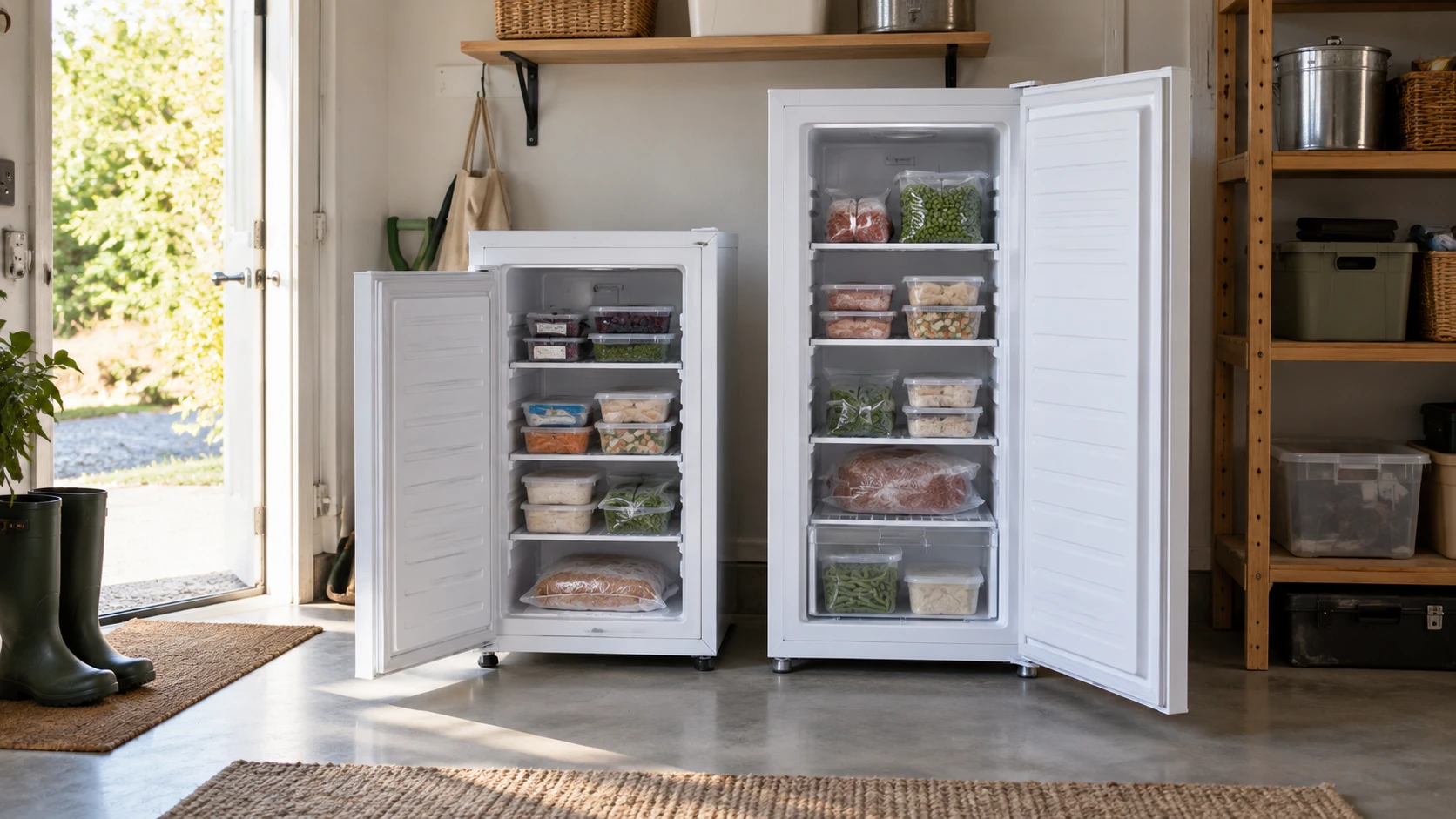
The Havato BD-88 mini freezer is listed at 3.0 cu. ft. and gives three exterior measurements. This guide to checking freezer capacity against size makes the general problem clear: a capacity label does not tell you whether a cabinet fits the room or your packages. The Kndko BD-165 upright freezer lists 5.9 cu. ft. and labeled height, width, and depth. Its added volume may be useful for a larger frozen-food routine, but the room and interior arrangement still need checking. The guide covers different models, so its measurements should not be used for either freezer here.
The two catalog entries point to different use patterns. Havato describes a removable shelf, a reversible door, adjustable feet, and a thermostat with seven settings. Kndko describes a taller cabinet with multilayer shelves, an adjustable thermostat, and a variable-speed inverter compressor. The saved text does not provide a common interior layout, a matching set of temperature tests, or comparable energy measurements. A household choosing between them should map its food and proposed location before ranking the features.
Start with the cabinet and the path around it — Kndko BD-165 upright freezer
Havato's saved description gives dimensions of 20.87 by 20.28 by 31.5 inches without labeling each axis. Do not assume which of the first two figures is width or depth from their order alone. Request the current BD-88 dimensional drawing, including the door and any projecting parts. Kndko's entry is more explicit: 50.98 inches high, 21.85 inches wide, and 21.26 inches deep. Those numbers can be marked on a wall and floor, but they still exclude any ventilation gap or door-opening clearance required by its manual.
Kndko is roughly a tall-cabinet choice while Havato's listed height is much lower. Check whether the additional height is available and whether the top shelf remains easy for everyone who will use it. A freezer can fit physically and still be awkward if food has to be lifted above a person's comfortable reach. Havato may occupy less vertical space, but do not plan to place items on top of it or enclose it under shelving until its installation instructions allow that arrangement. The saved descriptions do not settle top clearance for either unit.
Draw the closed footprint, then the open door. Mark nearby cabinets, furniture, outlets, and the route used to carry groceries into the room. Havato explicitly names a reversible door, which may help when one side meets a wall. Verify the hinge-change procedure and the space needed to remove its shelf after reversal. Kndko's brief excerpt does not state whether its door can reverse. Ask for its hinge arrangement rather than treating that omission as a nonreversible-door claim.
Both listings suggest domestic or office uses, and Kndko's description also mentions a basement or garage. Those are Republeq's catalog use examples, not proof that every temperature, electrical, or ventilation condition in those spaces is permitted. Review the current manual for the exact proposed location. If the unit would stand in a garage, ask specifically about the manufacturer's ambient-temperature range and whether the location is dry and supplied as required. A basement with a narrow stairway needs another measurement: the path for bringing the cabinet in and removing it later.
Capacity is useful after you measure the packages — guide to checking freezer capacity against size
Kndko's 5.9-cu.-ft. figure is nearly twice Havato's 3.0-cu.-ft. figure on the listing. That makes it a plausible choice for a household with a larger standing stock of frozen food. It does not prove that a particular pizza box, large pan, or stacked meal container will fit. The usable cavity depends on shelf positions, the door opening, and any cooling structure inside. Neither saved entry gives enough interior measurements for a reliable package-by-package comparison.
Write down what you store at the same time rather than what you might buy over a month. Include the longest flat package and the tallest container, with packaging intact. Havato says its shelf is removable. That may create space for a tall item, but verify whether removing it leaves a useful arrangement for everything else. Kndko says it has multilayer shelves, without specifying their spacing or whether they move. Request exact-model interior diagrams and ask how a wide item enters through the open door.
Frequency of access matters too. If you pull out one meal every day, the most common item should not sit below several heavy packages. A larger freezer may allow you to group foods by use, but only if the shelf arrangement supports that organization. A smaller freezer could be sufficient if the actual load is modest and turnover is frequent. Lay out a week's or month's typical frozen items on paper at their real dimensions. That exercise tells you more than a visual impression of the exterior cabinet.
Kndko's tall body may present a different lifting routine from Havato's shorter one. Think about who will reach the upper shelf, who will move heavy frozen packages, and where a bag can rest while the door is open. The listings do not provide shelf-load limits. Check the manuals before assigning dense items to a high shelf or removing any shelf for extra height. The more usable arrangement depends on the foods and the people using it, not just the number of cubic feet.
Controls, temperature, and evidence — Kndko BD-165 upright freezer
Havato's catalog description says its thermostat offers seven settings at the back of the unit. It does not assign a measured compartment temperature to each setting. A rear control may require access to the back, depending on its actual placement; inspect the manual before building a tight enclosure around the freezer. The description names an R600a compressor and says it cools quickly. It does not give a test showing how long a full load takes to reach a storage temperature.
Kndko describes an adjustable thermostat and states a refrigeration-system temperature at or below 0°F. Its saved text does not spell out the lower end of an operating range or the conditions behind the figure. It also says a variable-speed inverter compressor adjusts cooling intensity according to demand. Ask for the exact model's temperature-control instructions and measured range before treating that language as a promise for every room or load.
For either freezer, a control position and a catalog temperature line should be checked against the actual compartment after installation. Follow the manufacturer's setup instructions and use a suitable thermometer if food storage depends on a particular temperature. Load size, room conditions, and door openings can influence the reading. Verify the current setting instructions rather than assuming that the same number on two different dials means the same result.
Havato's listing gives 0.6 kWh per day and says noise is below 40 dB. Kndko's description speaks of energy saving and reduced noise from its variable-speed compressor, but provides no matching daily kWh or dB figure. Do not rank annual running cost or bedroom comfort by comparing a number with general language. Request comparable energy information and noise test conditions for the exact models. A quiet claim measured in one setting does not guarantee how the appliance will sound beside a desk or bed in another room.
Cleaning and long-term handling — Kndko BD-165 upright freezer
The saved Havato description does not state a defrost method. Kndko's excerpt does not state one either. Find the care sections of both manuals before deciding where a freezer should stand, particularly over sensitive flooring. Ask how frost is handled, whether shelves can be removed for cleaning, and where water goes during any defrost procedure. A model that is easy to reach for daily food can still be frustrating if maintenance requires moving a heavy cabinet out of a tight corner.
Havato lists adjustable feet, which may help level the freezer according to its installation procedure. Kndko's excerpt does not describe leveling feet, so verify that point rather than assuming it lacks them. Correct leveling affects door behavior and everyday use. Check the approved adjustment range and surface requirements in the current instructions. Do not use blocks or an improvised stand in place of the manufacturer's guidance merely to make a cabinet fit a preferred spot.
The descriptions also leave warranty and service terms incomplete. Ask who supplies parts for the exact BD-88 and BD-165 models, what labor is covered, and where service would occur. A tall cabinet may be more difficult to move for service; a smaller unit may be easier to relocate, though its actual weight and handling instructions must be checked. Keep a path for access to the rear and the electrical connection as required by the manual.
Match the freezer to a real load — Kndko BD-165 upright freezer
Choose a short list by measuring both the room and the frozen packages. Havato's 3.0-cu.-ft. claim, reversible door, removable shelf, and shorter listed cabinet may suit a limited load in a constrained location. Verify which exterior dimension is width or depth, the ventilation gap, and how the door opens in that location. Its seven thermostat settings and 0.6-kWh-per-day figure need exact-model context if temperature or operating cost drives the choice.
Kndko's 5.9-cu.-ft. claim and 50.98-inch listed height offer a different storage scale. Verify the shelf layout, top-shelf reach, door swing, ambient-temperature suitability, and current energy data before treating it as a straightforward upgrade. Request manuals and drawings for the exact Havato BD-88 and Kndko BD-165 models so the answers belong to the two freezers under consideration.