Crypto Commerce
Gymax 15-inch beverage cooler 100-Can vs HUMSURE 150-Can for beverage storage
Compare Gymax 15-inch beverage cooler by can capacity, ventilation, placement, temperature controls, shelves, and installation evidence.
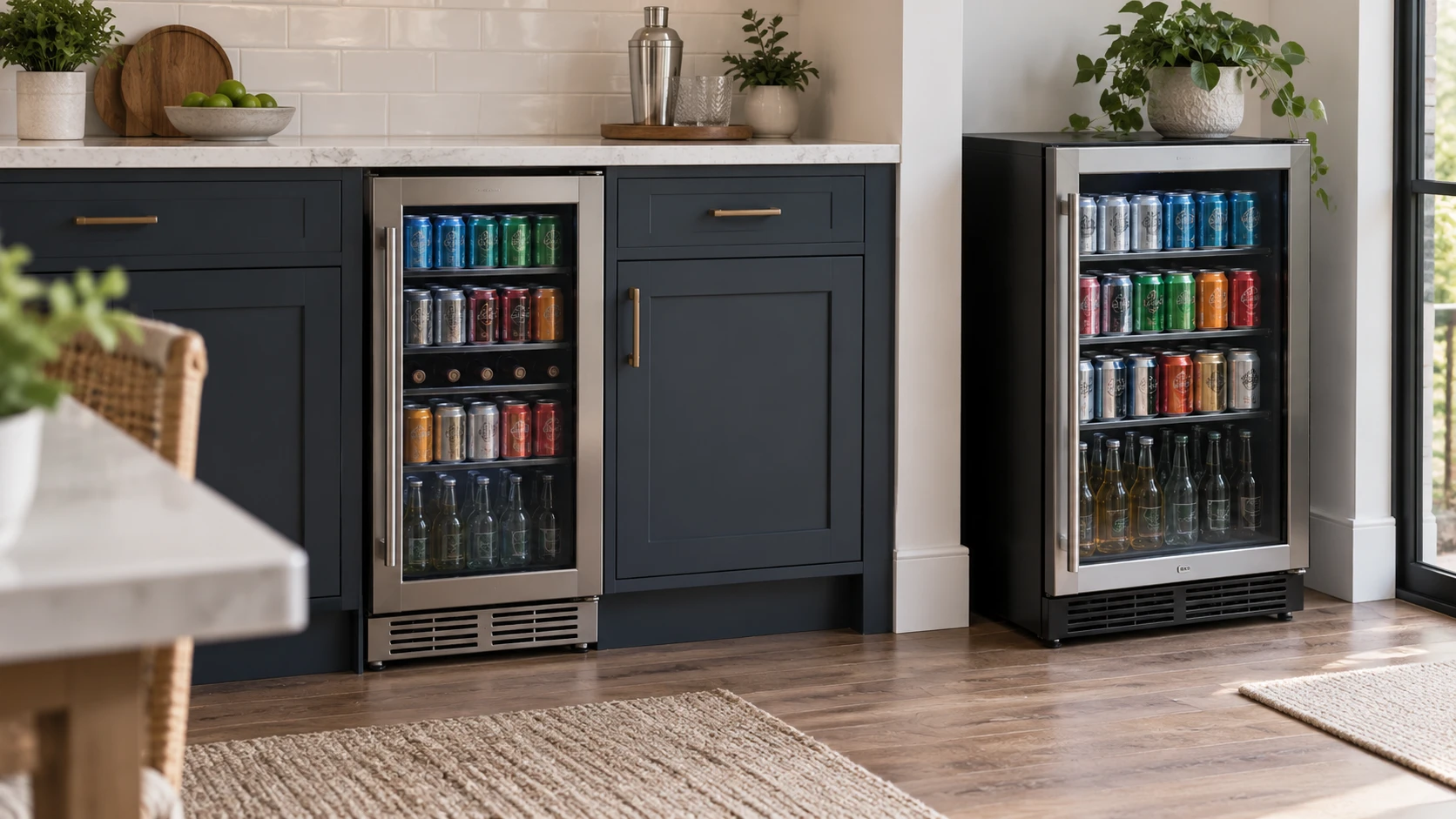
Two glass-door beverage refrigerators can have very different placement requirements even when both fit beneath a counter in a photograph. The listing for the Gymax 15-inch beverage cooler describes front ventilation and both built-in and freestanding use. Its stated capacity is at least 100 standard cans, based on cans measuring 2.6 inches wide and 4.84 inches high. The HUMSURE listing advertises up to 150 cans in a 4.5-cubic-foot cabinet, but calls the refrigerator freestanding. That difference should guide the first decision. If the appliance must sit in a tight, enclosed opening, verify the manufacturer's installation instructions before comparing advertised can counts or appearance.
Neither product excerpt provides a complete installation manual, a measured energy-consumption figure, or an independent noise test. The capacity numbers are listing claims, not a promise that every mix of bottles and cans will fit. A realistic choice starts with the actual room, the beverages you store, and the clearances required for safe operation. The exterior measurement of a refrigerator, the size of a suggested recess, and the usable interior storage are three different measurements. Confusing them can turn a seemingly suitable purchase into a difficult installation.
Placement comes before capacity — beverage fridge installation clearance
Gymax describes a front-vented cabinet that can be built in or used on its own. The saved listing recommends a recess of 15.4 by 23.1 by 33.7 inches, presented as length, width, and height. It also mentions leveling legs for an uneven floor. Treat the listed recess as a starting point for measurement, then check a current manufacturer manual for the required side, rear, and top space, the vent path, and access to the electrical plug. The excerpt does not say that every opening at those dimensions is safe. Cabinet trim, a kickplate, a door hinge, or a wall outlet behind the unit can change the fit.
HUMSURE's excerpt describes a compact freestanding refrigerator and says no installation is needed. That wording can mean setup is simple; it does not establish that the cabinet may be sealed into a counter opening. Freestanding refrigeration equipment still needs the clearances in its own instructions to shed heat. Do not assume a model belongs in a built-in slot simply because its height appears low enough. If you want it under a desk or counter, identify the exact model and obtain its ventilation requirements before ordering. A retailer photograph is not a substitute for those requirements.
The related published guide on beverage fridge installation clearance walks through opening and ventilation checks for another pair of beverage units. Its lesson applies here: determine the location and air path before choosing a refrigerator. It does not provide Gymax or HUMSURE specifications, so use the instructions for the unit you actually buy. Measure the narrowest part of the opening as well as the face. Note the floor's slope, outlet position, cabinet trim, and room needed to open the door far enough to remove a shelf.
What 100 and 150 cans mean in practice — HUMSURE 150-can beverage refrigerator
Gymax says its 3.5-cubic-foot cabinet holds at least 100 standard cans of the dimensions stated in the listing. It includes three removable wire shelves with anti-slide stoppers and multiple shelf-height positions. That lets a buyer trade one kind of storage for another. Taking out a shelf may create room for taller bottles, but it usually reduces the number of small cans that can be stacked in neat rows. Before relying on the 100-can figure, compare your usual drink containers with the listing's reference can. A tall slim can, glass beer bottle, or wine bottle can consume a different amount of space.
The HUMSURE listing gives a larger nominal cabinet volume, 4.5 cubic feet, and says it holds up to 150 cans. It also describes removable, adjustable wire shelves. The saved excerpt does not state the can dimensions or shelf configuration behind the 150-can claim. As a result, 150 divided by 100 is not a reliable estimate of the extra usable space for your particular drinks. The difference between 4.5 and 3.5 cubic feet may be useful for a broad first comparison, but interior shape, compressor housing, door clearance, and the arrangement of shelves determine what fits. Ask for an interior diagram or measurements if the appliance must take a particular bottle height or case of drinks.
A quick home inventory makes the comparison more concrete. Count how many standard cans, tall cans, and bottles you keep cold at once. Measure the tallest container and consider whether you need several rows accessible without unloading the front row. Then sketch shelf positions for each product, using verified interior dimensions if available. If neither listing supplies those dimensions, record the gap instead of assuming the advertised capacity tells you everything. A smaller cabinet with suitable shelf spacing could serve a mixed collection better than a higher can count achieved only with uniform cans.
Temperature settings and what they do not establish — HUMSURE 150-can beverage refrigerator
Gymax describes a compressor with fan-forced circulation and an adjustable temperature range from 37°F to 64°F. Its touch-button panel and LCD display are listed as controls. The excerpt says the unit starts an automatic defrost cycle every four hours. Those are product claims about the design and controls. They do not establish how evenly the refrigerator holds a chosen temperature in a warm room or how long it takes to cool a full load. Consider the unit's permitted ambient temperature range and the placement instructions when you review the current manual.
HUMSURE describes a digital thermostat and gives 38°F for beer and 50°F for wine as examples. The saved excerpt does not provide a complete minimum-to-maximum setpoint range or measured temperature variation. If you need a particular target, especially one at the edge of a model's range, obtain the exact model specifications rather than extrapolating from two example settings. A single-zone beverage cabinet also should not be assumed to hold separate beer and wine zones at the same time. Neither excerpt establishes independent compartments with separate controls.
For either appliance, the display's setpoint is not the same thing as a tested temperature at every shelf. Opening the door, loading room-temperature cans, and putting warm items in front of the air path can temporarily change what a thermometer reads. If precise storage temperature matters, use a separate thermometer after the unit has stabilized and check more than one shelf. These listings concern beverage storage. Do not infer suitability for medication, laboratory material, or perishable food that requires tightly controlled refrigeration from a beverage-cooler description alone.
Doors, shelves, and daily access — HUMSURE 150-can beverage refrigerator
Gymax lists a double tempered-glass door, blue interior LED lighting, a stainless-steel handle, and a lock supplied with two keys. The lock could matter in a shared game room or family space, though the listing does not establish child-proof security. Keep keys in a sensible place and follow the maker's instructions on door adjustment and cleaning. The glass lets you see choices before opening the door, but the room's light and the door's construction also matter if the unit will stand near a sunny window. The excerpt claims the glass helps limit heat and sunlight; it does not give a measured insulation or ultraviolet rating.
HUMSURE advertises a glass door, interior LED lighting, and a reversible door. Door swing can determine whether a refrigerator works beside a wall or a kitchen island. Verify which side the hinge is on when shipped, the steps and parts needed to reverse it, and how far the open door extends. Also check whether reversing the door affects a warranty or requires a service technician. The saved description does not settle those details. The shelves are removable for cleaning, which helps when a spilled drink leaves a sticky surface, but confirm the shelf's load limits if you plan to store heavy glass bottles.
Think about access after installation. A counter lip can prevent a door from opening fully even though the appliance slides into the recess. A bar stool can block a lower door corner; a nearby cabinet handle can strike the glass. In a freestanding location, leave a path for routine cleaning around the unit. Check how you would remove the shelves and reach the back of the cabinet without moving furniture each time. These small room measurements can matter more than the difference between two advertised can counts.
Noise, energy, and upkeep claims — HUMSURE 150-can beverage refrigerator
HUMSURE states a 38 dB operating-noise figure and describes the unit as suitable for offices, bedrooms, and other shared spaces. The listing does not identify the measurement distance, room conditions, or whether that figure covers compressor starts and fan operation. Gymax calls its compressor quiet but provides no comparable decibel figure in the saved excerpt. Do not rank the two by noise using a quantified claim from only one Republeq's catalog and an adjective from the other. If a bedroom location makes sound critical, seek independent measurements for the exact model and check return terms before purchasing.
HUMSURE also calls the refrigerator energy efficient and low cost to operate without giving a kilowatt-hour figure in the saved description. Gymax does not supply a comparable consumption number there. A claimed efficient design cannot be translated into an annual electric bill without consumption, the room conditions, and your local electricity rate. Look for an official energy label or measured consumption tied to the exact model. Compare like-for-like annual kWh figures if both are available, and account for the fact that a larger cabinet may consume a different amount of power depending on use.
Basic upkeep starts with the manual. Keep the ventilation path open, clean removable shelves, and inspect the door gasket for a proper seal. Let a newly delivered appliance stand for the time its manufacturer requires before plugging it in if transport orientation calls for that precaution. Do not assume a universal waiting period from a different brand's advice. Gymax's auto-defrost claim does not mean no cleaning is necessary, and HUMSURE's easy-maintenance description does not prove it has the same defrost system. Check the actual care instructions before using solvents or removing internal panels.
Which one belongs in your space? — HUMSURE 150-can beverage refrigerator
For a narrow under-counter opening, Gymax has the more directly relevant listing evidence: it names front ventilation, built-in use, and a proposed recess size. Verify the current manual, outlet access, and full door swing before treating that as a final fit decision. A 15-inch name is not itself an installation drawing. The unit may still be unsuitable for a particular cabinet if airflow or access cannot be maintained. If the opening cannot meet the manual's requirements, choose a different location or a model specifically designed for the available space.
For an open freestanding spot and a large collection of uniform cans, the HUMSURE 150-can beverage refrigerator offers the higher advertised capacity and larger nominal volume. Confirm external and internal dimensions, clearance, and the actual can size used for its rating. Its reversible door may solve a room-layout problem, subject to the exact model's instructions. Neither claimed advantage justifies putting it in an unventilated enclosure. For mixed bottles and cans, shelf layout may matter more than the headline count.
Before paying, match the exact model or SKU shown in Republeq's catalog number to the maker's manual and warranty, then measure your containers and installation site. Check current availability and price, since the saved product excerpts do not establish what is in stock today. Ask for missing specifications that matter to your choice, especially full dimensions, required clearances, temperature range, annual energy use, and warranty terms. This comparison can narrow the options, but the model-specific manual should settle whether either refrigerator can operate safely where you intend to place it.