Crypto Commerce
GE PFW870SSVWW front-load washer vs Whirlpool WFW5720RR: check the laundry space first
Compare GE PFW870SSVWW front-load washer by installation fit, capacity, moisture care, detergent handling, and connected cycles.
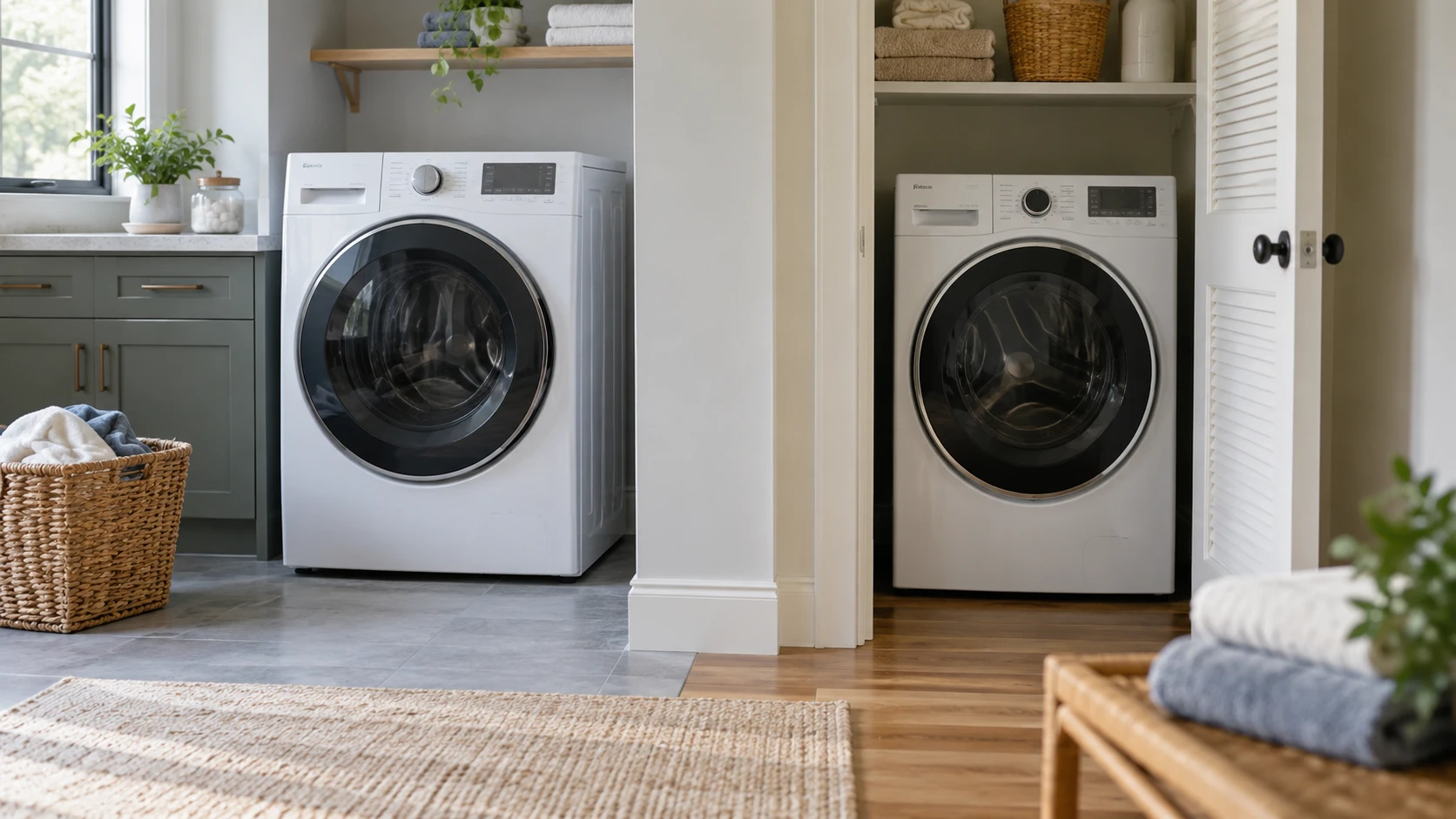
The GE PFW870SSVWW front-load washer has a listed 5.3-cubic-foot capacity, a system intended to remove moisture from the machine, and an automatic detergent dispenser. The Whirlpool WFW5720RR has a listed 4.5-cubic-foot capacity, a 33-inch closet-depth claim, and an option that tumbles clothes with a fan after a cycle. Both listings describe connected controls. The right choice depends heavily on the space where the washer will sit and the loads it will actually wash.
These are Republeq's product descriptions, not matched tests of cleaning, noise, water use, or odor prevention. The GE row gives a three-number dimension sequence without labeling every axis. The Whirlpool row supplies a closet-depth phrase without a full dimension drawing. Confirm either model against the current manufacturer installation instructions before ordering. A washer that appears to fit the alcove can still block a door, crowd a dryer, or leave too little room for hoses.
Start with the delivery path and door swing — checking a Whirlpool washer's closet-depth fit
GE lists the PFW870SSVWW as a 28-inch front-load washer and gives dimensions of 34 by 28 by 39.75 inches. Because the saved row does not assign width, depth, and height to that sequence, use the manufacturer's drawing for measurements. Measure the narrowest doorway, hallway turn, and stair landing on the delivery route as well as the finished laundry space. A machine can clear the opening and still be difficult to turn into position.
Whirlpool describes the WFW5720RR as having a 33-inch closet-depth fit and a stackable design. That description is a useful lead for a compact room, but it does not state the complete installed depth with hoses or the space needed to open the door. Check the specified clearances for the exact model and the installation method you intend to use. Stacking also requires the correct compatible dryer and kit; the word “stackable” alone does not identify either one.
The published guide to checking a Whirlpool washer's closet-depth fit covers a different Whirlpool model. Its measurement approach is useful, but its model-specific dimensions should not be carried over to the WFW5720RR. Draw the actual door arc on the floor with tape, then consider the room with a laundry basket in front of the machine. Include any nearby closet or bathroom door that must open while someone unloads the washer.
GE's row says the washer and dryer doors can be reversed during installation. That could help a side-by-side pair whose doors otherwise swing into the working space. Ask the retailer or installer to confirm the door configuration for the exact units and whether reversal is included in the delivery service. The Whirlpool row does not make a comparable reversible-door claim, so verify its hinge arrangement rather than assuming both machines offer the same option.
Match capacity to your usual loads — Whirlpool WFW5720RR smart front-load washer
The difference between 5.3 and 4.5 cubic feet may matter if the household often washes bulky bedding or larger mixed loads. It may matter less if most loads are small and are separated by fabric or color. Capacity labels do not guarantee that a particular comforter will wash well: the item's size, care label, and the washer's loading instructions still determine what belongs in the drum. Bring the dimensions of the bulkiest regularly washed item to the retailer and ask about the manufacturer's guidance.
Whirlpool describes its 4.5-cubic-foot drum as large enough for family-sized loads. That is a claim in Republeq's catalog, not a promise that every household's weekly laundry will fit in fewer cycles. GE's larger stated capacity is a clear numerical difference, but it comes with no matched throughput test in these saved rows. If the laundry space is tight, compare the practical benefit of a larger drum with the clearance it requires. A full-size machine that prevents comfortable loading can make a weekly routine harder even if its drum is larger.
Think about the loads you actually run. Several modest loads of uniforms or workout clothes put different demands on a washer than one bulky bedding load. The number of people in a household is a starting point, but load size and fabric care are better guides. Record a normal week's load count before deciding how much value to place on the 0.8-cubic-foot capacity difference.
Consider what happens after a cycle ends — Whirlpool WFW5720RR smart front-load washer
GE's UltraFresh Vent System+ OdorBlock is described as using a sensor to detect and remove excess moisture. The listing also describes Microban-treated parts in the gasket, dispenser, and draining system. Those features address areas of a front-loader where moisture can linger, but the row does not provide a comparative odor test. Ask how the vent cycle runs, whether it uses power after the wash, and what routine cleaning the manual still calls for. A moisture-management feature is not a reason to ignore the door seal or detergent drawer.
Whirlpool's FanFresh option uses a fan and tumbling after a cycle to keep clothes fresh while they wait to be unloaded. That addresses clothes sitting in the drum, a different part of the laundry routine. It may be useful if a wash often finishes while the household is out or asleep. Check how long the option runs and whether it must be selected for each load. The saved row does not establish that FanFresh dries the machine interior as GE's vent system is intended to do.
Whirlpool also lists a Clean Washer with affresh cycle. That gives the owner a named maintenance cycle, although the row does not state a cleaning schedule or say which supplies are required. Both machines still need the maintenance described in their manuals. If the laundry room has poor airflow or a history of dampness, ask about drain placement and ventilation as well as washer features; the installation environment affects what happens after washing.
Compare detergent and cycle habits — Whirlpool WFW5720RR smart front-load washer
GE's SmartDispense is described as holding detergent for up to 32 loads and dispensing according to load size and fabric type. That could reduce the small daily chore of measuring detergent, particularly in a household running frequent loads. The “up to” figure depends on the amount used per cycle. Check which detergents the reservoir accepts, how to clean it, and how the machine handles a load that needs a different product. The saved row does not tell us whether every household's detergent routine is compatible with the dispenser.
The Whirlpool WFW5720RR smart front-load washer listing does not describe an equivalent bulk detergent reservoir. It does list a 25-minute Quick Wash cycle for a full load, a Cold Wash cycle, Steam Clean, Sanitize, and AI Intelligent Wash. These are useful choices to inspect against your ordinary fabrics, though the saved description does not spell out the test conditions behind the time or energy claims. A quick cycle might be convenient for lightly soiled everyday items; its stated time should not be treated as the duration of every program or load.
GE lists a steam cycle, a 16-minute cold Soak Rinse intended for use with color-safe liquid sanitizers, and a Sanitize + Allergen cycle. The row makes strong claims for those programs, but it does not provide the cycle conditions or test report needed to compare them directly with Whirlpool's Sanitize cycle. Follow garment care labels and the machine manual, especially when a cycle or additive makes a health-related claim. If sanitizing is a deciding factor, request the manufacturer's exact cycle documentation for both models before buying.
For a household that routinely changes detergents or uses special fabric products, manual dosing may be simpler than keeping a bulk reservoir filled. For one that repeatedly washes similar loads, automatic dispensing may save handling time. Either way, compare the steps required for the cycle you will use most often, not the length of the feature list.
Check connected features without counting on them — Whirlpool WFW5720RR smart front-load washer
GE describes SmartHQ access for cycle status, remote control, and downloadable specialty cycles. Whirlpool describes app-based start, tracking, and notifications, plus voice commands through a compatible device. A notification is useful when the laundry area is far from the living space; remote start has value only if the household is comfortable preparing the machine beforehand. Ask which features work without Wi-Fi, which require an account, and whether ordinary cycles remain easy to run at the control panel.
The Whirlpool row names AI Intelligent Wash as a setting that adjusts the wash automatically. The GE row describes Dynamic Balancing Technology as detecting and correcting uneven loads during spin. These claims concern different parts of a cycle and are not a matched comparison of cleaning or noise. GE's row says balancing is intended to reduce noise; neither saved row supplies measured sound levels. If vibration could bother an adjacent room, ask about installation requirements and the return policy instead of relying on a technology name.
Look beyond the efficiency badge — Whirlpool WFW5720RR smart front-load washer
GE is listed as ENERGY STAR Tier 2 certified and meeting CEE Tier 2 standards. Whirlpool is listed as ENERGY STAR certified. Its Cold Wash description claims energy savings under unspecified conditions. The saved rows do not provide matched annual water or electricity figures, so the badges and cycle descriptions cannot establish which washer will cost less to run in this home. Request the current EnergyGuide information for the exact models and compare it using your expected number of loads.
The installation quote matters too. Confirm the required hoses, drain arrangement, electrical supply, stacking kit if applicable, haul-away, and door-reversal service before comparing checkout totals. A supposedly convenient feature can become expensive if the room needs additional work to use it. Make sure the person doing the installation sees the actual measurements, including the space in front of the door and behind the machine.
GE merits a closer look when the household can use its larger stated drum, reversible-door option, vent system, and detergent storage. Whirlpool merits one when the measured installation favors its closet-depth claim and FanFresh, Quick Wash, and stackable layout fit the routine. Neither saved listing settles physical fit or measured performance. Get the exact dimension drawings and current energy information, then choose the washer whose door, drum, and maintenance routine work in the finished laundry room.