Crypto Commerce
GE GFW148SSMWW vs LG WM5700HVA front load washer and LG WM5700HVA for a laundry closet
Compare GE GFW148SSMWW vs LG WM5700HVA front load washer by closet width, door clearance, listed wash features, and the specifications still worth checking.
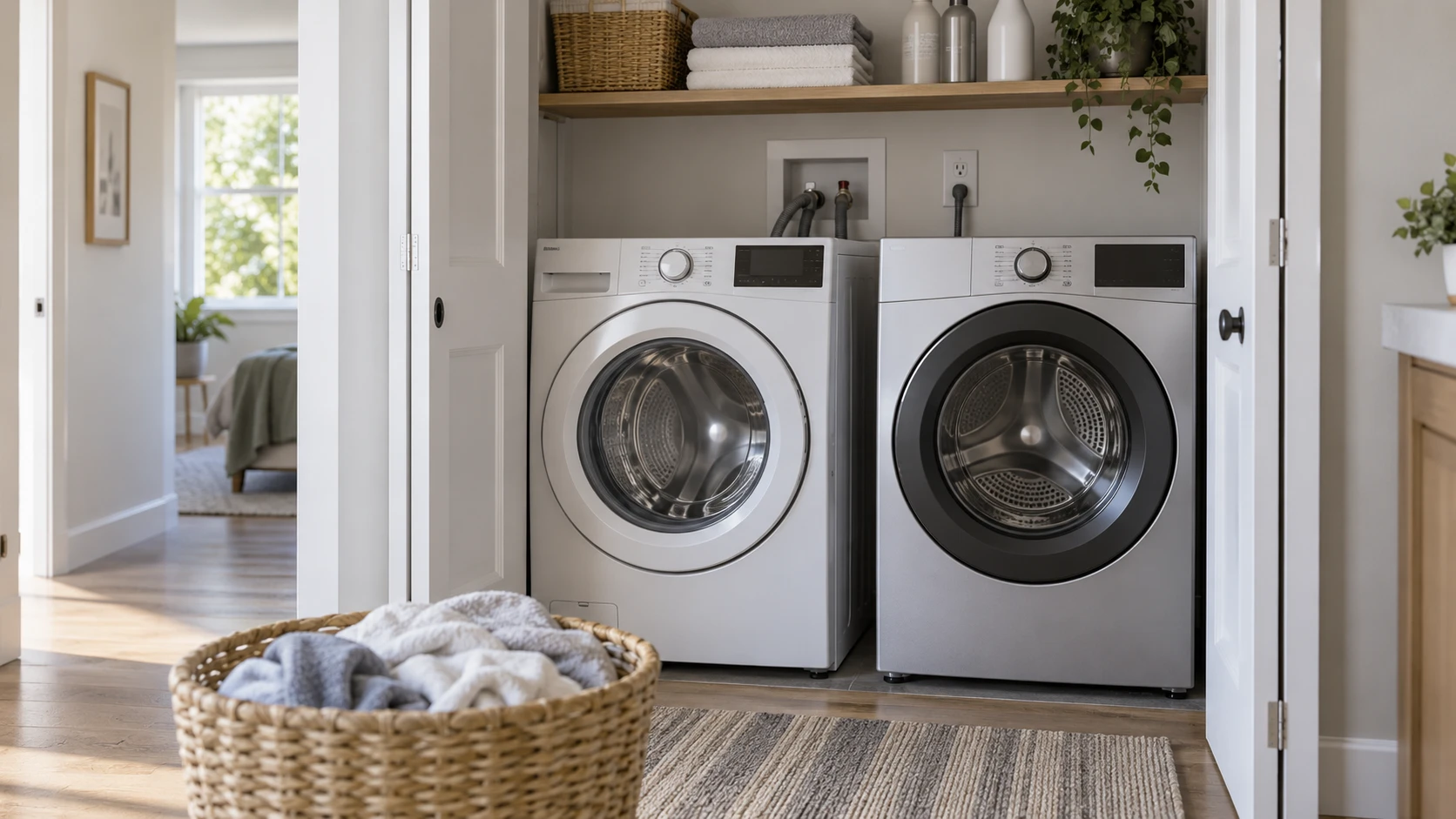
A laundry closet has to fit more than a closed washer. There must be room for delivery, hoses, the open machine door, and a person with a basket of wet clothes. The saved GE GFW148SSMWW listing gives approximate dimensions of 33 1/4 inches high, 23 7/16 inches wide, and 25 5/8 inches deep. LG describes the WM5700HVA as a 27-inch-wide front-loader with a 4.5-cubic-foot drum, but its short catalog entry does not supply a full height and depth. That makes width the first screening question and the installation drawings the next one.
These details come from a September 30 catalog capture. The exact product pages and the related guide were reachable when checked on October 3. A live page is not proof that an item fits your closet or that a Republeq's catalog lists every hose and accessory you will need. Confirm the current model number, dimensions, installation instructions, and offer before ordering.
Measure the route and the working space — front load washer closet fit
If the clear opening is close to 24 inches, start with the GE GFW148SSMWW vs LG WM5700HVA front load washer width difference. GE's listed 23 7/16-inch width makes it a candidate for a narrow space. LG's stated 27-inch width rules it out of an opening narrower than the machine itself, even before required clearances. Neither number settles the installation. Measure the closet at several heights, including places where trim, pipes, or uneven walls reduce the usable width.
Walk the delivery route with a tape measure. The narrowest doorway, a stair landing, and a turn into the laundry area can matter as much as the finished closet. Check whether the closet doors can be removed if necessary and whether that is allowed in your home. Record the space in front of the washer with both its own door and the closet door open. You need enough room to transfer clothes without holding a basket in a hallway or blocking another room.
GE's approximate 25 5/8-inch depth is a cabinet figure in the saved listing. It does not say whether every rear protrusion or connected hose is included. Get the current GFW148SSMWW dimension drawing and the maker's rear, side, and top clearance instructions. The LG excerpt gives no depth or height, so do the same for WM5700HVA before deciding it will sit behind a closet door. Drum capacity is not a reliable way to estimate exterior depth.
The related guide on front load washer closet fit considers the measurement problem for another model. Use its approach here: draw the washer, open door, hoses, outlet, drain, nearby shelving, and any dryer that shares the space. Check service access as well as everyday loading clearance. A washer can clear the doorway and still be awkward to use or difficult to repair once installed.
If you plan to stack a dryer, identify the exact dryer and the manufacturer-approved kit first. The saved GE and LG descriptions do not establish compatible stacking pairs or kit numbers. Verify the completed stack height, reach to upper controls, floor support, connections, and any venting requirement for the dryer. A washer that fits by itself may not produce a safe, usable stacked installation.
Compare your loads, not only the drum labels — LG WM5700HVA washer
LG states a 4.5-cubic-foot capacity. GE's short saved entry does not give a capacity number, so this source cannot support a direct cubic-foot comparison. Look up GE's exact-model capacity in current documentation if it matters to your choice. Even with both numbers in hand, check the care label and washer instructions before assuming a bulky comforter or rug belongs in either drum. The shape and weight of a wet item matter, not just its dry volume.
Write down a normal week's laundry. How many loads are small and routine? Which ones fill the machine? Would a larger drum actually eliminate a cycle, or would you still separate fabrics and temperatures? A person washing small workwear loads may get little value from unused capacity. A household with frequent bulky loads could care a great deal, provided the machine and the textiles are compatible. The saved listings contain no shared test load for those cases.
LG lists 25 wash cycles and says built-in sensors detect fabric texture and load size to select motions and temperatures. GE lists 14 cycles for different fabrics and soil levels. Those counts do not say which machine handles your usual items better. Compare the actual cycle tables in the manuals against the clothes you own. Check the available temperature, spin, and soil settings on the programs you would use most, rather than treating eleven additional cycle names as an automatic advantage.
The LG description says five jets spray clothes from several angles and advertises large loads washed in under 30 minutes. That timing is a product claim, not a promise for every fabric, soil level, or load size. The saved GE entry has no comparable timed wash test. If a fast cycle is important, find LG's stated conditions for it and check whether that cycle accepts the clothes you intend to wash. A short program is less useful when it excludes your regular load.
Think about what happens after the cycle — LG WM5700HVA washer
GE lists a 1,400-RPM maximum spin and LG lists 1,300 RPM. GE says its spin removes water to shorten drying time, but a 100-RPM difference alone does not tell you which washer leaves your own towels drier. Fabric type, load balance, cycle selection, and permitted spin setting affect the result. Check the highest setting allowed for the loads you wash. Delicates may call for a slower spin on either machine.
LG describes an ezDispense automatic detergent reservoir that lasts for an estimated 18 to 31 cycles per fill. That could reduce daily measuring, but you would still need to refill and clean the dispenser. Ask which detergent types and programs support it and whether manual dosing remains possible. The GE catalog excerpt does not mention an equivalent reservoir; a short listing is too thin to prove the absence of every convenience feature.
LG also lists an AAFA-certified Allergiene cycle and a claim that it removes more than 95 percent of pet dander and dust. The saved text marks that claim with a note but does not provide the full test conditions. If you are buying primarily for allergy-related laundry, read the current manufacturer's complete claim and the fabrics and settings to which it applies. A cycle name is not a medical outcome. GE's short description gives no corresponding allergen-removal test, so there is no fair head-to-head result in these sources.
Door handling is easy to overlook in a closet. Find the hinge side and opening angle for both exact models. Check whether the open washer door collides with shelves, a wall, or a neighboring appliance, and whether you can unload into a basket without twisting around it. Look up access to the drain filter, detergent drawer, and door gasket. The saved product descriptions omit those maintenance details, yet they can determine whether the machine stays convenient after the first week.
Noise and vibration also deserve an installation check if the closet adjoins a bedroom or living space. The saved entries do not provide a comparable operating-noise measurement or a floor-specific vibration test. Follow the leveling and floor requirements in the manuals and check that the closet doors can close as intended during use. Do not use a quiet-looking product photograph or a short feature list as evidence about sound in your home.
Think about where a small leak would go, too. Identify the water shutoff before installation and check that the hose connections will remain reachable once the washer is in place. If the closet has a drain pan or floor drain, include it in the measurement drawing. The saved product summaries do not specify leak protection or the home's plumbing requirements. A tight fit should still let someone inspect a connection and service the appliance without damaging the surrounding cabinetry.
Confirm the delivered offer — LG WM5700HVA washer
GE's catalog configuration line mentions hot and cold water hoses and a warranty, but it is too terse to establish everything a Republeq's product details state deliver. Confirm the required electrical supply, hose type, drain arrangement, included parts, and installation service for the exact offer. Ask whether the delivery team will connect the appliance, remove packaging, and take away the old washer. In a narrow home, the delivery route and turning space should be settled before scheduling that visit.
At the September 30 capture, GE was listed at $1,708.43 and LG at $1,688.18, with both marked available. Those are historical catalog values, not current checkout totals. Compare today's exact-model price, shipping, installation, haul-away, return terms, and warranty. A low appliance price may not be the lower installed cost if a compatible kit or difficult delivery adds expense.
GE is the stronger starting point when width is tight because its saved listing supplies a narrower width and a full set of approximate exterior dimensions. You still need its clearance drawing and a usable door-opening plan. If the space can safely accept a 27-inch washer, the LG WM5700HVA washer offers a stated 4.5-cubic-foot drum, sensor-based wash description, and automatic dispenser to evaluate against your routine. Obtain LG's missing exterior measurements and GE's capacity, then decide from the installed fit and the cycles you will actually use.